The acclaimed Elder Scrolls saga continues to spark debate over whether a remake of Morrowind should be produced, the third title in the series released in 2002 with a notably low rating of 83 in PC Gamer. This figure is the lowest for a main Elder Scrolls game in the magazine and has raised mixed feelings among fans. A remake worsens Bruce Nesmith, lead designer of Skyrim, has shared his perspective on this demand, suggesting that the interest in a remake is driven more by nostalgia than by the current experience of playing Morrowind. In a […]
The acclaimed Elder Scrolls saga continues to spark debate about whether a remake of Morrowind should be produced, the third title in the series released in 2002 with a notably low rating of 83 in PC Gamer. This figure is the lowest for a main Elder Scrolls game in the magazine and has generated mixed feelings among fans.
A remake re-worse
Bruce Nesmith, design leader of Skyrim, has shared his perspective on this lawsuit, suggesting that the interest in a remake is driven more by nostalgia than by the current experience of playing Morrowind. In a recent interview, he stated: “Play Morrowind again and tell me if it’s really the game you want to play again”. According to him, memories of the gaming experience are often idealized over time, and players are likely to face uncomfortable moments when returning to a title from twenty years ago.
Nesmith also noted that even its predecessor’s success, Oblivion, features “awkward moments” and acknowledged that older game designs may not stand the test of time. While he does not rule out the possibility of a remake, he expressed doubts about the availability of the source code for Morrowind, which could complicate its development. Instead of focusing on reviving a classic, he suggested that it might be more appealing to create a new game that “avoids the things that wouldn’t have survived.”
Additionally, some critics believe that other Elder Scrolls titles, such as Daggerfall or Battlespire, might be more deserving of a remaster. The opinion among fans and developers suggests that the legacy of Morrowind, while significant, may not be the only one worth reviving, leaving open the possibility for new approaches to the series.
In the video game industry, there are many legendary franchises, but not so many that have managed to establish themselves over the decades. Many have a couple of decades at most, and the longest-lasting ones tend to be Japanese. This is logical considering that the Japanese market has never faced the cataclysmic problems that the American market has and has managed to have much greater prominence than the much more fragmented European market. That doesn’t mean there aren’t great franchises in the West. And one of them has become the latest big sensation in pop culture. Thanks […]
In the video game industry, there are many legendary franchises, but not so many that have managed to establish themselves over the decades. Many have a couple of decades at most, and the longest-lasting ones tend to be Japanese. This is logical considering that the Japanese market has never faced the catastrophic problems that the American market has and has managed to have much greater prominence than the European market, which is much more fragmented.
This does not mean that there are no great franchises in the West. And one of them has become the latest big sensation in pop culture. Thanks to an excellent first season of its series, Fallout is now on everyone’s lips. Something that does not seem to be changing with its second season.
The Fallout series places us in the year 2296 after the Great War of 2077 led to a massive nuclear exchange between the US and China. After two hundred years in bunkers, the survivors of the catastrophe began to emerge from their Vaults little by little after several generations living there. Some by their own choice, others because they had no other option. In the case of Lucy MacLean, a young inhabitant of Vault 33, her situation is the latter. After raiders from the Wasteland kidnap her father, she will have to leave the safety of the Vault to venture into the inhospitable thermonuclear desert of the future.
Only to discover that it is less inhospitable than I expected. In the more than 200 years since the war, a new society has been created in the desert, many humans have mutated into scavengers and literal mutants, and the retrofuturistic technology of this alternative world continues, to some extent, to function. With The Wasteland having its own technology and factions fighting against each other, Lucy soon discovers that it will not be easy to find her father not because everything there is empty and full of dangers, but because it is full of people and full of dangers.
That is its premise and why its first season worked well. It is plausible, it is funny, and moreover, it has no problem subverting our expectations. The people who join Lucy, the peculiar squire Maximus, and the even more peculiar bounty hunter Cooper, are authentic characters, and besides, it is exactly what Fallout has always been: a franchise about the absurdity of humanity.
Some video games that have always been about the same thing
Fallout was created by Tim Cain and Leonard Boyarski in 1997 at Interplay. Being an immediate success, particularly in Europe, it presented us with a USA devastated by nuclear war, obsessed with its own past, and with an incomprehensible retro futurism. Thanks to its success, just a year later, they released Fallout 2, and in 2001, a spinoff, the underrated Fallout Tactics.
Unfortunately, the studio did not survive the ups and downs of the market. With RPGs becoming less popular in an era that prioritized elaborate graphics over the quality and depth of stories, they watched as the franchise fell into oblivion. Although not for very long. A company called Bethesda bought the rights to the franchise in 2004 for $1,175,000. A deal that, to this day, seems like a very wise purchase.
In 2008, the studio released Fallout 3 for PlayStation 3, Xbox 360, and PC. It wasn’t as deep and systemic as the original games and no longer had the same dark and depressing sense of humor, but it was much more agile, easy to play, and above all, it had spectacular graphics for the time. It is also true that it had an obscene amount of bugs, but that didn’t stop the public from acclaiming it: it was great. At least, until a studio formed by former Interplay employees decided to make their own version. And to show that Bethesda had barely scratched the surface.
In 2010, and publishing for the same platforms, Obsidian Entertainment released Fallout: New Vegas. Considered by most fans to be the best Fallout to date, it has the gameplay simplicity of Fallout 3 and its spectacular graphics, but recaptures the humor and depth of the original games. Its only problem being that it is one of the most broken games in video game history. Released to the market filled with bugs, it received harsh criticism because, at times, it could be unplayable. Even if, over time, it has proven to be one of the greatest cult games in video game history.
Fallout has never reached the levels of respect and celebration that New Vegas achieved. Something that has never sat well with Bethesda and particularly with its head, Todd Howard. That is why Obsidian has never had the opportunity to work on another installment of the franchise.
More Fallout for everyone (and the series in New Vegas)
After the success of New Vegas, it would take them 5 years to return to the franchise, but they would do so with a tremendously divisive game: Fallout 4. Visually spectacular, but with a marked division of opinions between those who think it is the weakest entry in the franchise and those who believe it simply does not have as strong writing as previous entries, it would integrate many more systemic elements in the style of Bethesda’s other flagship series, The Elder Scrolls. Allowing players to build houses and inhabit The Wasteland, that would be its main selling point. Making you feel like you were truly living in the post-apocalypse.
Something they would take even further with their latest release to date. Fallout 76, released in 2018 for PlayStation 4, Xbox One, and PC, was an absolute disaster at launch. Broken everywhere, nonsensical in its design, and with nothing to do, it was universally hated by critics and fans alike. But at Bethesda, they took the task of fixing it seriously. So much so that, over the years, it has become a highly regarded and beloved MMORPG, continuously expanding, celebrated as an excellent gateway into the Fallout universe.
Meanwhile, the series continues to draw inspiration particularly from the main installments of the franchise. While the first season seems to generally draw from the tone of Fallout 3 and Fallout New Vegas, rather than the originals or the more recent ones, this second season explicitly takes place in New Vegas, the setting of Fallout New Vegas. Demonstrating that they know exactly what the franchise’s strong point is.
In any case, Todd Howard has already said that this is just a stop along the way. His wish for the Fallout series is that it focuses on the future in the events of Fallout 76, even if it chronologically does not fit with the series as Fallout 76 takes place in 2102 and the series in 2296, 15 and 9 years after Fallout New Vegas and Fallout 4 respectively.
In any case, it seems that we have Fallout for a while longer. And whatever the series and the franchise have in store for us, what is clear is that Bethesda knows that what they have in hand has reached a broader audience. And they don’t want to let it slip away.
Since its launch, The Elder Scrolls V: Skyrim has established itself as one of the most acclaimed fantasy RPGs in the video game industry. With over a decade in the market, the game has been the subject of constant re-releases, maintaining a fervent interest among players. Recently, the Special Edition of Skyrim reached over 24,000 concurrent players on Steam, a notable number that significantly eclipses the barely 2,000 of Oblivion Remastered. He knows why, but is equally surprised Bruce Nesmith, the lead designer of Skyrim, expressed his astonishment at the game’s lasting popularity. In a recent […]
Since its release, The Elder Scrolls V: Skyrim has established itself as one of the most acclaimed fantasy RPGs in the video game industry. With over a decade in the market, the game has been the subject of constant re-releases, maintaining a fervent interest among players. Recently, the Special Edition of Skyrim reached over 24,000 concurrent players on Steam, a remarkable number that significantly eclipses the barely 2,000 of Oblivion Remastered.
Knows why, but is still surprised
Bruce Nesmith, lead designer of Skyrim, expressed his amazement at the game’s lasting popularity. In a recent podcast, he commented on how Todd Howard, another prominent team member, periodically shares player numbers, to which Nesmith reacts incredulously, emphasizing that, “ten years later, it still impresses”. This longevity is attributed, according to Nesmith, to the game’s design freedom, which allows players to experience the world without significant restrictions.
Despite the fact that Skyrim has certain limitations compared to its predecessors, such as Daggerfall and Morrowind, its world is characterized by being full of surprises and captivating side quests. Every corner of the map offers possibilities for exploration and discovery, making the player’s journey very rewarding. The open gameplay structure, although now frequently mentioned in other titles, remains one of Skyrim’s most distinctive features.
The rich modding community also plays a crucial role in sustaining the experience. This group has developed expansive content that continues to refresh the game and attract new generations of players. With the enthusiasm surrounding Skyrim, it doesn’t seem like the conversation around this classic will cease anytime soon.
The highly anticipated total conversion project known as Skyblivion, which aims to recreate The Elder Scrolls IV: Oblivion using the Skyrim engine, has been in development since 2012 and is expected to be released in 2025. The news comes in a year that will also see the official remastering of Oblivion, recently announced and expected for the same period, which poses an interesting dilemma for fans of the saga. They see it as ideal for players, not a problem for them. Rebelzize, the leader of the Skyblivion project, has commented that the simultaneous arrival of the official remaster and the mod can […]
The highly anticipated total conversion project known as Skyblivion, which aims to recreate The Elder Scrolls IV: Oblivion using the Skyrim engine, has been in development since 2012 and is expected to be released in 2025. The novelty arises in a year that will also see the official remastering of Oblivion, recently announced and expected for the same period, which presents an interesting dilemma for fans of the saga.
They see it as ideal for the players, not a problem for them
Rebelzize, the leader of the Skyblivion project, has commented that the simultaneous arrival of the official remaster and the mod can be beneficial for users, as it offers more content from the beloved title of 2006. In a recent post, he stated that this phenomenon represents a victory for fans, who will be able to enjoy two different approaches to the same game during 2025. “It has always been a passion project and will continue to be until the end,” he added.
Unlike the official remaster, which may include significant changes to the visual aspect and combat mechanics, Skyblivion promises to stay true to the original essence of Oblivion while adding fresh content. This mod will include new quests, monsters, expanded cities, new music, and a reinvented lockpicking minigame, as well as an improved user interface. The stylistic differences, such as the more desaturated approach of the official remaster, suggest that both experiences will be unique and complementary.
Players will face a relevant choice between the officially remastered content and the Skyblivion modification, each offering a distinct experience. The wait for the next installment of the saga, The Elder Scrolls VI, continues; however, the arrival of these two projects in 2025 promises to satisfy fans of the franchise in an era marked by nostalgia and innovation.
In ‘Daggerfall,’ there were 15,000 dungeons, towns, villages, and cities to visit, an overwhelming number that hasn’t been surpassed by Bethesda itself even now.
If we talk to you about the biggest game in Bethesda’s history, you probably rub your hands thinking about ‘Starfield’ or ‘Skyrim’ with all its expansions. But, however, they pale in comparison to the true behemoth of the developer, a title that time has forgotten and that you can now recover for the modest cost of zero euros. It’s a good deal, isn’t it?
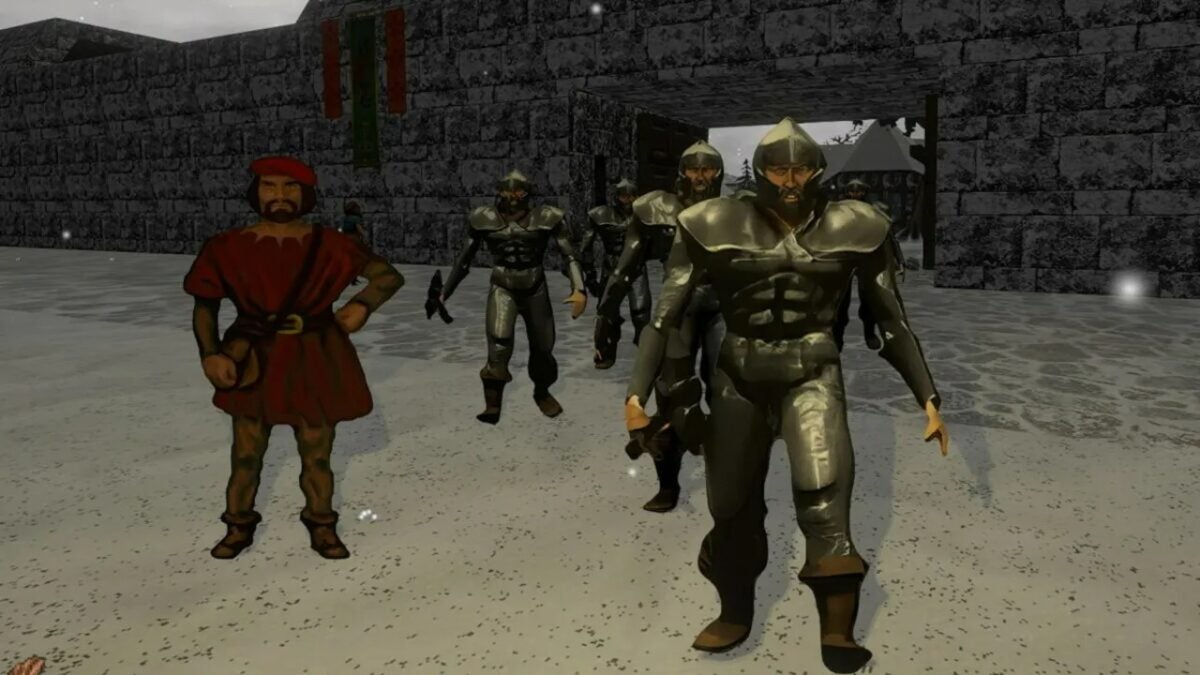
On August 31, 1996, Bethesda Softworks, specialized in all kinds of games for MS-DOS (from “Where’s Wally?” to “The Terminator: Future Shock”), released the second part of one of their titles, “The Elder Scrolls: Arena”. It was “Daggerfall”, an open-world role-playing game that at that time was an absolute innovation.
And if in ‘Starfield’ we have a thousand planets to explore, in ‘Daggerfall’ there were 15,000 dungeons, towns, villages, and cities to visit, an overwhelming number that has not been surpassed by Bethesda itself yet. It is estimated that four years after its release, it had already sold 800,000 units worldwide, but the arrival of the third installment, ‘Morrowind’, caused it to be forgotten.
Until now. And it is that a community of fans has recreated ‘Daggerfall’ exactly as it is, but adapted to Unity. It has been almost four years of pain since August 2014, but this remake has come to a good end, being playable from start to finish. ‘Daggerfall Unity’ is finally considered officially finished, and its project leaders can finally move on to something else. It was about time.
It’s absolutely free, but you have to be willing to explore a map of 209,000 square kilometers, which is the same size as the United Kingdom. Bethesda wanted people to never stop playing ‘Daggerfall’ (similar to what they have said about ‘Starfield’). 27 years later, it can be said that they have achieved it.
At Obsidian, they wanted to do for Skyrim what New Vegas meant for Fallout, but Bethesda told them it was better to stay put.
Sometimes the best thing that can happen to a franchise is for someone outside of it to take the reins. Or if not take the reins, at least provide their own perspective on it. When it feels exhausted, or those in charge of it don’t seem to know what to do with it, that new or different perspective can help put it back in its place. Something that should never be underestimated.
This is something that Obsidian should know well. Fallout 3 was a tremendously successful game, but it didn’t exactly enamor the classic fans of the franchise. Something that Fallout: New Vegas did, a game that Obsidian Entertainment was in charge of. However, they never did something similar again. And thanks to Chris Avellone, an employee of Obsidian, we have known why.
The proposal made by Obsidian, as commented by Avellone himself on his social media, was to create games that filled the gaps between the main installments. Just like Fallout: New Vegas served to bridge the gap between Fallout 3 and 4, the idea was for them to make games for The Elder Scrolls so that there wouldn’t be such a long wait time between their titles, like Call of Duty does. This was necessary since almost six years passed between The Elder Scrolls IV: Oblivion and The Elder Scrolls V: Skyrim.
Unfortunately, the proposal didn’t get very far. Bethesda flatly refused, cutting their wings claiming the reception that Fallout: New Vegas had. A commercially less successful game, but one that has ended up being recognized over time as the best modern Fallout in terms of criticism and public.
Although since then at Obsidian they have been able to work on many projects, some of them very unique and close to what would be a Fallout: New Vegas 2, such as The Outer Worlds, they have never gone back in this direction. A real shame because, between The Elder Scrolls V: Skyrim and The Elder Scrolls VI fifteen years will pass at least. And that’s only if everything goes well in an industry where things almost never go well.
“All those companies that start talking about their games years before launching them are hurting themselves. The best time to start talking about them is six months before their release”
‘Skyrim,’ the fifth installment of ‘The Elder Scrolls,’ was released in 2011 for PS3, Xbox 360, and PC. Since then, Bethesda Game Studios has only released five more games, with ‘Starfield‘ being the most prominent among them, along with ‘Fallout 4.’ However, fans of the medieval saga have had to settle for remasters, small additional content, and mobile games like ‘The Elder Scrolls: Blades.’ Well, with a glimmer of hope on the horizon.
E3 2018. Bethesda releases a teaser for ‘The Elder Scrolls 6,’ and everyone goes crazy: little did they imagine that, five years later, we still wouldn’t have more information about this sixth installment that fans have already given up on. Some believe the silver lining is that they’ll have time in their retirement to explore it fully.
The reality is different, of course, as explained by Bruce Nesmith, one of the designers of ‘Skyrim‘ who, by the way, no longer works at Bethesda: the reason for releasing the trailer was to appease toxic fans who had started threatening the studio. You know, in the classic gamer style: do it my way, or I’ll get angry and hold my breath. And really, their perspective on the gaming world and hype makes perfect sense.
“The video game industry has a short memory. All those companies that start talking about their games years before releasing them are hurting themselves. The best time to start talking about them is six months before their release,” Nesmith said. And truly, seeing the public’s reaction to delays in ‘Beyond Good and Evil 2,’ which was announced in 2008 and apparently will be released in 2024, one has to agree: announcing your games far in advance only leads to frustration.
“Just the fact that everyone had taken out their torches and tridents led Todd to say, ‘Yes, we’re going to make Elder Scrolls 6. I promise, it’s real, it will happen.’ But he warns us that indeed, we will only hear about it half a year before it goes on sale. If it works for Bethesda, who are we to say otherwise, no matter how much hype we have?”
The Elders Scrolls VI, the continuation of Skyrim, may never see the light of day on PlayStation 5, as leaked from Xbox documents.
Microsoft is having a bad day today. With a massive leak happening due to documentation that should not have seen the light outside of the courtroom, Xbox is witnessing how all its plans for the coming years are exposed to the world. Not only to gamers but also to competitors. While it’s true that many of these plans have already been executed, and many may have changed, all this information sheds light on what they have in store for the future, including what they do not have planned for the competition.
The Elder Scrolls VI, the successor to The Elder Scrolls V: Skyrim, was announced during the E3 event in 2018. Although we now know that its development didn’t begin until the release of Starfield in September of this year, we’ve been aware of its existence for five years. And Bethesda has a target release year for the game: 2026.
While it may seem excessive to announce a game eight years before the target release date and five years before the start of its development, there’s even more concerning news. Among the confidential information that has accidentally leaked during the trial with the FTC, it has been revealed that The Elder Scrolls VI would be an Xbox and PC exclusive.
From Microsoft's responses in the FTC vs Microsoft case. Elder Scrolls VI listed here as Xbox and PC and releasing 2026 or later.
During testimony at the hearing, Xbox's Phil Spencer went on to say the game was at least five years out and platforms were technically TBD pic.twitter.com/Kto9bE5U8C
As analyst Stephen Tolito has shown in a chart depicting Bethesda’s upcoming releases, The Elder Scrolls VI has a big red cross indicating it won’t be released on PlayStation. This is very disappointing news for fans of the franchise and those who enjoyed Skyrim and only have a PlayStation 5, as they will be forced to switch to Xbox Series X, Xbox Series S, or PC if they want to play its spiritual sequel. Because, as Microsoft has made clear, albeit accidentally, starting in 2023, all of Bethesda’s games have little to do with Sony.