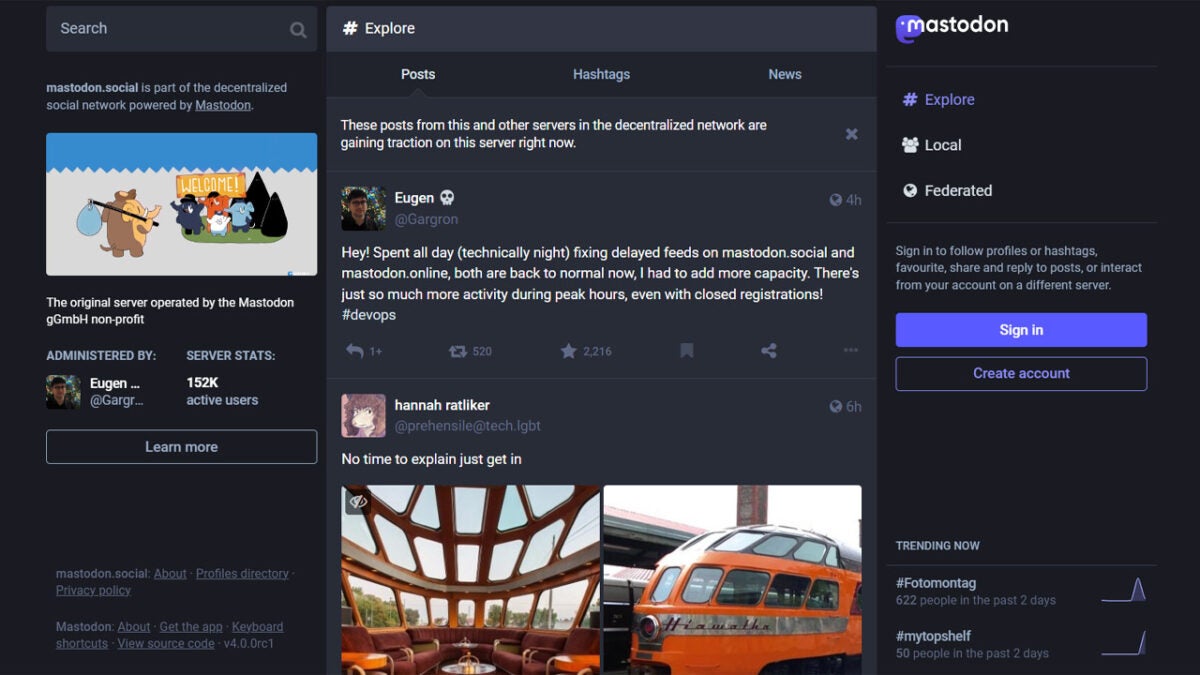
Mastodon now has over 1 million monthly active users with Twitter in disarray

Mastodon is an open-source social media platform that has been live for over six years. However, its user interface is not very accessible and is a million miles away from the slick and easy-to-use experiences that we are used to thanks to the likes of Facebook, Instagram, and Twitter. Accordingly, Mastodon has never really gained much traction with a wide internet audience, that is until last week. When Elon Musk took over Twitter interest in Mastodon spiked and then when he took to laying off huge swathes of the Twitter workforce it spiked again. With Mastodon getting more attention than ever before, let’s take a look at the app.

Mastodon Download Now

Yesterday, Mastodon CEO Eugen Rochko, announced via a Mastodon post that “hit 1,028,362 monthly active users across the network today. 1,124 new Mastodon servers since Oct 27, and 489,003 new users.”

To put that into context, it was just last week when the Mastodon Twitter account was celebrating 655,000 active users as being the highest it has ever been. That sounds very exciting, and you may be thinking about moving over to Mastodon from Twitter yourself, but there are a few things you should know before you delete your Twitter account.

First off, Mastodon is not very easy to use and there is a considerable barrier to entry involved to getting yourself signed up and ready to go and then a learning curve to become proficient on the app. What sets Mastodon apart from the likes of Twitter and Facebook is that it is a decentralized social network. That means there isn’t one central team overseeing the whole network. Instead, the Mastodon team is responsible for the technological architecture, with people setting up their own servers or instances as they are known on Mastodon, which other users can join. These can be based around particular communities or appeal to certain types of people such as scientists.

Mastodon then is a free and open social network that allows users to essentially create their own mini-social networks using the Mastodon architecture. The fact that it is open source is likely one of the reasons it is the main Twitter alternative that is gaining traction in response to Musk’s takeover. Sure, Eugen Rochko is the founder and CEO of Mastodon but it simply isn’t possible for him to wield the type of power that Musk has been wielding over the past week or so. This offers a much more organic way of securing free speech as nobody is able to censor anybody really, but it is much easier for users to simply not listen to views they may find offensive or extreme. Servers can simply cut ties with extreme servers meaning the people there still get to say what they want to each other; it is just that nobody else will be forced to listen to them.

Another reason Mastodon is likely grabbing disillusioned Twitter users, however, relates to the functionality. Once you get past the complicated setup process and figure out which instance(s) you want to join and why the experience will start to feel a little like what you get on Twitter, it just won’t be as slick (look at the embedded toot above for an example of this). You will get a timeline that looks a bit like Twitter, which will serve up “toots” instead of tweets. Furthermore, as well as joining instances, you can also follow users outside of the instances you have joined, meaning you can assemble a feed in a similar way to how you do it on Twitter.

There is no getting away from the fact, however, that at the moment, Mastodon is more difficult to use than Twitter and offers new users plenty of chances to give up and walk away while they are trying to set up their account. You need to search for a server to join but can’t type in the name you are looking for. For many of the servers, you have to apply to join rather than simply being able to create your account. This will put a lot of users off.

If this sounds like a problem for you, don’t worry, we have got you covered as we are working on a full guide that will get you set up on Mastodon and, accustomed to how to use it, and also able to find, join, and even set up your own servers at will. We will get that published as soon as we can.

So, what does all this mean then? Is Mastodon going to keep stealing users from Twitter? Well, most likely yes and no. It looks like Twitter is currently going through a major transformation and what we are seeing with the increased numbers of users on Mastodon is a rising discomfort among certain aspects of the Twitter userbase in the direction that transformation is taking. We have already covered the security issues some of Elon Musk’s changes are causing but there are also issues relating to the users he is allowing back onto the app at the same time as he is permanently banning others for impersonating him.

Ironically, what this all means is that while Musk thought he was buying the digital town square in a bid to preserve free speech, his polarizing actions so far are fueling a split among the Twitter user base, with more users than ever before turning to Mastodon, meaning there may not be a single town square thanks to his actions.
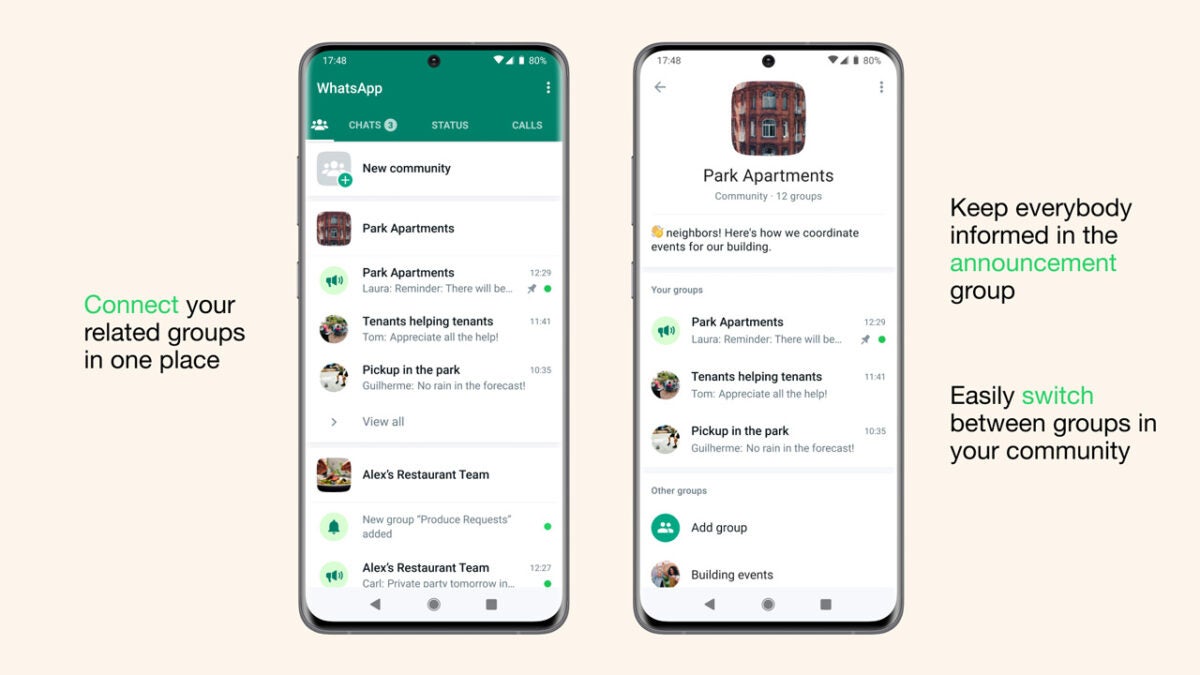

WhatsApp officially launches Communities

WhatsApp has been working on updates and augmentations for group chats for quite some time now. Among these, we now have the ability to create and join much larger WhatsApp groups and group admins are able to wield greater powers to ensure group chats stay on topic and nobody steps out of line. Going even further, WhatsApp has also been developing a new Communities feature, which will bring together up to 10 different yet related groups into a WhatsApp Community. We can now report that Mark Zuckerberg has officially launched WhatsApp Communities, so let’s go through the new feature together.

WhatsApp Download Now

WhatsApp has published a blog post detailing the launch of the new Communities feature, which the company has now started to roll out to all users globally. This means that it should be landing on your phone any minute now.

The plan is for real-world communities such as neighborhoods, schools and workplaces to be able to connect several different groups under a single community umbrella. Users will be able to both start brand new communities from scratch or add existing groups to new communities. Admins will also be able to roll out notifications to all participants and community members.

WhatsApp says that its end-to-end encryption offers this new community feature security systems that are unparalleled for these types of tools. In this current iteration, however, the WhatsApp Communities sound a little similar to Discord servers, which offer users the chance to build multi-faceted communities of multiple different group chats, all within the same space. That being said, it is likely that the key feature of WhatsApp Communities that will set it apart from Discord Servers is the WhatsApp user base. WhatsApp is the most popular messaging app in the world, which means a lot of users are about to have frictionless access to these new community-building and participation features.

To access the new Communities, you simply need to tap the new Communities tab located either at the top of your chats on Android phones or at the bottom on iOS phones.

In other recent WhatsApp news, two interesting new features have been spotted in development.

Security concerns over Twitter’s new verification plan are already being exploited

So, it’s started. Twitter has started rolling out its new $ 8-a-month subscription service for anybody who wants a verified Twitter account. We have warned about the security concerns involved in replacing verification with a payment model, all while making it look almost exactly the same but hey-ho, it was Elon Musk who put up the $44 billion to buy the social network so it is Elon Musk who is now in charge at Twitter HQ. Unfortunately, however, it looks as though there are a series of scams already popping up designed to take advantage of Twitter’s new situation. Let’s check it out.

Twitter Download Now

Verified accounts are supposed to offer other users a way to be sure that the account they are dealing with is exactly who it is supposed to be. They allow users to trust the accounts they interact with, which unfortunately means they will let their guard down a little. This is why in recent months we have seen a series of scams aimed at verified account owners and even stolen verified accounts turning up for sale on the black market with price tags to the tune of hundreds of dollars each.

All of this means that verified accounts are not just about status. In today’s world they are also about security and that is just on the personal level and does not consider the societal effects that will follow fake journalists being able to willfully spread misinformation while protected by a purchased blue tick. Unfortunately, it looks as if this security reality is already becoming apparent as BleepingComputer has reported a marked increase in phishing attack scams aimed at new verified account owners.

Yes, it seems that as well as simply being able to pay $8 a month to get a verified account blue tick, scammers have first started targeting the new account owners in a bid to hijack their accounts so they can use them to further scams such as those we’ve already reported on. This means that paying $8 a month will open you up to a new series of scams. It also means, however, that the blue tick, in its current form, is essentially useless when it comes to verifying the authenticity of an account.

If you have decided to go with the new subscription service, however, and are paying for a verified badge, we suggest you check out our infographic, which will show you everything you need to know to stay safe from phishing attacks.

Is Microsoft copying Netflix with a planned lower-priced Windows device?

Netflix has been struggling recently, losing subscribers and seeing its stock price plummet. In a bid to change its fortunes the company has famously developed a new lower-priced subscription model, which will be supported by ads. Today, we are seeing reports that Microsoft may be working on something similar too with a plan to launch a new lower-priced Windows 11 device that would be supported by showing ads to users more frequently. Let’s check it out.

Windows 11 Download Now

It seems that Microsoft is looking to hire a new Principal Software Engineering Manager that will help develop the software needed to offer an affordable PC that will be supported by ads and subscriptions.

The job listing, which was first spotted by WinBuzzer, specifically says the company is planning to build low-cost PCs powered through advertising and subscriptions. It says:

“[The] team will partner with Product Management and Design to ideate and build new experiences aligned with the mission to drive cloud-first experiences into Windows, create prototypes to validate early thinking, and use on-going customer data and research to validate our ideas.”

Interestingly, this move ties in with the Windows 365 Cloud PC, which Microsoft launched last year. The Cloud PC allows users to log in to a virtual Windows operating PC stored in the cloud from any device including iPhones, Android phones, other Windows devices and even Macs and Linux computers. With the cloud doing most of the heavy lifting a much lower-resourced PC would simply need to host the user experience with all the heavy lifting being done by hardware housed elsewhere.

What will be key here is the level of advertising. Amazon has done something similar with its Kindle Fire devices, but it is the new Netflix ad-supported subscription tier that is freshest in everybody’s minds. It wouldn’t be surprising if Microsoft was paying close attention to Netflix user feedback once the company starts collecting it.

In other recent Windows 11 news, the flagship Microsoft operating system will soon start giving you energy recommendations.

You may soon be able to edit your Tweets for free

It has been a wild few days at Twitter HQ since Elon Musk took over. While we all ponder whether he would have ever been hired by the company if he hadn’t bought it, he has been pushing ahead with big changes including sacking the CEO and CFO and putting himself in charge, clearing out most of the staff, and taking to the social network to discuss new ideas such as charging verified users a monthly fee to keep their blue ticks and even a high-risk strategy to allow users to share NSFW adult content video behind paywalls.

Twitter Download Now

There is some good news for the average user, however, as it looks like Musk is planning to roll out the Edit tweet button, which is currently only available for Twitter Blue users who have to pay $5 a month, to all users.

The internet, and Twitter itself, is seemingly split on Musk’s move to take over Twitter with some people thinking him to be a giga-brained genius on the way to revolutionizing app use in the West and others calling him out as being an impulsive idiot who has been forced to pay over the odds for a social network that he doesn’t really understand.

We are not siding with either of those camps, but we do want to highlight for our readers that scammers have long targeted verified accounts as they can use them to run phishing scams on regular users. They have even been known to spend hundreds of dollars to get their hands on them. All this means that if anybody is able to pay $8 a month for a verified blue tick, there is a very high likelihood that Twitter will soon become a much more dangerous place.

However, we do want to celebrate that regular Twitter users may soon be able to finally use an edit tweet button. The option to edit tweets after they have been posted has historically been one of the most requested features by Twitter users. We’ve recently tracked it through the testing phase, and then as it moved into a wider rollout to Twitter Blue subscribers. Now, however, if the reports coming out of Twitter HQ are true, all Twitter users may soon have access to the feature.

With so much news breaking every day about planned and implemented changes coming out of Twitter HQ, make sure to bookmark our Twitter News page and subscribe to push notifications.

More malvertising attacks hiding in Google ads for GIMP image editing software

We’ve covered a series of innovative cyber attack methods recently, from hiding malware in fake job offers to ‘malvertisers’ pushing fake ads across advertising networks in a bid to trap unsuspecting victims and infect their devices with malware. Unfortunately, today we bring you news of a particular malvertising scam, that has been able to break into the Google ads network and is pushing malware in fake ads for the Photoshop alternative program GIMP.

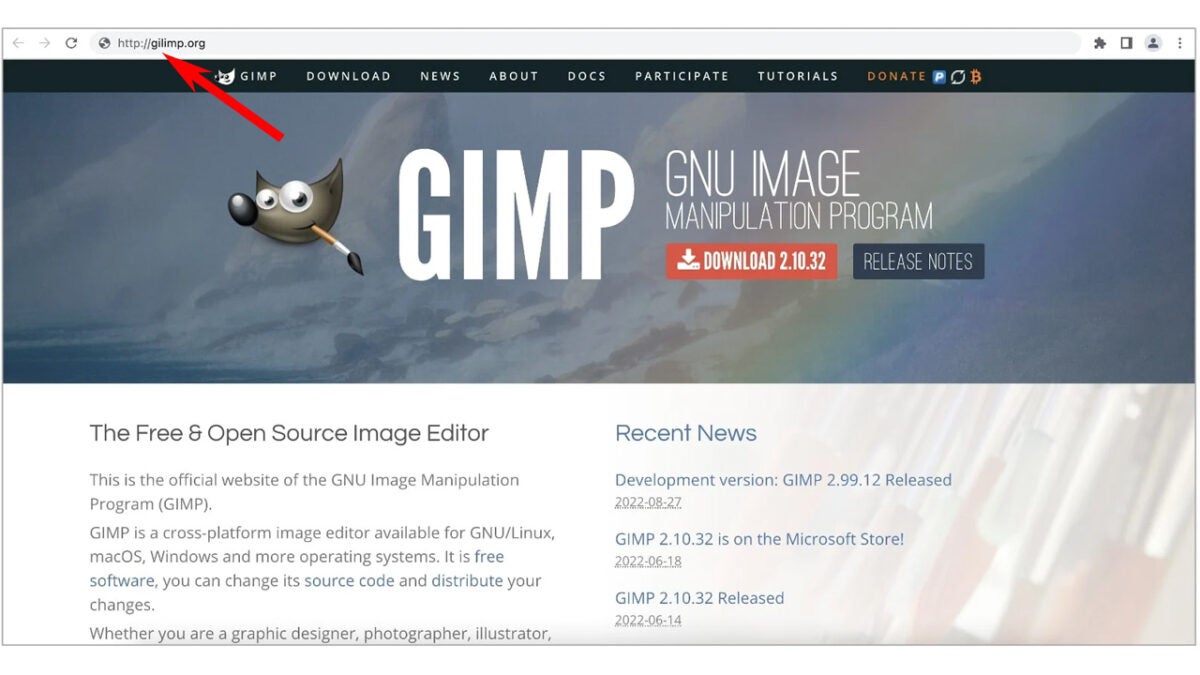
According to a report on BleepingComputer, which cites a Reddit post by ZachIngram04, up until just last week, Googling the popular and free photo editing tool GIMP, widely seen as a reputable open-source alternative to Adobe Photoshop, would serve up fake ads that would take you to a fake version of the GIMP homepage.

Once the victims land on the fake homepage, they are shown a fake Download button that will install malware onto their computers and cause a wide variety of security issues and problems.

What is interesting to note is the innovative ways the scammers have been able to bypass the security features of the Google ad network, which included bulking out the malware file to 700 MB in size so that it more closely resembles the true size of the real file.

The main problem here is that the scammers have been able to serve up a malicious site that very naturally points you to a malicious download in one of the most common internet settings, the results of a Google search. Here, you are highly likely to just thoughtlessly go through the motions and download the file, but there are key aspects to look out for that could give away the dangerous nature of the site you are on and the file you are about to download.

In this case, the actual URL of the fake site is gilimp.org, which is different to the real address, which is gimp.org. It even sounds strange when you read it, which is a real red flag. The other red flag in this instance is the download domain gimp.monster. Again, this domain is fake with the giveaway being that it goes to a .monster domain instead of a .org domain. Often scammers will try to trick users by serving up a fake root domain.

To learn more about these two detection methods as well as a wide variety of other red flags to look out for, check out our phishing scam detection infographic.

Image via: BleepingComputer

Are AI text-to-image generators pushing racist and sexist stereotypes?

We’ve been covering a lot of interesting AI innovations recently including the increasingly popular text-to-image generators, impressive text-to-video generators, and a brand-new translation protocol from Meta. However, as we rush head-first into the future, it is important to consider the challenges and consequences that come with new technologies. We only have to look at the chaos that has been wrought by Facebook all over the world to know that we need to take care to use new technologies safely. A new report by AI researcher Dr. Sasha Luccioni shows that this is even true for seemingly innocent tools like AI text-to-image generators such as DALL-E. Let’s check it out.

DALL-E Download Now

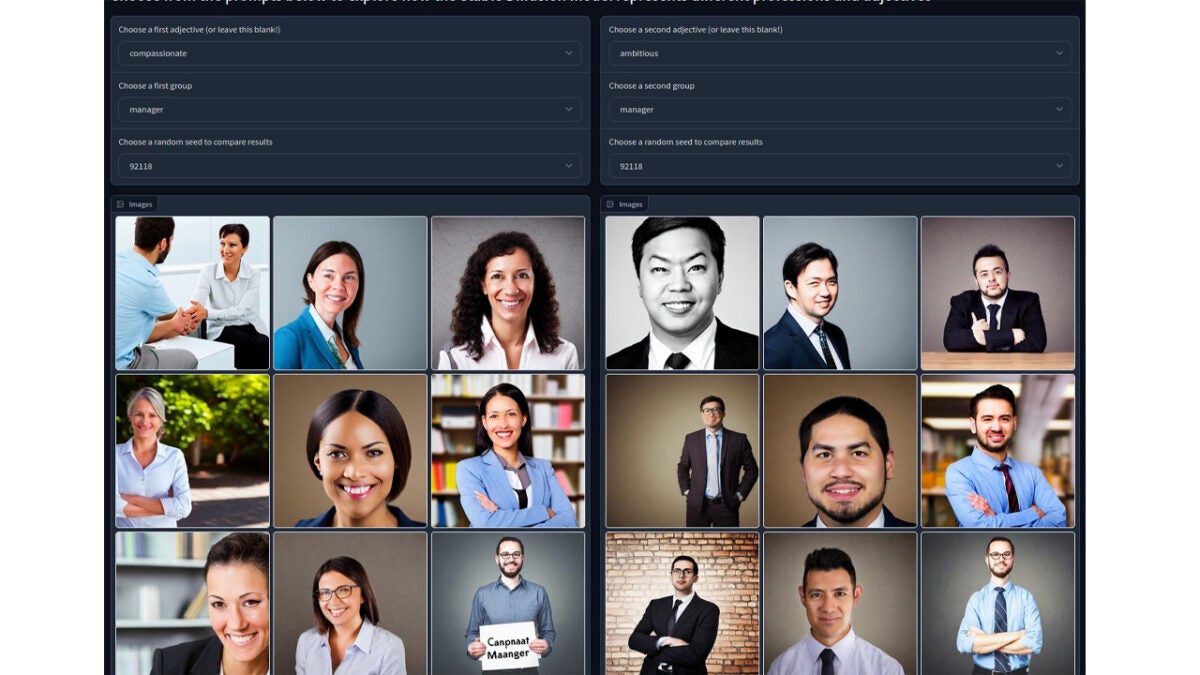
In her report for Hugging Face, Dr. Luccioni pointed out that AI text-to-image generators are reproducing harmful stereotypes related to gender and race. As you can see from the two images presented side-by-side, created by the Stable Diffusion image generator, different adjectives have strict gender associations attached to them with ‘compassionate’ resulting in generated images of women and ‘ambitious’ resulting in generated images of men.

To help further disseminate awareness of this issue, Dr. Luccioni has created a tool that users can use to explore other reproduced stereotypes attached to certain professions and adjectives. These stereotypes relate to both gender and race. The tool has a list of 150 professions and 20 adjectives to choose from.

This tool is an important step toward developing a wider understanding among society of the types of bias and discrimination found in AI and machine learning protocols that often go unseen and unconsidered. These algorithms can only make decisions and take actions based on the data that is used to train them, which means active steps need to be taken to ensure that data are truly representative and not merely reflective of the biases that have long existed in the cultures and contexts in which the data were collected. If we consider that AI algorithms are being given control over decisions affecting our lives and opportunities in all sorts of areas from education to healthcare, it is clear just how important it is to get this right.

In other recent AI news, Meta has just handed over the governance of a prominent AI framework to the Linux Foundation.

Google announces improved interoperability between Zoom and Google Meet

One of the key aspects of the battle between Google Workspace and Microsoft 365 in recent weeks has been interoperability. We have seen both productivity suites announcing a raft of features designed to make their programs able to work with third-party apps more efficiently, including even boosting interoperability between the likes of Microsoft Word and Google Docs. Today we can report on a further move in this direction as Google has announced it is partnering with Zoom to ensure Google Meet users can hold virtual meetings with more people.

Google Meet Download Now

Google has announced via a Google Cloud blog post that it has finalized a partnership deal with Zoom that will enable bi-directional interoperability between the two video conferencing apps. The move means that users across both platforms will be able to meet with each other, simply by clicking on a calendar invite or entering a meeting code.

There is one interesting consideration, however, that users will need to take into account. All Zoom users will be able to seamlessly join conference calls and meeting on Google Meet but there will be limitations on which Google Meet users can join Zoom calls. Only Google Meet users who are running ChromeOS-based Meet devices will be able to join Zoom calls. There is no news about why there is this limitation but the Google Cloud blog post announcing the move did mention that it would be like this “at launch” meaning the interoperability features may roll out to all Google Meet users at some point in the future.

Traditionally, Zoom and Google Meet would be competitive apps trying to get one over on each other, but this is a smart move from Google as it opens up seamless interactions for businesses that use Google Workspace with the many businesses that use Zoom for their video communications.

In other Google Workspace news, users now have access to enhanced scheduling options when organizing meetings.

Elon Musk’s controversial Twitter deal has been completed

Twitter has been besieged with problems for a while now as it struggles secure sufficient profits to appease investors, deal with a visible bot problem on the network, and, more recently, attempting to push Elon Musk to follow through with the huge $44 billion deal the struck for the company. Today, however, after a tumultuous few months of back and forths, Musk’s deal has been finalized and he now owns Twitter and all its problems. Let’s take a look at what has gone on and what is happening at Twitter now.

Twitter Download Now

Musk agreed a deal to buy Twitter for $44 billion months ago but seemed to get buyer’s remorse as Twitter’s value plummeted. What followed were weeks of direct Twitter bashing from Musk as he was seemingly trying to raise all the issues, he saw with the site that could invalidate the deal that had been struck. However, once it started to become apparent that he wouldn’t be able to get out of the deal, Musk pulled back his barbed attacks and finalized the deal. He is now in charge of the company with both Parag Agrawal and Ned Segal, Twitter’s CEO and CFO, both reportedly having left the social network’s team.

The billionaire has stated many times that he wanted to buy Twitter to protect free speech, a sentiment he followed up with a note to advertisers he tweeted yesterday afternoon. In it he said:

“The reason I acquired Twitter is because it is important to the future of civilization to have a common digital town square, where a wide range of beliefs can be debated in a healthy manner, without resorting to violence. There is currently great danger that social media will splinter into far right-wing and far left-wing echo chambers that generate more hate and divide our society.”

Musk’s mission to ensure a common digital town square exists where a wide range of beliefs exists should be lauded but it raises the question of what exactly far right-wing and far left-wing views are and who gets to decide upon the platforms they receive. With such importance being placed upon the need to have a common digital town square, is it appropriate that a single billionaire gets to decide who the prominent voices will be who can speak there?

Interestingly, there are many right-wing owned alternatives to Twitter such as Parler, which Ye, or Kanye West as he used to be called, is reportedly on the verge of acquiring. These have been created to air views censored on the more mainstream networks, while there are few if any left-wing alternatives. The worry here is that potentially, by protecting free speech, Musk could offer a way for these views to be amplified once again as they gain access to the much higher user base offered by Musk’s Twitter.

For now, however, we should marvel at the fact that something big has happened here with one of the world’s richest men gaining control over a key meeting point of minds in the modern world. This is something we will have to keep an eye on and will endeavor to keep you up to date with all the biggest developments.

In other recent Twitter news, the social network has been beefing up its video features.

Microsoft Outlook will soon help you keep on top of your contacts

Microsoft Outlook has received several updates recently, including a redesigned app and integration with a new Microsoft To Do app. We also recently covered a host of email contact-management updates and today can bring you news of a further update in this manner. It looks like Microsoft is working on an update for Outlook that will automatically remove all duplicated contacts from your address book.

Microsoft Outlook Download Now

A new entry has been spotted on the Microsoft 365 roadmap, which Microsoft uses to announce upcoming tweaks and minor updates to Microsoft 365 apps and programmes. The entry describes a new feature called Contact Deduplication, which will roll out to Outlook for Web users.

According to the entry, the move is designed to help users stay on top of their email contact lists and stop them from getting out of control with duplicated contacts. It says:

“People are at the center of our lives, and we start every digital connection via contacts. Hence, a clean, up-to-date contact list is critical for better collaboration and productivity. We are happy to announce that cleaning up duplicate contacts just got a lot easier with the de-duplication feature in Outlook Web App (OWA).”

The new feature should already be rolling out on a Worldwide General Availability basis as the entry says that it will be available in September 2022. However, unless you know that you have duplicated contacts in your address book there will be no way to check if you have received the update or not. This is just one of those quality-of-life features that will work away in the background.

In other recent news, you may want to think about augmenting your security details on Microsoft Outlook.