Gemini transforms email marketing strategies in Gmail

Google has introduced artificial intelligence tools under the name of Gemini that transform the way messages are interpreted, prioritized, and presented in Gmail. This change represents a turning point for marketers looking to improve the visibility of their emails in an ecosystem that now values the relevance of messages more than their chronological order. Adapting to Gemini With the integration of Gemini-powered features, marketing professionals will need to focus on aspects such as segmentation, content quality, and technical compliance. Otherwise, they risk falling short […]

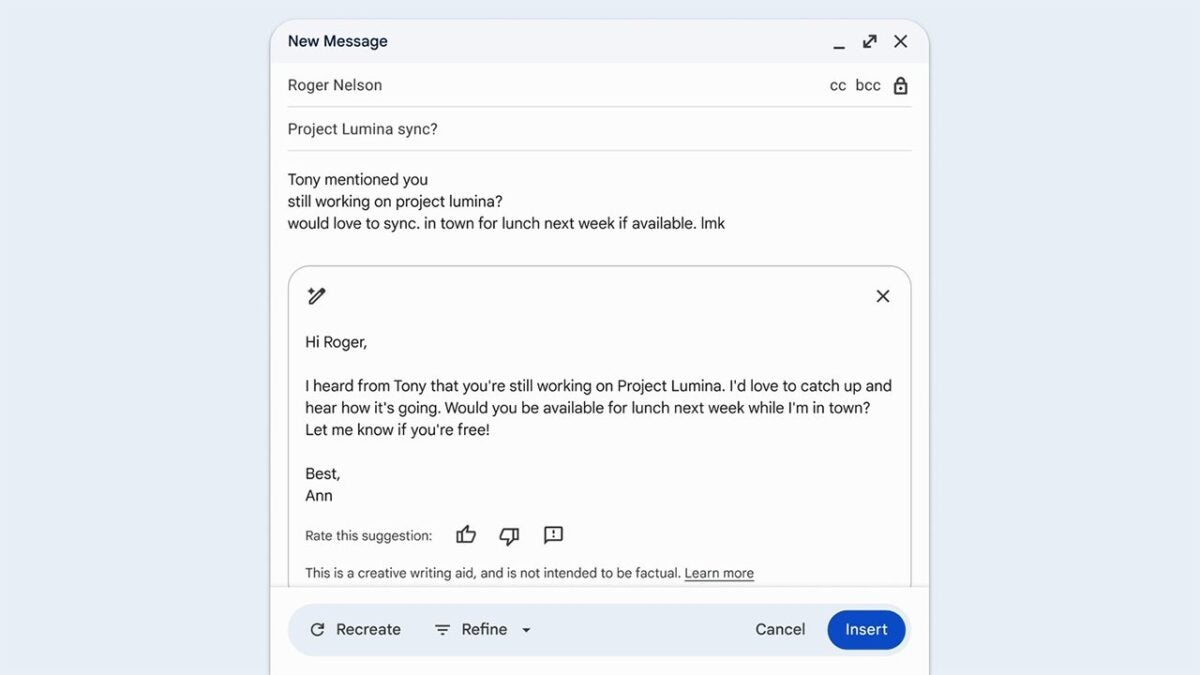
Google has introduced artificial intelligence tools under the name of Gemini that transform the way messages are interpreted, prioritized, and presented in Gmail. This change represents a turning point for marketers looking to improve the visibility of their emails in an ecosystem that now values the relevance of messages more than their chronological order.

Adapting to Gemini

With the integration of features driven by Gemini, marketing professionals will need to focus on aspects such as segmentation, content quality, and technical compliance. Otherwise, they risk falling behind in an environment where artificial intelligence determines how emails are displayed in users’ inboxes.

One of the most notable changes is the recent update to the sorting logic in the Promotions tab of Gmail, which now prioritizes messages based on their relevance. Although Google has not revealed the exact criteria of this new algorithm, it is likely that effectiveness in targeting and engagement rates play a significant role.

In addition, the compression of the attention window will become increasingly evident, as users may start to rely on the overviews of emails instead of reading them in full. This would force marketers to optimize their subject lines to quickly capture the recipient’s attention.

To add complexity, the visual representation of brands will also be essential, highlighting tools like BIMI and Annotations. However, these tools will only be available to brands that demonstrate relevance to users, emphasizing the need to personalize advertising campaigns.
In the not-so-distant future, we may see more changes in Gmail driven by Gemini, deeply rooted in the ideology of optimizing the user experience, which could mean an even more competitive environment for marketers.


This is the first malware for Android that uses generative AI

Cybersecurity researchers have identified the first malware for Android that uses generative artificial intelligence, called PromptSpy. This malicious program, which leverages Google’s Gemini technology, has the ability to capture data from the lock screen, block uninstallation attempts, and collect device information, in addition to taking screenshots and recording activity in video. Do not download anything unsafe PromptSpy is distributed through a dedicated website and has never been available on Google Play, suggesting that this malware campaign is designed for users in Argentina. According to the analysis, […]

Cybersecurity researchers have identified the first malware for Android that uses generative artificial intelligence, called PromptSpy.

This malicious program, which leverages Google’s Gemini technology, has the ability to capture data from the lock screen, block uninstallation attempts, and collect device information, in addition to taking screenshots and recording activity in video.

Do not download anything unsafe

PromptSpy is distributed through a dedicated website and has never been available on Google Play, suggesting that this malware campaign is targeted at users in Argentina. According to the analysis, there is evidence pointing to its development originating from a Chinese-speaking environment, as simplified Chinese debugging strings have been found.

The operation of PromptSpy is based on Gemini, which allows the malware to analyze the current screen and provides detailed instructions to ensure that the malicious application remains active in the recent list. This is achieved by using accessibility services, which forces users to restart the device in safe mode to uninstall the program. Interaction is done through a command and control server, giving attackers remote access to the victim’s device.

ESET researchers, who made the discovery, point out that PromptSpy represents a significant evolution of Android malware, using generative AI that allows it to adapt to different devices and operating system versions. This approach not only facilitates a more dynamic interaction but also makes it more complicated for users to eradicate it.

It has been indicated that the tactics employed suggest a possible financial objective on the part of the threat actors, highlighting the increasing sophistication of cyber attacks in the mobile space.

North Korea is already using Gemini to hack computers around the world

A group of North Korean hackers known as UNC2970 has begun using Google’s Gemini artificial intelligence model to carry out reconnaissance activities and cyberattacks. This behavior has been documented in a report from the Google Threat Intelligence Group (GTIG), which highlights a concerning crossover between professional research and malicious activities in the field of cybersecurity. AI is fine, man According to reports, UNC2970 has focused on companies in the cybersecurity and defense sector, using open-source intelligence (OSINT) to profile high-value targets and prepare specific phishing campaigns. […]

A North Korean hacker group known as UNC2970 has begun using Google’s Gemini artificial intelligence model to carry out reconnaissance and cyberattack activities. This behavior has been documented in a report from the Google Threat Intelligence Group (GTIG), which highlights a concerning intersection between professional research and malicious activities in the field of cybersecurity.

AI is fine, man

According to reports, UNC2970 has focused on companies in the cybersecurity and defense sector, resorting to open-source intelligence (OSINT) to profile high-value targets and prepare specific phishing campaigns. The group uses Gemini to map technical roles and their salaries, creating profiles that facilitate the design of targeted attacks.

Researchers have identified new types of malware that use Gemini, such as HONESTCUE, a framework that allows attackers to generate additional functionality code, and COINBAIT, a phishing kit designed to masquerade as a cryptocurrency exchange, aimed at collecting credentials. HONESTCUE, for its part, operates by using the Gemini API to receive source code in C#, which is executed in memory, leaving few traces on the target system.

Additionally, ClickFix campaigns have been detected that use AI-generated instructions to solve common computer problems, but ultimately distribute malware designed to steal information. Experts warn that assuming keeping the model weights private is enough for protection is a serious mistake; gathering information through queries can result in the replication of the model’s original behavior.

Google has taken steps to disrupt these attacks and has highlighted the growing risk posed by hacker groups that use tools like Gemini to accelerate the phases of the cyber attack cycle. As technology advances, so do the tactics of those looking to exploit it.

Google deploys Gemini in Android Studio

Just like the Studio bot, the new Gemini bot lives in the IDE, and developers can ask code-related questions.

Google continues to roll out Gemini in different products, with today’s announcement that the Android Studio bot is updated with Gemini Pro, Google’s most powerful AI currently.

Gemini DOWNLOAD

In May 2023, during the Google I/O developer event, the company introduced Studio Bot with the PaLM-2 foundation model. The company is rolling out Gemini in Android Studio in over 180 countries for the Android Studio Jellyfish version.

In February, Google also updated the base model for the PaLM-2 chatbot Bard to Gemini Pro. Just like the Studio bot, the new Gemini bot lives in the IDE (integrated development environment) and developers can ask coding-related questions.

What does this addition mean for Android Studio

According to the company, developers should notice an improvement in the quality of the responses when completing code, debugging, finding relevant resources, and writing documentation.

Google stated that, for privacy reasons, users will have to sign in and explicitly activate Gemini in order to use it. In addition, the chatbot’s responses depend mainly on the conversation history and context provided by the developer.

According to the company, users can easily access the Gemini API starter template through Android Studio to add AI-based generative functions to their applications.

Gemini DOWNLOAD

Google is determined to compete with tools like GitHub Copilot in its various developer products. Last year, it introduced the Codey assistant based on PaLM-2 to respond to programming queries and Google Cloud Services.