
WhatsApp Payments could be launching very soon

WhatsApp Payments is now closer to a general release in India

Loads of cash and WhatsApp

The WhatsApp Payments system that will give users a quick, secure, and easy way to send money across the network has been “coming soon” for quite some time now. We first broke the story of the feature landing in the WhatsApp beta in 2017, but news of the feature then went quiet for almost 12 months. It wasn’t until May last year that we heard the feature was finally going to roll out to all WhatsApp users. Again though, we were met with nothing but radio silence on the issue and that has pretty much where we’ve been up to, until now.

WhatsApp Messenger Download Now ►
8

 WhatsApp Payments is now closer to a general release in India

A new report from Bloomberg says that Facebook is making slow progress towards launching WhatsApp Payments in India, but is about to reach a huge milestone.

According to the report, the long delay has been partly due to government regulations. WhatsApp needs to produce the results of an independent third-party audit that will show that all of the payments data involved in the new feature will be stored in India.

According to an anonymous source, WhatsApp is now preparing to submit this report to the Reserve Bank of India, which is India’s banking regulator. If the report receives approval, then WhatsApp Payments could finally be good to go.
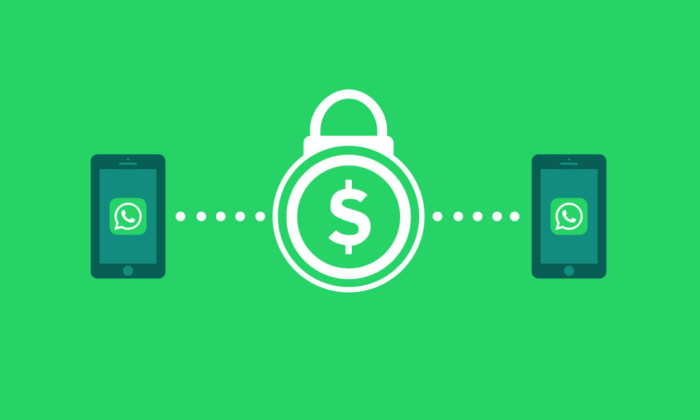
Whatsapp payment diagram
WhatsApp hopes to provide a secure way to send money between users.

The bureaucracy involved in setting up new financial services has caused the huge delays to the Facebook operation. There could be a lesson to learn for the social giant here as it pushes forward with the development of its own cryptocurrency called Libra.

The practical side of WhatsApp Payments has been wrapped up for quite some time now. Since last summer we’ve known that Payments will be backed by partnerships WhatsApp has made some of the leading banks in India including HDFC Bank, ICICI Bank, Axis Bank, and SBI.

The problem WhatsApp faces now, however, is that the long delay means WhatsApp Payments is moving into a crowded marketplace. Amazon Pay and India’s most popular digital payment platform, Paytm, have already complied with the Indian government’s regulations and so have a massive head start over the Facebook-owned messaging service.

Amazon pay logo
WhatsApp will face stiff competition from other digital payment platforms like Amazon Pay

What WhatsApp does have up its sleeve though, is a massive user base in India that is estimated at over 300 million active users. As with most digital services users will go for the payments service they trust and that is the easiest to use. If WhatsApp can establish payments as a simple and secure digital payment option there is a chance it could take off.

Unfortunately, there is no official news regarding a date for the rollout of WhatsApp Payments. The feature seems to be about to pass a very large obstacle, however, that has stood in its way for quite some time so maybe we’ll see it sooner rather than later. We’ve been here before though, so best not to hold your breath on this one.


Facebook to try WhatsApp’s message forwarding limits

Facebook is limiting message forwarding on Messenger in Sri Lanka and clamping down on purveyors of fake stories in Myanmar

Fake news and Facebook

We’ve written a lot about WhatsApp’s fake news problem over the last few months and how the problem has also gripped Facebook in various parts of the world. We’re technology advocates and marvel at the way apps can change our modern lives. We also, however, understand the power that social technology on a global scale can have and this is why we report on the bad stuff like fake news as well as the good stuff like helping you get to work on time, for example.

WhatsApp and Facebook’s fake news scandals have been truly shocking with WhatsApp being at the heart of lynchings and horrific beatings in India and Facebook helping facilitate genocide in Myanmar. It is in India where most action has already been taken, with WhatsApp starting a number of initiatives including placing limits on message forwarding capabilities and even setting up an investigatory helpline to look into how users interact with false news stories.

It now looks as though Facebook is starting to apply what it has learned from its WhatsApp efforts in India to other parts of the world experiencing similar problems.

Facebook is limiting message forwarding on Messenger in Sri Lanka and clamping down on purveyors of fake stories in Myanmar

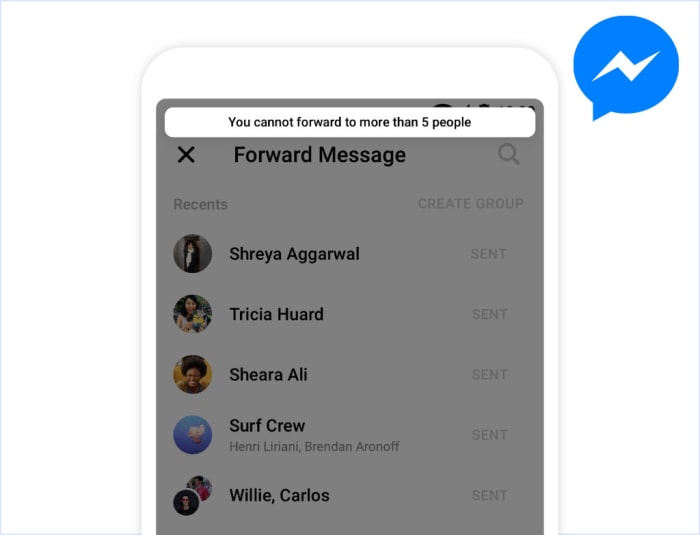
Facebook has released a blog post describing its efforts to halt the spread of fake news across its network and the most telling claim is that Facebook is starting to replicate what it has been doing on WhatsApp. In the post, Samdih Chakrabarti, who is a Facebook Director of Civil Integrity said, “In Sri Lanka, we have explored adding friction to message forwarding so that people can only share a message with a certain number of chat threads on Facebook Messenger. This is similar to a change we made to WhatsApp earlier this year to reduce forwarded messages around the world.”

Message forwarding n Messenger limited to five people

A screenshot posted to the Facebook blog indicates the limits Messenger uses in Sri Lanka face will be the same as those faced by WhatsApp users in India. If you’re forwarding a message on Facebook Messenger, you’ll only be able to forward it to five people at a time.

In Myanmar, where Facebook’s fake news problem has helped whipped up hatred of the local Rohingya Muslim population, Facebook is taking a different approach. Chakrabarti went on to say, “In Myanmar, we have started to reduce the distribution of all content shared by people who have demonstrated a pattern of posting content that violates our Community Standards, an approach that we may roll out in other countries if it proves successful in mitigating harm.”

They’re targeting the sources of the problem, which is refreshing, and Facebook even said it is prepared to ban individuals or organizations promoting violence. This echoes past action taken by the social network against the Myanmar military.

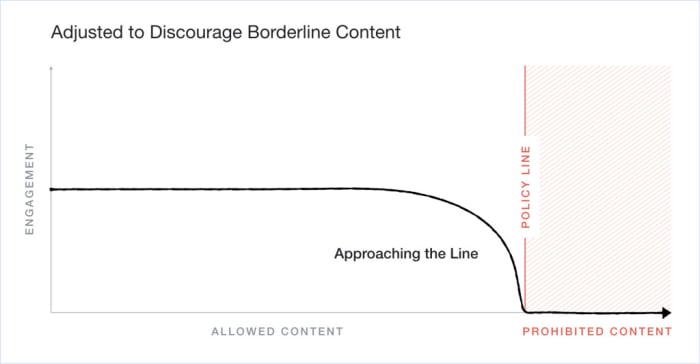
Facebook's new borderline content publication policy
Facebook’s new policy takes a harsher look on content that is close to its prohibition limit, rather than allowing it to naturally engage with other users.

It is good to see Facebook taking affirmative action in its bid to stamp out a true evil that has been able to spread across its network. It is also heartening to hear Chakrabarti recognize that, “This is some of the most important work being done at Facebook, and we fully recognize the gravity of these challenges.”

The damage that has already been done though, can’t be ignored and cleaning up the mess is only half of it. If Facebook truly understands the gravity of the situation, it will act more responsibly in the future to ensure this type of thing never happens again. With similar problems growing at home and with the hugely significant unveiling of Facebook’s planned cryptocurrency, it is more important than ever that the social giant recognizes its responsibilities and moves to fulfill them.

WhatsApp Privacy: India wants fingerprint ID on every message

The Indian government is pressuring WhatsApp to fingerprint all messages so they can be more easily tracked

End-to-end encryption is a double-edged sword. There is no doubt we all love the fact that we can talk away to our friends and family safe in the knowledge our messages really are private. In a modern world that has seemingly declared war on personal privacy, it really is something to be valued. The flip of that, however, is that some people hide behind that privacy and use the cover to cause problems.

These problems could be the planning of illegal activities or the whipping up of hatred by sending false infromation across the network. One country facing problems due to WhatsApp and its rigorous anonymity has been India, where lies spread across the network have caused lynchings, beatings, and even interfered in the democratic process.

The Indian government is now pushing WhatsApp to make changes so that it can better track who has been sending messages on WhatsApp in India. It is a little worrying, however, to see exactly what the Indian government wants WhatsApp to do.

The Indian government is pressuring WhatsApp to fingerprint all messages so they can be more easily tracked

a fingerprint on the WhatsApp logo

The Economic Times in India is reporting that two officials from Narendra Modi’s right-wing Hindu nationalist BJP government have said that they’re pressuring WhatsApp to add fingerprints to all messages sent, so it’ll be easier to track who has sent what.

The government has been pushing WhatsApp to add more traceability measures to messages ever since the first fake stories of child kidnappings in 2018 led to lynchings. One of the government officials is quoted as saying, “Fingerprinting WhatsApp messages will help find the originator of the message. That is all we want… We don’t want to read the messages but when we see a problematic message, we should be able to go to WhatsApp to help us trace the sender.” The official added that the government believes what it is asking is “technically possible.”

The official also went on to clarify that it will only request the data in limited circumstances, but the worry is that once the technology exists to do so, it could easily be abused.

WhatsApp has not commented on the government’s request, but industry insiders have said that should it go along with the request the messaging app will have to redesign its entire architecture. At the moment, WhatsApp doesn’t store this kind of data, so it’d be a major change if it were to suddenly start harvesting it. Such a change would then most likely affect WhatsApp all over the globe and not just in India.

WhatsApp is everywhere
WhatsApp will likely have to make the change everywhere and not just in India

If you’re a privacy advocate, this is something that should be grabbing your attention. The change could have massive privacy implications all around the world. This means we’re at a dangerous juncture here, but that global public opposition to the move could be the biggest thing standing in the way of the Indian government getting what it wants.

The question remains then, how do you feel about your fingerprint being added to every message you send?

Facebook is making changes to how it ranks public comments

Facebook is trying to make your comments mean more meaningful

Facebook comments are a lot of different things to a lot of different people. Some people beam proudly about their best Facebook comments ever; others recoil at the annoying Facebook comments they have to deal with on a daily basis; while some constantly worry if they can delete their Facebook comments, thinking, will they know if I did?

shocking facebook comments

We all have a different relationship with Facebook, which is why we can see the same things differently. This is why Facebook, and other social networks like Twitter, have long eschewed showing things like your feed or post comments chronologically and have since attempted to rank everything according to how each of us uses Facebook individually. We don’t see the most recent Facebook comments, not even the most awesome Facebook comments; according to the social giant, we see Facebook’s most relevant comments.

7

Facebook is trying to make your comments more meaningful

In a recent blog post, Facebook announced a series of changes it is making to its public comments ranking system. The idea behind the change is to make Facebook comments more meaningful to the people that read them but also in relation to the original post they’re commenting on.

Facebook states, “Ranking is on by default for Pages and people with a lot of followers, but Pages and people with a lot of followers can choose to turn off comment ranking. People who don’t have as many followers will not have comment ranking turned on automatically since there are less comments overall, but any person can decide to enable comment ranking by going to their settings.” This means your comments likely won’t be ranked if you say something about a post from a friend or family member but if you comment on posts by a popular Facebook Page or account, they will be.

How Facebook ranks comments

Image via: FB Newsroom

Facebook looks at a number of different factors when it ranks a comment. These are integrity signals, which are designed to keep comments safe by removing comments that violate Facebook’s Community standards and clickbaity comments; how Facebook users have responded in official Facebook surveys; comment interaction; and the various controls Facebook gives the poster of the original post. You can find more information about toggling ranking on and off for comments on your posts here.

What changes is Facebook making to its comment ranking system?

There are two major changes Facebook is making to how it ranks public comments. Comments will rank higher if they have interactions with “the Page or person who originally posted.” The other factor Facebook is now considering is whether the comments or reactions are from friends of the person who made the original post.

Facebook hopes that these changes will make the publicly viewable comments on prominent posts much more meaningful to the people reading them. This slight tweak, however, will no doubt delight some Facebook users and annoy others.

Google is bringing a cool Gmail feature to Google Messages

Google Messages will remind to reply to text messages you’ve forgotten about.

Ever since WhatsApp ushered in the era of free text messaging, we’ve all been guilty of ignoring a text message or two. Even those of us who don’t explicitly ignore messages still delay responding for some mystical and unknown reason. We could reply straight away but sometimes we just don’t. Of itself this isn’t a major problem or something to worry about; the real problem is when we forget to get back to those messages like we originally told ourselves we would.

Although not as popular, Google Messages has proven itself to be quite the capable free alternative to WhatsApp. Google’s messaging app shares many of WhatsApp’s best features and even packs in a fair bit of Google ingenuity that gives it the edge over the Facebook-owned messaging platform.

Google’s email service, Gmail, is packed full of ideas and if you’ve ever forgotten to check your Google Messages, you’ll know that Gmail reminds you about messages you haven’t dealt with. It now looks like this feature, or at least one similar to it, is coming to Android Google Messages too.

Google App Download Now ►
8

Google Messages will remind to reply to text messages you’ve forgotten about

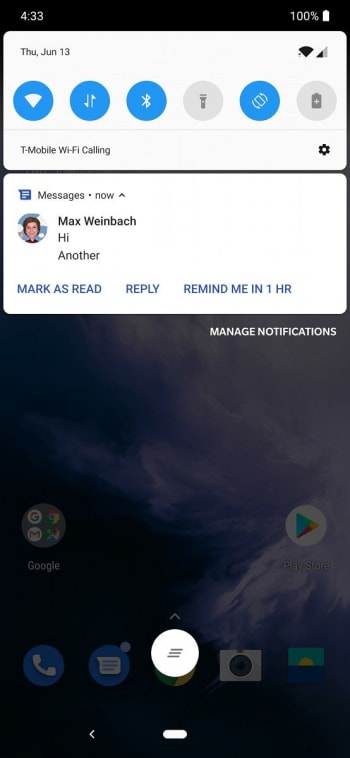
A report by XDA Developers indicates that Google is testing SMS Reminders in Google Messages. The discovery was made by an XDA-recognized developer called Quinny899 when he was looking around some of the hidden features Google had packed into the app. Sometimes, Google tests new features on select users by adding the code to the app but disabling it for everybody else, and this is how Quinny899 stumbled upon the Messages feature.

Google Messages SMS Reminder screenshot
Image via: XDA Developers

The feature is simple enough but gives your text messages a solid email feature. With the numbers of text messages we receive every day climbing steadily, it becomes easier and easier for them to slip through the cracks. Nobody likes to be ignored and it is just as awkward when somebody asks you if you received the SMS they sent you. This feature is designed to stop that happening.

The feature works by adding a new button to the Android system notification you get when you receive an SMS on Google Messages. As well as “Mark as Read” and “Reply” Messages users will now find “Remind Me in 1 HR”. This gives you a little bump to deal with the message an hour after it landed in your inbox. There is no way to change the amount of time for the reminder, but Google may add that to the feature later on if it even implements the feature at all.

So it looks like Google is adding a Gmail feature to Messages to try and help you remember to text your friends back. WhatsApp doesn’t have this feature, but is it enough to make you switch?

5 best online fax services

Ditch the big, expensive fax machine and try out one of these online services.

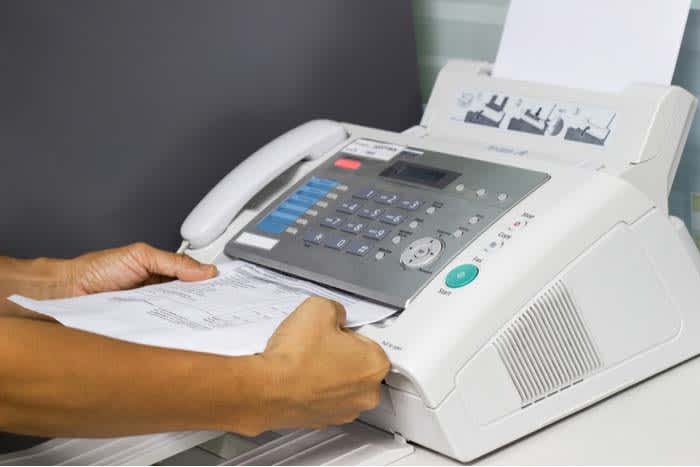
Fax machine

Look, we get it. You’re wondering if faxing even exists in 2019.

The short answer is, as long as there are hard copies of documents, faxing still performs a valuable service.

According to the market research firm, Arizton, the online fax industry is poised to grow to $2.4B by the year 2022.

What to look for in an online fax service

There are a ton of these online fax services out there, but there’s a lot of variation between platforms. As such, it’s important to approach your search after answering the following questions:

  • How many phone numbers will you need to connect?
  • Do you need cloud storage?
  • What about collaboration tools?
  • Do you want to create custom cover sheets?
  • How many faxes do you send every month?
  • Do you want to store inbound and outbound faxes?

Once you figure that out, it’s merely a matter of choosing a service.

MetroFax

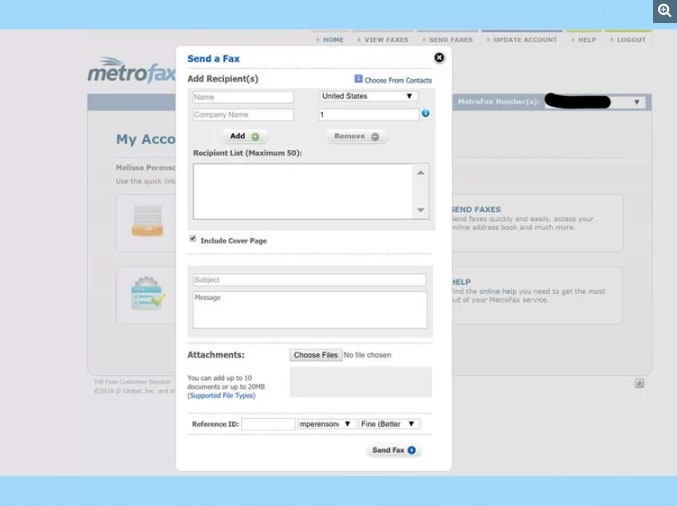
MetroFax interface

Metrofax is an online fax solution that starts at $7.95 per month and comes with a 30-day free trial so you can take it for a spin before committing. The set-up process is easy. You’ll sign up for an account and input your state and area code and select a plan.

The whole faxing experience is pretty straightforward. The platform allows you to send faxes as easily as an email, albeit with a clunkier interface that feels a little Windows 98.

This solution is ideal for those users who just want a fax service along with a storage system for incoming and outgoing faxes. It’s not an e-signing solution or comprehensive cloud storage system for all of your docs.

HelloFax

HelloFax home page

HelloFax is a user-friendly platform that offers e-signing and integrations with other popular cloud-based tools.

What’s nice is, you can use HelloFax for free if you need to send one fax a year or something. Receiving faxes is limited to paid accounts, but the entry-level Home Office plan is only $9.99 per month. You can send and receive 300 pages during that period.

That said, this platform is best reserved for the user who needs to send or receive a fax once in a blue moon (which is probably most of us). There’s no storage system, you can’t customize your cover page, and you just don’t get a ton of bang for your buck, here.

eFax

EFax is an online fax service that supports incoming and outgoing faxes and comes with some premium features. These include third-party storage, electronic signatures, lifetime storage, and a free mobile fax app.

Customers seem to like this service. It’s easy to use, and the mobile app provides a nice convenience for those who need to fax on the go or sign a document quickly from their phone. That said, some people reported that the billing and cancellation processes were less than satisfactory. So, hopefully, if you start using this service, you’ll never want to stop.

SRFax

SR Fax online faxing

SRFax is a great option for medical practices and other organizations that make their money dealing with sensitive data.

This fax service is HIPAA compliant with built-in security and encryption designed to keep data safe. Their key selling point is centered around enterprise and healthcare solutions. The service is pretty affordable even if you’re a lone-wolf freelancer who sends one fax here and there.

The basic plan includes a $3.29 monthly subscription that comes with unlimited storage and 25 pages of faxes per month. The Healthcare Professional Plus plan is a 10,000-page plan for $185 per month with some secured communications tools like PGP encryption for added security.

Nextiva

nextiva efax

Nextiva starts at just $4.95 per month and works with both fax machines and email. That $5 price tag gives you 500 pages a month — which run through a 256-bit SSL encrypted portal, keeping sensitive data private.

Weirdly, the tool requires Flash, and some users have experienced glitching in email faxes.

Adobe Flash Download now ►
7

While the portal looks nice, there are some weird issues with the interface. A reviewer from PCMag reported that clicking the View button at the top of the page leads to an empty fax viewer with no content, while the search button gives you a list with no filtering options.

In all, this is potentially a good option if you’re looking to send a lot of faxes for a low, low price.  However, it may work better through an old school machine.
Wrapping up

It’s difficult to say which fax service is best. We’ve come a long way from having to use clunky old fax machines, but many of these services still have kind of an outdated feel.

Given the fact that there are many cloud-based solutions in the software space across the board, we’re not so sure of the statistic mentioned above.
WhatsApp and Facebook take their first public steps towards integration

WhatsApp will soon allow users to post status updates on Facebook.
It was only recently, that Facebook announced it planned to pull together its three biggest apps. The code behind Facebook, Instagram, and WhatsApp would be transformed so that it would all resemble one single system. Although Facebook assured everybody that each would retain their independent qualities, the move was a controversial one as it was exactly what Facebook said it wouldn’t do when it acquired Instagram and WhatsApp way back when.

The move makes sense for Facebook as managing one big system is much easier than managing three smaller ones. Just ask Microsoft about why it is so determined to have all Windows users update to Windows 10, if you don’t believe us.

Facebook and WhatsApp link revealed
The links between WhatsApp and Facebook are beginning to show

For the users, the move is controversial as each app collects data from us in different ways, which means they collect different data. Putting the three together offers Facebook a much more complete picture of each of us to sell to advertisers and whoever else is willing to pay.

The flip side is that it might make it easier for us to start communicating across all three networks. Have a friend who is on Instagram but doesn’t have WhatsApp? No problem, soon you might be able to shoot them a message anyway. It looks like we might be about to start seeing these cross-platform features land on Facebook’s three big apps.

WhatsApp will soon allow users to post status updates on Facebook

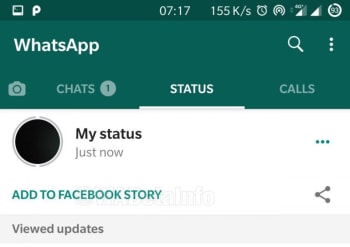
The latest beta version of WhatsApp for Android, version 2.19.151, has a very interesting new feature. For WhatsApp users who also have Facebook installed on their phones, a new button appears in the WhatsApp Status tab. Just below the My status button there should be the brand new “ADD TO FACEBOOK STORY” button.

WhatsApp share to Facebook
Image via: WABetaInfo

Tapping the new add to Facebook button gives WhatsApp users the chance to post status updates on Facebook. For now, the feature is pretty limited. Users will be able to post status updates including images, videos, GIFs, and text but it’ll all have to be done manually. It isn’t as simple as just sharing your WhatsApp status on Facebook just yet. But then again, who posts WhatsApp status updates anyway? When users tap the “add to Facebook” button, they’ll be redirected to Facebook where they’ll be able to share their story.

In itself, this new feature is not something to get too excited about. It is, however, the very thin end of what is looking like a very large wedge. As time goes by, we can expect to see many more of these inter-compatibility features coming to Facebook, WhatsApp, and Instagram. As to whether they’ll be worth the privacy sacrifices that go with them, that’ll be up to you.

The “add to Facebook story” button is currently in beta testing, so you shouldn’t expect to see it on your regular version of WhatsApp just yet. If we hear anymore about when to expect it, you’ll be the first to know.

What is the difference between WhatsApp groups and WhatsApp broadcast?

What are the differences and similarities between WhatsApp’s two major multi-message sending tools?

What is whatsapp broadcast?

Everybody knows about WhatsApp groups chats. We’re willing to bet that everybody is a member of at least one WhatsApp group. Broadcast, however, is much more mysterious and less well-known than the ubiquitous group chat. It is funny really because both offer ways for WhatsApp users to message more than one user at a time and both are useful in their own right and in certain situations. Let’s have a good look then at the main differences between WhatsApp groups and WhatsApp broadcast.

WhatsApp Messenger Download Now ►
8

WhatsApp groups vs WhatsApp broadcast

How to create a WhatsApp group

WhatsApp groups allow you to set up multi-directional chat rooms with your friends and family. Once people have been added to the group, they can send a group message and all other members of the group will receive it. They’ll also receive every message sent to the group by other group members.

Whats~App user tag
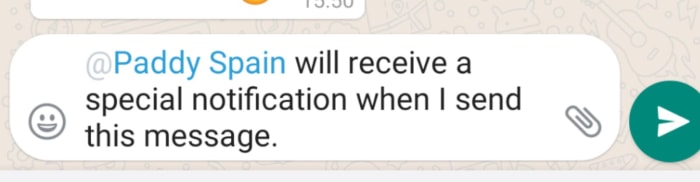
You can tag users in group chats to grab their attention, but the rest of the group will still be able to see the message

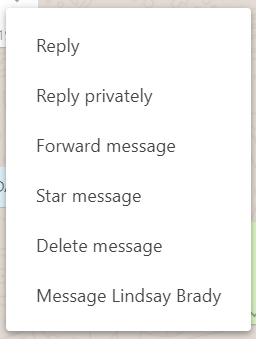
There are a number of WhatsApp group features like user tagging and Reply privately that allow you to aim messages at certain members of the group, but as long as you send a message to a WhatsApp group every member of the group will get to read it. Reply privately actually sends a message to the individual user you’re replying to, opening up in their chat with a quoted reply taken from the group.

WhatsApp private reply

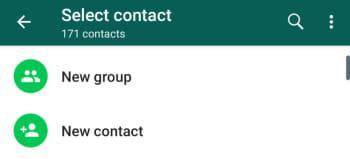
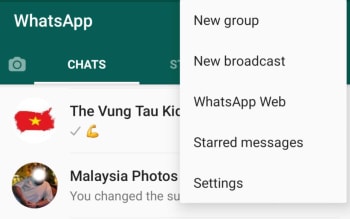
WhatsApp broadcast also allows you to send messages to lots of people at once, just in a different way to WhatsApp groups. You create a broadcast list in much the same way to create a group, too. You open WhatsApp and then click the more settings icon in the top-right. Once you’ve done that, you select all the members you want to add to the list and a chat window will pop up just like it does with a group chat. That’s where the similarities stop.

New WhatsApp boradcast

When you send a message to a broadcast list, it will appear to everybody who receives it as a normal chat would. They’ll receive a message from you, and it’ll appear in your normal chat window underneath the last messages that you sent to each other. When a user replies to a message you’ve broadcast, you’ll see the reply in much the same way, in your regular chat window beneath your broadcast.

You can only broadcast to WhatsApp users who have your phone number saved in their phonebeook

The other big difference between WhatsApp groups and WhatsApp broadcast is that you can only broadcast messages to contacts who have your phone number saved in their phone book. If they don’t have your number saved, they won’t receive any broadcasts from you. Also, unlike with a group chat, you can’t create a broadcast list from WhatsApp Web.

When to use WhatsApp groups and when to use WhatsApp broadcast

WhatsApp group chats are great ways to keep groups of friends and coworkers talking to each other, even if they’re separated by great distances. They’re also good for arranging social events and managing complex tasks across teams.

WhatsApp broadcast, however, is more about one-way communication. The admin who creates the broadcast list is the only person who can talk to everybody on it at once. This makes WhatsApp broadcast lists excellent tools for sending out important messages and alerts, like a birthday invitation or a prompt to ensure your tax information is up to date on your employee records.

The key factor with WhatsApp broadcasts is the private nature of responses. Once the original information has been sent out, all subsequent communication remains between the admin and the individual user. This also means that everybody’s inbox remains clutter free and safe from everybody else’s annoying messages.

WhatsApp cracks down on clone apps

WhatsApp has sent out cease and desist letters to a number of clone apps.

WhatsApp logo

Recently, WhatsApp has been gripped by a number of crises as fake news has spread across its network. This fake news has been used to aid political campaigns but has also seen terrifying attacks carried out by crowds whipped into a frenzy by horrifying stories that weren’t true.

In response to this, the messaging app has enacted a number of initiatives, with the most prominent being limitations to message forwarding.

WhatsApp Messenger Download Now ►
8

The first move saw a new Forwarded tag appearing above a message that didn’t originate from its current sender. This then evolved into a Frequently Forwarded tag. A tag becomes a Frequently Forward tag if the message had been shared more than four times. Eventually, WhatsApp set a limit on how many times a message could be forwarded at all. Thanks to this move, WhatsApp messages can only be forwarded five times at once.

Problem is though, the people who were spreading all of that fake news in the first place want to continue doing so. This means there is a demand for software that will help them bypass WhatsApp’s message forwarding limits and, accordingly, WhatsApp clone apps have sprung up that do just that.

Tech 2 reports that these clone apps can cost as little as $14 yet give users the ability to send up to 100,000 messages per day, if not more. A report by Reuters found that these tools were available to buy on Amazon. They were also being used to subvert WhatsApp’s new policies for political reasons as well as in marketing attempts for regular businesses.

WhatsApp has sent out cease and desist letters to a number of clone apps

WhatsApp’s response to these clone apps has been strong. The messaging app wouldn’t even allow Reuters to use one for test purposes.

WhatsApp responded, “We are continuing to step up our enforcement against imposter WhatsApp services and take legal action by sending cease and desist letters to hundreds of bulk messaging service providers to help curb abuse… We do not want them to operate on our platform and we work to ban them.”

As well as ordering the owners of the fake apps to stop operating, WhatsApp is also banning accounts that use them.

Whatsapp's fake news problem
WhatsApp knows it has fake news problem and is trying to stamp it out.

This isn’t the first time WhatsApp has taken strong action against users of unofficial versions of the app. Recently, users of GBWhatsApp and WhatsApp Plus were targeted with temporary bans. Some lost their entire chat histories in the process. Those apps were built to offer more user-friendly features like themes and added customization options.

This time, however, the clone apps have a much more criminal underworld feel to them. This money being made facilitating attempts subvert attempts by WhatsApp to make its network a safer place. There is a real battle taking place on WhatsApp, and we all need to hope that the right side wins it.

WhatsApp dark mode is back in development and testing

WhatsApp dark mode is coming, and it will be called Night Mode.

WhatsApp

We like to keep you updated on all the updates and new features that are coming to WhatsApp. Trouble is, WhatsApp very rarely makes announcements about these types of things. This means we have to scan through the beta versions of WhatsApp for iPhone and Android and use what we find there to determine what is on the way.

With this being the case, that code is sacred. We can only talk about what is in that code, or sometimes what isn’t in it. When we recently looked at the WhatsApp beta, one thing was missing that had been there before; the upcoming dark mode. The dark mode was gone from the code, Twitter wasn’t happy about it, and it led us to ponder whether we’d ever see a WhatsApp dark mode. Well, now we can put those doubts to bed.

WhatsApp Messenger Download Now ►
8

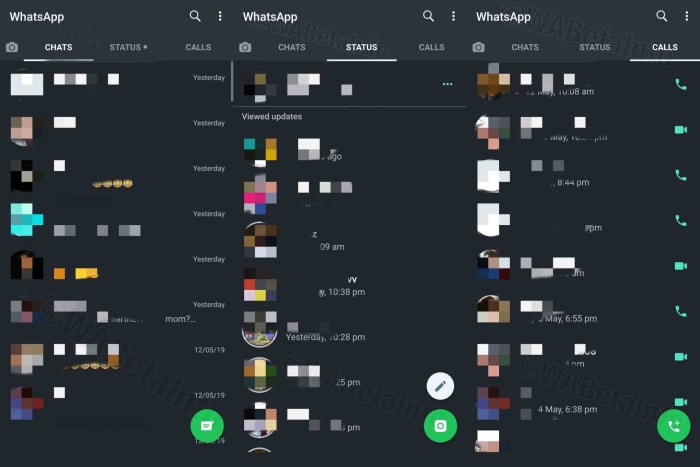
WhatsApp dark mode is coming, and it will be called Night Mode

We’ve already seen screenshots of the upcoming dark mode, which made it all the more perplexing when it was gone from recent versions of the WhatsApp beta. The dark mode is now back in the code, however, and we have new screenshots to add to those we’ve already seen.

The WhatsApp dark mode will be called Night Mode and it looks like it is well along the development path. Night mode is already compatible with the Chats, Status, and Calls tabs on the app but there is a chance that there might still be a few aesthetic changes to come before the feature rolls out to all WhatsApp users. WABetaInfo hypothesizes that the green buttons you can see in the screenshots will change to white for example.

WhatsApp night mode
Screenshots via: WABetaInfo

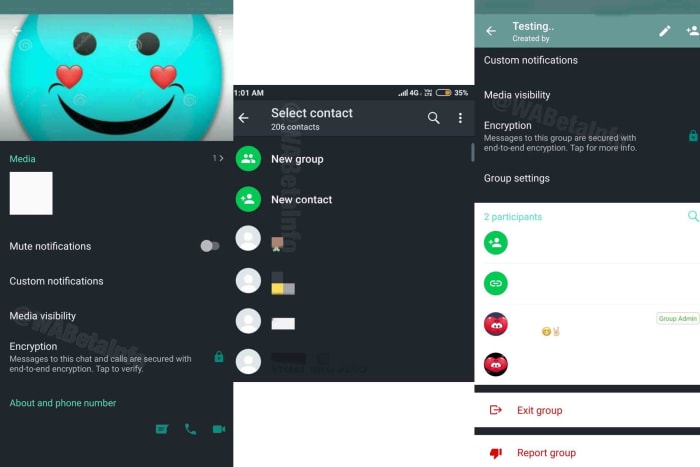
As well as the core features of the app, a more recent update to the WhatsApp beta has shown more WhatsApp pages and screens receiving the Night Mode treatment. WhatsApp beta version 2.19.139 has brought with it some rough night mode screens for the Contacts and Contact Info screen, and the Group Info screen

WhatsApp dark mode screenshots
Screenshots via: WABetaInfo

As you can see from the screenshots above, however, these still don’t look complete, which means WhatsApp still has work to do on the night mode aesthetics before regular WhatsApp users will begin to see it on their phones.

As well as aesthetics, however, it is likely that WhatsApp still has a lot of work to do on the backend of the night mode feature to ensure a bug-free experience when it finally rolls out to everyone. This is, of course, one of the major reasons apps go into beta testing before getting a full release.

Signing users up to beta programs helps developers iron out any creases from the code, while also giving them early access to new features. The flip side of this is the unstable nature of the new features. If you’re OK with this and would like to try out new WhatsApp features, like night mode, before everybody else gets them, check out our tutorial below.