Best websites for business cards

Need a business card? These are your best options.

BusinessCard2

Business cards can get you a job. They solidify connections. They ensure your last and best impression sticks. They’re important!

To make sure you get the best business cards for you upcoming career mixer, we compiled a few of the best sites for business cards, ranging from the highest quality and most expensive to the bargain brands.

Best websites for business cards!

Moo

Moo cards are the best! The company runs like Apple when Steve Jobs was around: more expensive, but definitely not just a brand name. These cards are great, they’re delivered promptly, and the service is professional.

If you want the best, go with Moo!

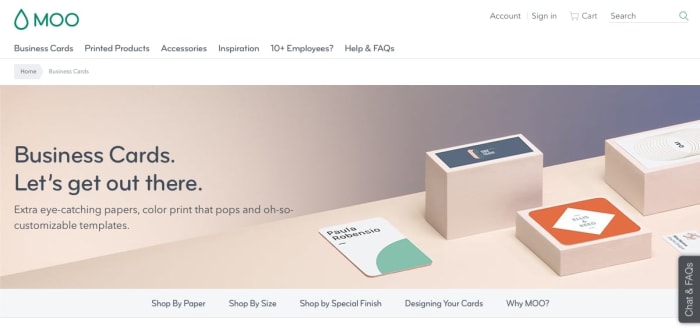
MooHomeWhen you open the website, you’re given the option to choose between a number of card options: if you’re going by paper, you have the choice of original, cotton, super business cards, and luxe business cards.

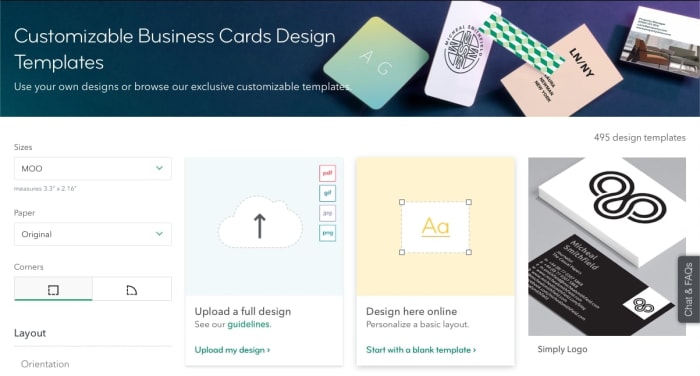
If you proceed with original, you’ll visit the selection environment, where you can discover card templates:

Find cardsFrom there, you enter a card creation environment that looks something like this:

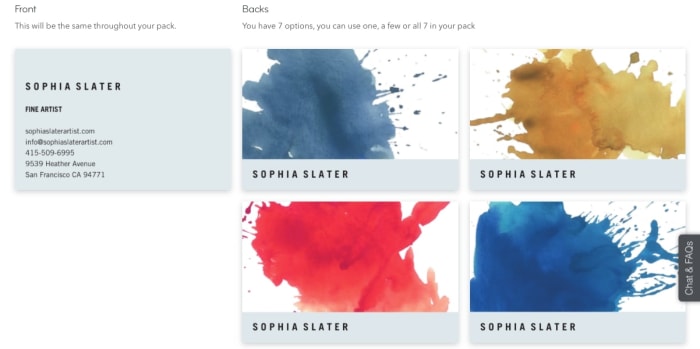
ColorsThe options look professional, you can find a great card with excellent color choices, and the renaming process works like a charm. All cards are automatically a good, quality thickness, 16pt. They are full-color on both sides, with options for Matte or Gloss.

The one downside? They cost $20 per 50 cards.

Picture it this way: rather than go to an all-you-can-eat buffet, why not go to a fancy sit-down restaurant that serves the best food? The answer is, it depends what you’re looking for: if you’re taking your whole family to dinner or going on a fancy date, your priorities may change.

That metaphor probably got out of hand, but you get the point.

Vistaprint

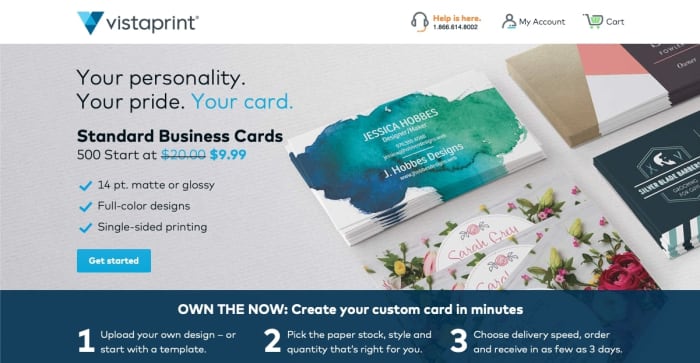
VistaPrintVistaprint specializes in all types of printing. In the realm of business cards, their base offer gives you 500 cards for $20. That’s a ton! However, this cost gets you 14pt cards (thinner), and only one side of print. To get all that, you’ll be paying closer to $45 for 500 cards.

VPHome

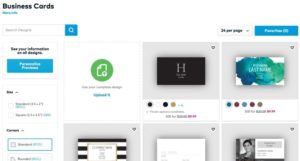
When you jump into the template chooser (because we’ve assumed most people buying business cards didn’t create their own design from scratch), you’ll be greeted by this window:

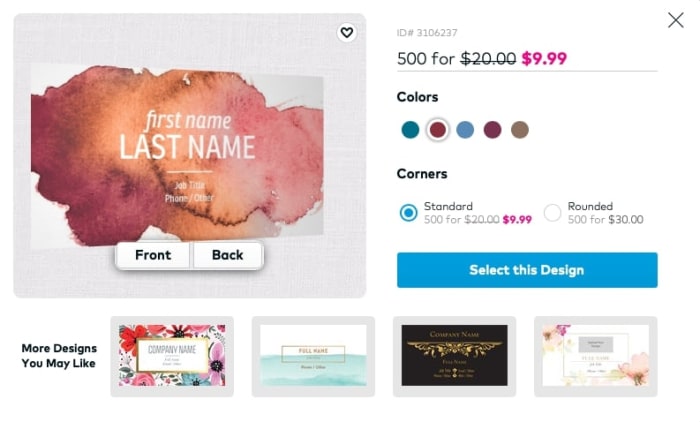
VP1Choose your design and then move on to the reworking portion:

VP2

Here, you can choose your color (which may result in a discount), and begin setting up your card as you wish. When you’re finished putting together the perfect design…

Congratulations, you have a card!

Staples

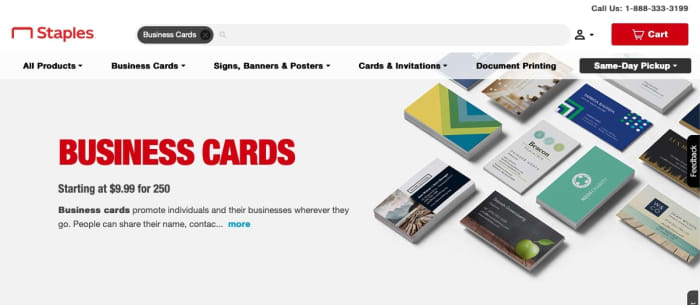
StaplesYou probably know Staples. They aren’t strictly in the business of business cards, they’re an all-around office specialist: ink cartridges, office chairs, envelopes, planners, folders, printing and more.

So, why wouldn’t they do business cards?

StaplesHome

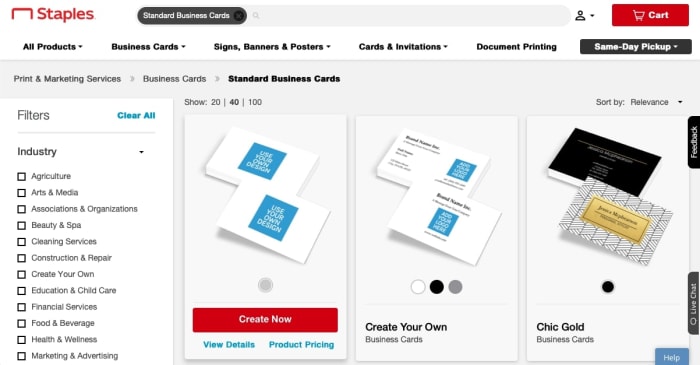
Their template environment will look something like the image below. Straight to the point, no messing around here:

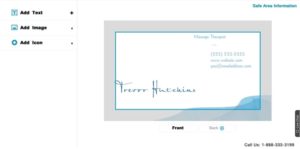
Staples1Their card creator environment also looks rather bland, but that may be perfect for a businessman or woman with a time crisis:

Finally, we arrive at the cost. Staples makes a set of 250 business cards for $9.99! Of course, these base cards are naturally thinner and only have print on one side. To upgrade to fancier options, you’ll be paying around $35 instead.

Another useful thing to note: Staples charges at least $9.95 for shipping. If you want to get your cards for free, you’ll just have to use their same-day pickup system. Which, frankly, may be a very good thing!

Conclusion

Any of these websites can deliver great service, and have a wide range of delivery options and card types. If you go with Moo, you can expect great service, great cards, and a great website, not to mention a reasonable amount of business cards. Staples and VistaPrint have great designs and reasonable prices for the large number of cards they produce. As always, the choice is yours to make.

We hope this helps you find a great business card!

Jobs that won’t be affected by AI

Worried a computer will take your job? Here are some that might be safe.

BulbAlright, so we admit: this is all speculation. Artificial Intelligence definitely could, and probably will, affect everything.

We’re not going to discuss whether or not AI is dangerous or not. Frankly, we find it hard to be overly concerned about the possibility of artificial intelligence destroying all of humanity. Why?

Partially, this may be due to the fact that there are great people like Elon Musk using programs like OpenAI to ensure artificial intelligence benefits humanity. Or, it could be one of a huge number of other reasons including, but not limited to: super-intelligent general AI may never exist, if we all die that’s that, and finally, everyone’s tired of worrying whether it’s reasonable to continue existence as energy-inefficient, carbon-based life forms.

Moral quandaries posed without sufficient data is one of the many things that makes you humans so inefficient in the first place.

So, let’s talk about the…

Jobs that won’t be affected by AI

Sports!

Remember when your parents tried to make you join track, baseball, curling? Well, you shoulda listened!

Sports, objectively speaking, are the most anti-AI job around. The very composition of these competitions necessitates human involvement from the players, because such challenges themselves revolve around people – real people – growing stronger. Getting faster. Developing coordination. Working as a team to beat the others.

Basically, offices can replace a worker with a machine and still be an office. A football team can’t replace their quarterback and be called a football team. At least… not for a long while.

So, the real question is, how will AI change sports?

We believe the most likely effect will be data management (a regular theme for AI, it seems).  Coaches will likely use AI-developed metrics to search for new players and design better practice routines to suit their current players.  The business side of sports has a number of great needs that AI could fulfill. However, this will not so much change the business as improve how teams operate, furthering what modern technology has already accomplished.

Art and Creativity

Art2

Oof. Danger zone.

Already, many AI programs have been employed to write scripts. It goes like this: someone pours a bunch of screenplays into a processing algorithm to see what the machine spits out. The results can be pretty crazy:

Yeah, that’s a Burger King ad written by AI. The future is bright!

But seriously, there may come a time when artificial intelligence can develop more than just weird ads and will develop great stories with well-rounded character development and detailed worlds. What happens then?

First off, we believe that will take a much longer time than it seems. Modern computers can easily compute “big data,” and string together streams of words based on inputs. Both those things are far removed from the synthesis required for creating a story.

It’s an even more difficult form of the Turing Test. The Turing test judges a machine’s ability to mimic (emphasis on “mimic”) human behavior in such a way that someone conversing with the computer couldn’t tell the robot from a human. Developing a coherent story requires far more than responses to inputs, the process demands true imagination and understanding of plot, character, locations, and theme.

Second, let’s say AI reaches that point. Even then, much of art, by its very definition, revolves around the outer expression of inner human emotion. Unlike a script, a painting often must be judged on the artist’s intent. As with sports, taking people from the equation removes the value of effort and expression, meaning there may always be value in creation.

Music is already under assault by some surprisingly good AI composers, however:

Law Enforcement

Right now, robots are used by police forces for such tasks as bomb disposal and even then, they are remotely controlled rather than autonomous. AI is used for license plate recognition and more, but never for field work.

We expect it will take many years before the general public trusts AI enough to give it a place alongside officers in robotic form. Even when this does occur (which we believe it will), we predict they will only be trusted with nonlethal measures.

After this, it’s possible AI will become the majority of the police force.

Why? An autonomous robot can use nonlethal force without risking its own “life” in dangerous situations a human officer shouldn’t enter without the sufficient protection of a firearm. As the technology and robotics required become less expensive, they will begin to have more functions like facial recognition, evidence management, and so on.

Therapy

Psych

…and psychology, to a lesser extent.

As you may have noticed, aside from jobs that require humans by sheer definition (sports and art), the jobs least likely to be affected by artificial intelligence are those dealing with sensitive human matters. Basically, any job where you wouldn’t want to see a robot working will keep humans around… temporarily.

Therapy relies on a delicate relationship between two people. Unlike movie therapists (who are generally worthless and often tell kids running from real monsters that “it’s all in your head, kid, you’re totes crazy”), real-life practitioners are experts in helping people get to the center of their problems and finding a way to defeat them. We suspect even if a robot could pass as a human, the knowledge that no warm-bodied person is present would make most people ill at ease.

And we’re a long way from robots that advanced.

On the psychology side, however, things could go either way. A robot adept at recognizing body language and speech patterns could use a patient’s data to more reliably provide accurate analysis. The question is: would a visitor be more likely to act natural around a human, or a robot? Humans provide more of a physical presence, but sensitive topics may be easier handled with a friendly robot.  Once again, we need more information to decide.

Ministry

Praya!A common phrase in church goes: “If AI takes over pastoral jobs, I’ll be a monkey’s uncle.”

Okay, that’s totally not a phrase. But congrats, you’re paying attention!

Many, if not all faiths, rely on a human element due to their belief in a soul or reincarnation. With that idea in mind, what rational churchgoer would want the word of God preached by a soulless machine, no matter how lifelike it seems?

Now, we could talk all day about the ramifications that a “godlike” AI could have on humanity’s belief in a higher power, but we’re not going to. We’re just not.

Termination

This is the end.

Of the article.

If you have a few suggestions for occupations that are AI-safe for the time being, please let us know below! Specifically, do you think robots will take over the dental industry? Yes, that’s a pretty specific question, but we were on the fence about it and thought you might have an idea.

Complete guide to advancing your career

From building your resume to acing your interview to succeeding in an office, here’s everything you need to know to grow your career.

Ready to take the next step in your career? Just getting started? Looking for a side-hustle to make some extra money? Or maybe you’re ready to strike out on your own and start your own business. Whatever the case, we’ve got some excellent articles to help you on your journey.

Guide to advancing your career

career guide

Looking for a traditional job

Interviewing

job interview

At the office

office work

Productivity tips

Personal tips

staying calm

Working remotely

remote working

Entrepreneurs, freelance, and self-promotion

entrepreneur

Make yourself more valuable

skills learning

The future

future work

6 LinkedIn mistakes screwing up your job search

A great LinkedIn profile can be the difference between a great career and a lame job. Don’t make these mistakes!

LinkedIn

A LinkedIn profile sometimes seems like this thing we have to have, if only for show.

Many of us are guilty of it ourselves. We sign up for a LinkedIn profile and assume it’s a “set and forget it” solution.

You put up that one photo of yourself looking semi-professional and bam — you’re ready to make some sweet connections with thought leaders and go-getters. But you might be making some mistakes that are wrecking your job prospects. Read on, dear job seeker.

6 LinkedIn mistakes screwing up your job search

1. No picture or unprofessional picture

Oh, man. One of the biggest mistakes you can make is failing to put up a decent picture. Opting out of uploading a photo makes you seem like a weirdo, a faker, or someone who just doesn’t care.

An unprofessional profile pic is just cringe-y. By all means, avoid from including your boyfriend, cat, or baby in your LinkedIn pic — it’s all about you.

Don’t overthink the picture. The biggest thing is, you’re wearing clothing that looks clean — at least somewhat professional — i.e., no superhero shirts or bikini tops.

Employers want to see that you look alert — eyes open, standing up straight — and smiling. Your picture serves as a way to communicate that you look well, normal.

A couple of examples that are LinkedIn-approved:

example profile pic

profile picture for linkedin

Additionally, a profile picture comes in handy when you meet people in person or other corners of the web.

People tend to look you up after that networking event or after you’ve sent an email. A bad pic or no pic makes it harder to find you, and could lead to a missed connection.

2. Your recommendations suck

Recommendations are the easiest way to demonstrate credibility — and allow you to squeeze in a few brags without tooting your own horn.

You don’t need a ton of recommendations to make a positive impression. Quality over quantity cannot be emphasized enough here. Still, recruiters might think something is wrong with you if there aren’t any recommendations at all.

But, this area is all about quality. Someone looking at your profile might see a boring recommendation that says “easy to work with, team player.” But that could be about anyone.

By contrast, something like “Sarah has a real knack for rallying people together and getting them to share ideas. She doesn’t hesitate to help others and always has some out-of-the-box solution on hand.”

If you don’t have any recommendations, offer to trade with a few trusted colleagues (or former colleagues) who can describe in detail what you bring to the table.

It’s uncomfortable to ask people for recommendations. Sometimes you’re lucky enough to receive one without calling in a favor, but mostly, you have to ask nicely.

3. Boring descriptions are getting in the way

LinkedIn is like a dating profile for jobs. You want to put your best self forward, but that “best self” should still resemble who you are when you’re out in the world.

So, get those stale, meaningless buzzwords out of your head. You know, “detail-oriented,” “multitasker” (we all know that’s a lie), “hard worker” — highlight unique areas where you excel.

The experience section should offer more information than just the company you’ve worked for and your job title.

Job titles mean different things at different companies. For instance, a marketing manager at one company might be a generalist with few responsibilities whereas someone with the same title elsewhere might oversee a whole department and have a highly sought-after skill set.

Now, we’re not saying you should spit out every duty related to your job. LinkedIn offers limited space, after all. Instead, focus on a few bullet points that demonstrate your capabilities. Leave “proficient in Microsoft Office” out of the mix.

4. You have a terrible headline

Many people don’t know that you can change your headline with minimal effort. Generally, if you leave it alone, LinkedIn defaults to whatever you have listed as your current position.

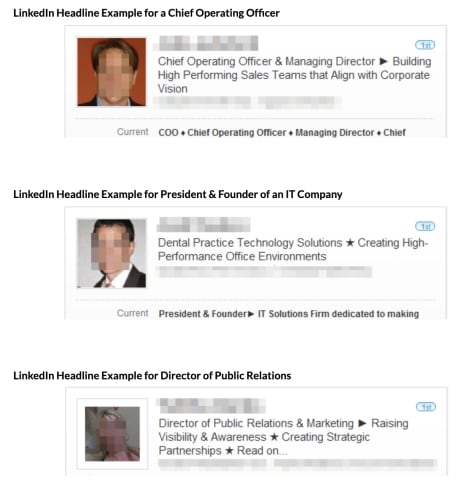
Your LinkedIn headline (right under your name) is the lead-in to your brand. It’s less about sharing your job title verbatim, more about giving recruiters the short answer to “what you’re all about.”

We’ve all seen those people in our feeds with weird, vague descriptions  —  either a mishmash of industry jargon or an overly long sentence.

Be specific — tell people exactly what you do. Industry focus, what you’re known for — i.e., Marketing Professional: Social Media Specialist and Content Expert.

LinkedIn good headline examples

5. You’re not using keywords

Keywords aren’t limited to optimizing blog posts. They’re a handy tool for making sure that recruiters can find you — and more importantly — that they’ve got an “in” with the types of jobs you’re looking for.

With keywords, you’re at the mercy of the algorithm — however, you still need to make sure that people can read your profile. Using a bunch of buzzy terms like “design thinking,” “marketing/sales/etc. guru/wizard/sorceress” gives the reader a word salad they didn’t ask for.

What’s more, Google and LinkedIn’s algorithms might punish you if they feel you’re engaging in keyword stuffing — or trying to game the system with too many keywords.

Still, you should use industry terms that correspond with your skills, experience, and location.

LinkedIn published a keyword guide that can help you kickstart the research process if you’re unsure where to begin.

6. You’re lurking around the platform

Sharing a status update might not seem like an important part of your online strategy. But it’s vital for helping you appear engaged and active.

This is where you can share your accomplishments — promotions, published articles, new business ventures. It’s also a great place for users to let their network know that they’re seeking new opportunities as well.

You don’t have to post your status every day, just a few times a month so that people can see you — and keep you top of mind.

The second part of this is — don’t lurk. LinkedIn is great for joining groups relevant to your industry. Participating in these conversations — in an authentic way — allows you to connect with a network of other people in entertainment, finance, startups, and may pave the way for job openings down the road.

How to do the open office plan right

Does your company have the dreaded “open office” floorplan? Here’s how to cope.

Open Office

Today’s office is more for show than anything. Bright colors and the trappings of a fun, creative culture are powerful recruiting tools.

For startups, well-designed open spaces signal to visitors that things are happening. Which can lend them some credibility when they need to impress angel investors, VCs, and the board.

At a glance, it’s easy to see the appeal. A lack of walls visually represents a silo-free workplace. A place where ideas flow freely and workers can talk to each other on an equal playing field.

Optics aside, study after study has shown that the open plan is not so good for those who need to work inside it. According to a 2013 study from the University of Sydney, a lack of sound privacy was by far the biggest offender associated with participants’ working environments.

And it makes perfect sense. There’s very little privacy, causing performance anxiety for those who need to make a call.

These spaces might even make us feel less positive about collaborating. That total lack of alone time can lead people to retreat inward.

People have tried all sorts of things like working at home after hours to arriving super early to beat the rush. Some organizations have coped by implementing strange rule sets aimed at clarifying the new norms.

Why are we committed to an open office plan if it doesn’t work?

The office (one with private rooms) was established in the 1960s. When open plans came on the scene in the 1990s, there was a sense of excitement that came with tearing down the walls.

But, as the inventor detailed in a 2016 Planet Money episode, that initial excitement quickly turned into a nightmare for workers.

Yet, here we are in 2019 and open offices keep hanging around. In part, because it’s cheaper than renovating.

The floor plan allows offices to fit more people into less space, thus saving money. They also make it easier for companies with high turnover rates — think startups who hire en masse — and sometimes downsize at that same scale.

The point is, we’re kind of stuck with the bad choices we made in the 90s. And workers are left to deal with the fallout.

Here are some thoughts on how to do the open office right, because we all know, it’s probably here to stay for the long haul.

Respect peoples’ need to get things done

If you don’t love the wide open space, make sure you’re a good example yourself. Don’t add to the noisemaking culture if it drives you up a wall.

Send messages to coworkers via email or chat to see if they are available to talk about something. Or, consider whether the issue demands an in-person conversation at all.

While we’re not advocating that you avoid the IRL conversations, it’s smart to consider when it’s appropriate and when it risks knocking yourself or a colleague out of a productive session.

Are you the chatty one in the mix? Chances are unless you’re an extreme introvert or hate your coworkers, you’re guilty of joking around on the job or chatting up other bored colleagues. We are human, after all.

Still, if you work in one of these spaces, it’s partly your responsibility to learn to read the “I’m busy” cues your coworkers are putting out and making sure that your desk neighbors are able to get their work done.

Minimize distractions

work distractions

Everyone presumably needs to work at work.

While entering your average open plan might have you believe that we’re all here to socialize, deadlines need to be met and solutions implemented.

As mentioned above, noise pollution is the biggest threat to productivity in the modern office. Employers should do their part to reduce noise levels. Sometimes it’s not so simple — certain rooms lend themselves to echoes, of course.

But, things like area rugs, large plants, adding noise canceling panels to certain walls — these things might be within a company’s budget.

Employees should invest in a great pair of noise-canceling headphones. The benefits are two-fold — there’s nothing like a big pair of headphones to say, “leave me alone.” And second, well, the noise-canceling aspect.

But, beyond that — focus on controlling other elements that can throw your focus out of whack. For example, keep your desk clean and make sure you have a comfortable space to work. Have sweaters at the ready if it gets cold and space for your favorite beverages.

Things like checking email at designated times or silencing notifications are also good ways to keep on task. As is listening to white noise or music that helps you concentrate.

Colleagues can talk all day and it’s often out of your control. But taking some measures to ensure you carve out your own space — comfort, noise-canceling, and some smart routines — can help you deal.

Dedicated quiet and loud spaces

This one is more on management, but the office needs to change to accommodate different tasks and different working styles.

One solution is designing a workspace that emphasizes compromise. There are indeed some benefits of tearing the walls down. It’s great for the brainstorming phase — just not the actual implementation of the ideas you generate.

But these collaborative conversations should be limited to specific spaces — conference rooms, a cafeteria, a walk around the business park.

There’s a reason those portable phone booths have blown up over the past couple of years — these pods present an affordable solution for companies recognizing this growing need to provide a refuge from noise.

We all need to look toward flexible work cultures

Maybe the modern workspace should take a cue from the modern co-working space. What we mean is, organizations may be wise to incorporate a flexible schedule or a partial remote policy.

Instead of forcing employees to suffer at their desk for a set number of hours each day, allow them to choose the space and time that works for them.

Sure, flexibility depends a lot on the types of jobs people do, but employers need to closely consider why some employees need to be at their desks. Knowledge workers, in particular, spend a lot of time working on the internet — many of them can do their job from anywhere,  but require focus to actually tap into their knowledge.

Complaining about the floor plan, unfortunately, won’t get anyone far. Unless the company is discussing a major remodel — most of us are stuck with these plans for the foreseeable future.

That said, we are starting to see more organizations adopting solutions that lessen the pain. From quiet phone booths to a variety of flexible rooms, this approach may well be the best compromise.

How to uncover your hidden talents

Feel like you’re supposed to do something else? Here’s how to find your hidden talent.

Work daydream

We all talk about the dream: doing what we’re passionate about. It’s a noble aspiration, but realistically, we’re not all able to pull this off.

Some of us start careers we thought we wanted, only to find the shine wearing off sooner than expected. In other cases, we try to make moves from a job that’s just a paycheck to something that offers more than food on the table.

It’s frustrating to watch other people dive into careers they care about, while you’re feeling side-lined, waiting for your hidden talents to reveal themselves.

Is there a way to distill this down to a science? Or are we doomed to hoping we luck out and stumble upon our greatest gifts when we least expected?

Here are some tips for finding out what you’re good at, as well as how you might apply them in the real world.

How to find your hidden talents

What makes you lose track of time?

Imagine you have a full day with nothing on the books — what activity would you do to pass the time? Is it going for a long run? Starting a new art project or playing an instrument? Writing short stories?

Identify a few of these activities and write down what you like about them.

If you’re a writer in your downtime, take note of what you like about it. Is it inventing new worlds or analyzing current events and sharing your opinion?

If it’s the latter, those qualities could lend themselves to being a blogger or an analyst. The former, you might find yourself helping brands tell their story.

An artist looking for a more reliable career path could be well-suited to UX design or something with a strategic component — as it takes a lot of big-picture planning to execute a series of paintings.

The point is, the things you like about your existing hobbies could be transferrable — it just might not be obvious from the outset.

Do some personality testing

Personality testing does have some limitations, but they might get you to think outside of the box when it comes to finding your strengths.

We recommend taking a few and being as honest as possible — not answering with aspirational responses.

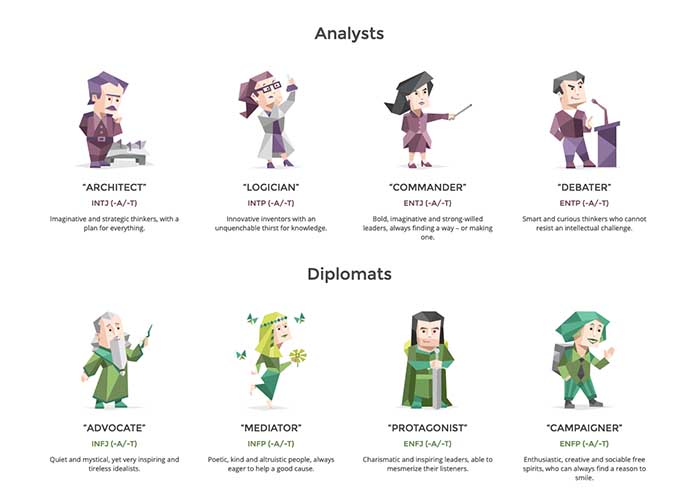
The 16 Personalities Test is one of the more popular choices around, and the free test goes into great detail when it comes to the best career paths and why your personality might be attracted to those choices.

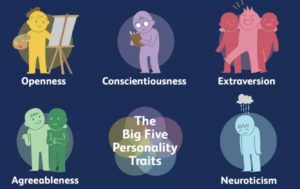
There are longer personality inventory tests, as well. There’s the Revised NEO Personality Inventory, a test aimed at measuring the Big-5 personality traits (openness, conscientiousness, extraversion, agreeableness, and neuroticism).

OCEAN personality

Or, the HEXACO Personality Structure Inventory, which measures those same traits — both are around 200 questions long and take about an hour to complete.

Ultimately, test results should be taken with a grain of salt. They’re not perfect — but they can give you a sense of the qualities you might want to seek out in a career.

Ask around

Obvious, right? It might be a little uncomfortable, but one of the most effective ways to identify your strengths is to get some external feedback.

The key is to ask a handful of people — friends, family, colleagues — those who know you well and likely to be honest.

Frame it like this, “I’m doing some self-work and could use some feedback.” “Or, I’m considering a career change and am crowdsourcing suggestions.”

Then ask some questions:

  • What do you think I’m good at?
  • What stands out about me?
  • What was your first impression?
  • What was I good at when I was younger?

What kind of compliments do you receive?

Compliments

Building on the last suggestion, take stock of the compliments and criticisms you receive from others.

What praises or frustrations are documented inside the inbox? Understandably, it’s no fun to go searching for feedback, but looking back at everything from your LinkedIn endorsements to emails that highlight a forgotten detail can be eye-opening — and serve as a starting point for future careers.

Also, make sure you take stock of those compliments you tend to brush off. These are the qualities that could help you find a hidden gem in an unlikely place.

Take a class, do some research — really, just broaden those horizons

Upskilling is one of the best ways to carve a better career path and broaden your horizons.

If you have an existing skill set, consider looking into ways to specialize more and become an expert — or cultivate a rare, valuable skill.

We’ll add one big caveat here — if you’re looking to secure better paying, fulfilling work, your best bet is to level up skills that relate to one another. For example, if you work in marketing, you might want to take data science courses or polish your social media skills.

Another thing to consider when looking for classes or certifications is, will these skills be needed in the future?

Look at the stats before investing in a new skill. A good starting point is the U.S. Bureau of Labor Statistics; you can search their database by occupation and learn more about which roles are in demand. Payscale or LinkedIn’s Salary Tool offer a more user-friendly approach to sizing up the job market. These sites provide you with information about careers, their pay, and job outlook.

Finally, talk to people already working in the industries you’re looking at. From influencers on LinkedIn and Twitter, to forums like Reddit and Quora, there are countless opportunities to chat with people of all experience levels. Ask questions to find out more about paying your dues, leveling up, and what the daily grind entails.

Be honest with yourself

Again, the passion thing comes into play. When you’re looking into potential paths, you definitely want to find something that pays the bills.

Really look at whether there are opportunities available before you head down a new path. Following your passion is one of those fantasies, like the American Dream. Some people really luck out.

Instead, your best bet is to find where your skills are needed and valued, then seek to find where those skills intersect with your passion.

As much as money can’t buy everything that contributes to happiness, removing financial worry from your daily life is a big part of finding fulfillment.

2019 Ultimate Guide to Resume Apps 

It’s safe to say that the internet has changed almost everything about jobs. Interviewing for jobs, identifying opportunities, and doing your job.

The whole cycle has been disrupted.

This is all well-documented — we live in a world where preparing for an interview means knowing how to impress an algorithm.

What hasn’t gotten a lot of attention is how to upgrade the stodgy old resume.

Sure, social media and digital portfolios have taken over many traditional CV duties, you still need to have a solid resume on hand.

Just because you’ve been hoping it might fade away along with fax machines and stamps (just us?), you still need to put some effort into creating a memorable, professional one-pager.

To help you out, we’ve pulled together a list of apps that make the formatting, editing, and polishing process relatively painless.

Best resume apps for 2019

Cake Resume

Cake Resume example

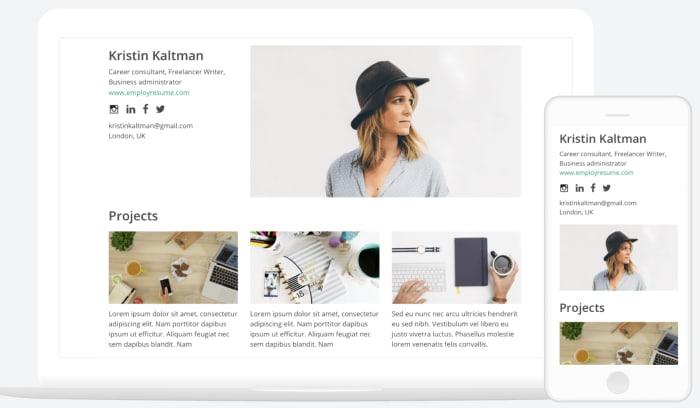
Cake Resume is a drag-and-drop-style resume editor that allows you to customize your design without being held back by the confines of a pre-designed template.

The result is a slick-looking resume that looks more like a well-designed website. How it works is, you’ll fill in each field: name and intro, experience, education, etc., plus photos, links to projects, or anything else that makes sense to include.

From there you can customize the layout — move things around, add, delete, resize — however you please.

If you’re not sure where to start, Cake Resume offers tons of examples of resume creations organized by industry. Because real people create them, some examples look better than others. Still, you’re bound to get some ideas for how you can present yourself.

Though the process is pretty easy, some users might feel a little overwhelmed, if they don’t have any design experience.

The process is similar to a landing page builder — so marketers and designers should be able to get the hang of Cake Resume right out of the gate. For everyone else, the site does come with tutorials that can help you out.

Canva

canva resume templates

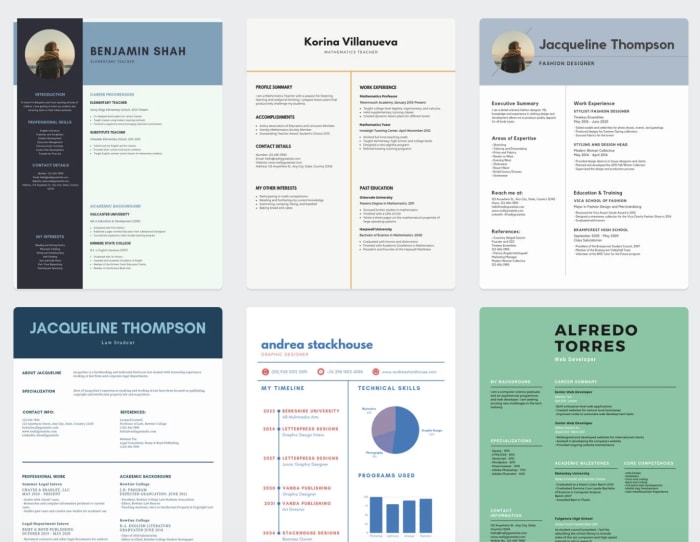
Canva isn’t just for creating logos and custom graphics; you can also use the web app to make your resume pop. Resume designs span a range of styles — some colorful and artsy, others minimal, and many, somewhat traditional. Sort through the template selection by choosing a categoryand finding the one you like best.

Choose from literally thousands of templates — adjust fonts, colors, and make it your own by adding photos, icons, and illustrations from Canva’s library.

Change the font and color, update the details, resize the various elements, and move things around.

Playing around with the tool — those who stand to get the most out of it will change nothing but the details. For a more personalized approach, you will need a bit of design savvy, as it’s easy to mess up the individual elements.

Canva is free if you stick to the tool’s free design elements, plus a dollar per graphic if you add in premium graphics.

10

Visme

Visme does offer fewer templates and graphics than Canva, which means that you can’t customize your CV to the same extent. But, it also makes things easier on people without a design background.

Right away, we were impressed with Visme’s aesthetic. They’ve got a more defined look than Canva—which sources designs from professionals around the world.

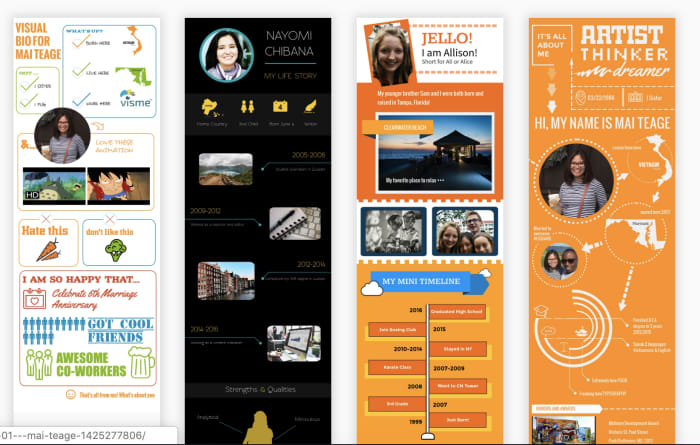
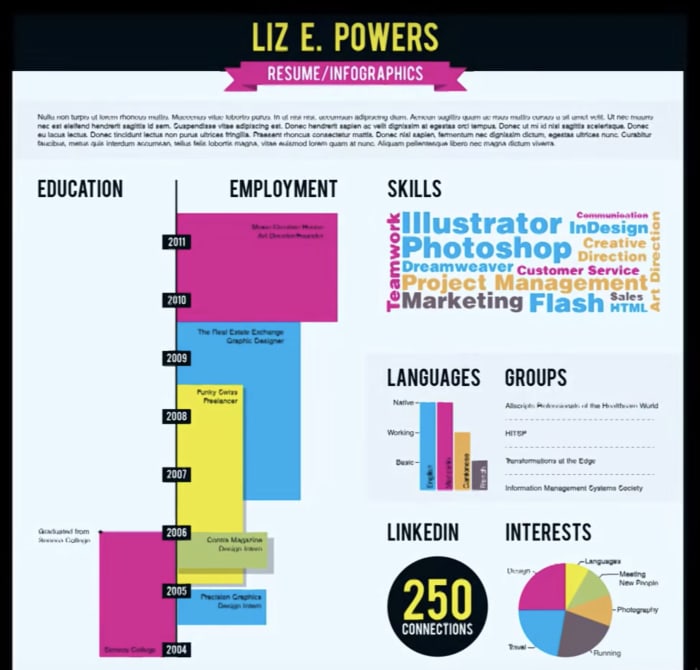
Where Visme brings something fresh to the table is the infographic resume templates. These might not be right for every industry, but they do stand to help you stand out in a sea of white paper.

We should mention, that the resume section isn’t clear upfront. The site is used for creating graphics spanning slide shows and social media designs to infographics.

CV Engineer

CV Engineer mobile app for resumes

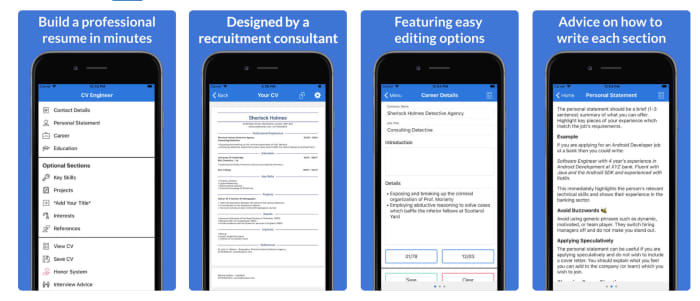
CV Engineer allows you to put together a resume from your phone. While you won’t get the same visual components as Visme or Canva, the app makes it easy to organize your details in a clear, concise way that employers are sure to appreciate.

You’ll get started by filling out each section (skills, references, education, interests, and experience) and CV Engineer chimes in with little tidbits of advice, as you move through the process.

Once you’ve filled everything out, CV Engineer pulls everything together, and from there, you can save your final copy to your Google Drive.

The app is free, but you can tip the developer later on — you know, if the resume lands you a job.

CV Engineer - Free Resume Builder CV Template Download Free
8

Vizualize.me

Visualize me visual resume

Vizualize.me is an infographics maker with a mission to give the traditional resume a much-needed makeover. The app instead takes your LinkedIn details and compiles your professional achievements into a simple, yet visually engaging graphic.

While the tool is in beta, it already has some pretty rad features. Compile your experience in the form of a colorful timeline, add skills by way of bubble charts, and compile your “stats” as a pictogram — in case you’re wondering “stats” might be how many LinkedIn connections you have or deals you’ve wo n— you know, those little brags.

CVOne

CV One Video Resume

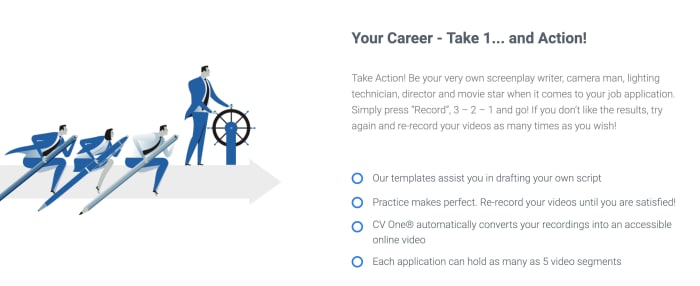
CVOne is a video resume builder that comes with a scrolling teleprompter you can use, so you don’t forget your lines.

While the tool is free, you are forced to share your CV by way of branded URL, which might be a deal breaker for someone trying to put their most professional foot forward. Still, what we liked about this option is, it’s an easy solution for creating a video in a pinch.

We’ve come across job postings that ask for a video — and admittedly, the prospect is a little daunting for those who don’t make a lot of videos in their personal or professional lives.

Microsoft Word

Word for Resume Templates

Okay, you’re probably thinking — wait, my resume is already in a Word doc, this isn’t new information.

Fair assumption, but hear us out.

Word isn’t the most exciting option on the block, but they do offer several good looking templates, and chances are, you already know your way around the platform. Resume options are free (if you have an account) and designed by Moo — you know, the business card folks.

There are also some super simple options for those who prefer to stick to the old school approach —important details, easy to read.

Microsoft Word Download Free
8

How humans and AI are currently working together

Will AI take your job, make your life better, or both?

humans and robots

Artificial intelligence has become good at so many things we once believed were the domain of humans and humans alone. From providing top-notch customer service to diagnosing cancer, bots are beating us in all kinds of industries from logistics to medicine.

We talk about collaboration a lot, but generally, it’s between humans working together toward a common goal. With robots, we’re dealing with a new class of coworkers, those with contrasting strengths and perhaps, less capacity for humor.

Companies like Tesla, Apple, and Facebook lead the charge on technological advances, but artificial intelligence has made its way into businesses of all sizes. Only about 41% of adults support advancing AI, and those folks tend to be wealthy, tech-savvy males.

Those who stand to see an influx of these new coworkers likely won’t fit the description of your average AI enthusiast.

Here are some examples of how humans and bots are already working together:

Chatbots — retailers across the board

Chatbots are the most obvious example of automation in the workplace — or at least the most visible sign of change.

Chatbots offer 24-hour support and the ability to take on tedious customer service tasks and free up support staff. According to a report from Juniper research, chatbots will bring roughly $11 billion in cost savings by 2023 across healthcare, retail, and financial services sectors.

Today’s customers care most about receiving top-notch service at their convenience, so the industry-wide investment in chat makes total sense. Gartner predicts that AI will take over more customer service tasks, which allow companies to better manage the customer experience.

Dealing with more automation is changing the role of the customer service rep, to be sure. On the human side, this role is more strategy-based — focused on improving the customer experience at every touch point.

Tech-enhanced brick and mortar staff

Marty

Marty is a tall gray robot that can navigate grocery store aisles on its own, using a collection of cameras and sensors to find and report safety issues like spills. Giant Food Stores have plans to add Marty robots to all of the chain’s 172 locations. Marty’s main purpose is to spot hazards, but other robots offer shoppers and stores a variety of benefits.

There’s the LoweBot, an autonomous service robot there to help customers find items and answer basic questions. The bot has been around for a couple of years now, and helps users figure out what type of tool they need and can process requests in multiple languages. Additionally, the LoweBot can help workers keep track of inventory.

Walmart’s autonomous scanners reduce issues caused by frequent stock shortages. The big box chain says that unavailable items are a major pain point for customers, and it can be a time-consuming task for employees to scan for items that customers can’t find.

Robot janitors

Walmart is about to unleash an army of robotic janitors in their stores. The company put out a call for bids and recently announced a partnership with a company called Brain Corp. Walmart will employ 360 cleaning machines, equipped with a platform called BrainOS.

The goal is to keep the stores sparkling clean with no human oversight required. The existing scrubbers require a human operator to guide them down the store’s aisles each time the store needs to be cleaned. The initial onboarding phase requires someone to ride each robot around the entire store, so it memorizes the layout. After that first ride, the robot is ready to work without a human on its back.

Walmart says that the aim of this new initiative is to allow employees to focus on helping customers, rather than performing tedious cleaning tasks.

Because the stores are currently in the midst of training the robot janitors, we don’t know how this will impact employees. As it stands, Walmart employs more workers than any other U.S. company, so it could have a negative impact on the economy.

Robots in the medical sector

medical robot

Given the startling statistics regarding patient infections in hospitals, medical staff need all the help they can get when it comes to keeping things germ-free. A study by the CDC found that using germ-killing robots can reduce the rate of hospital infections by 30 percent.

Vanderbilt University Medical Center has started using robots to do follow up job after humans perform normal sterilizations. The robots use ultraviolet radiation to kill germs, which allows hospitals to catch germs that human cleaners leave behind.

There’s also robotic surgery. The concept isn’t exactly new, but technology has improved dramatically in recent years.

The Senhance System is a surgical robot that was just cleared by the FDA for use in minimally invasive procedures. How it works is, surgeons use software to control surgical instruments, performing surgery remotely using three separate robotic arms. Senhance-based surgery stands to improve patient outcomes

Wrapping up

Resistant as we may be to tech entering the workplace, we won’t be able to avoid it for long. It’ll be interesting to see how human job descriptions and duties shift in roles like customer service and medicine.

Customer service is becoming a more skilled job than it has been in the past. The role is now more strategic than being on hand to answer calls and assist customers. Medicine stands to change in the way that doctors might increasingly work with software, rather than directly performing surgery.

It seems robots are fitting in okay, though they’re still relatively new at this whole workplace thing. In the end, we will have to rethink the human scope of work — and find roles that align with every skill set.

How to create a solid freelance portfolio

If you want to be a freelancer, you need to show your skills. Here’s how to make your portfolio pop!

portfolio

If you’re currently working as a freelancer or thinking of diving into self-employment, you already know that your portfolio is one of the biggest assets for growing your business.

The goal is, your portfolio will help you market yourself, find new clients, and differentiate yourself from the competition.

Word of mouth is great, but if you’re a writer, designer, or web developer, showing always beats telling, hands down.

But, if you’ve ever looked at other peoples’ professional portfolios, it can be a real zap for your confidence.  Or maybe you’re just not sure where to start.

In this post, we’ll go over some of the ways that you can create a digital portfolio built to impress.

What a good portfolio website should accomplish:

  • Increases visibility
  • Provides a way for contacts to get in touch
  • Creates new opportunities
  • Proves professionalism
  • Stands out
  • Demonstrates where you can add value

If you went to school for art, design, or web development, you’re already familiar with the idea of a portfolio. But a school portfolio tends to include a little bit of everything you’ve learned during your academic career. A freelance portfolio should focus exclusively on the work you want to be known for.

Which areas are you an expert in? Do you write about food and beverage? If that’s your space, then your portfolio should not be loaded with content about your thoughts on the latest iPhone or training dogs.

Instead, it should have a clear focus on recipes, nutrition, ingredients, and so forth. There may be a broader theme — think wellness and health, along with some restaurant reviews, but everything should tie together.

What if I don’t have much to show?

worker

There are two main ways to build up your body of work when you’re just starting out. The first is by showing off your personal projects.

Personal projects are a great way to drum up attention — especially if you’re already creating a lot of material on your own time. A consistent personal project—like a web comic, a blog, or a series of photos — can help you showcase your talents.

This won’t work if the personal project doesn’t match up with how you plan on earning money. However, posting illustrations to Instagram can help you show off your design skills to a captive audience.

Personal works depend a lot on consistency. If your goal is to build a following on Instagram that you can then leverage into paying clients, you need to consistently push out content.

The second way you can build a portfolio is to do some work for free. We don’t recommend advertising your services for free. This can lead to low-paying gigs — a cycle that unfortunately, can be hard to break.

You can do pro bono work for a friend or family member with a small business or a company that you admire that falls within your niche. Provided you do good work, potential clients won’t know that you worked for free in the past — consider it a marketing expense.

Additionally, if you do good work for a pro bono client, they may be more inclined to refer you to others in their network.

Other things you can do to bulk up your portfolio:

Shorter samples

thinking

Call these snippets, excerpts, shorts. Whatever you decide, consider making a selection of shorter samples that give prospects a taste of what they can expect from working with you.

Write the introduction to an article, compile a selection of mock-ups for an app, or design templates, and write a short description that offers some context.

The point is to show prospects that you have the skills to help them achieve their goals.

Fake projects

Fake projects are another way to show that you have what it takes to help brands level up.

This is especially effective for designers, as it’s easy to present visuals as if they were part of a real portfolio.

You might create a social media campaign for a fictitious brand — with stock photos, logos, and custom typography.

While you can’t use logos from real brands on your site, this is a great way to present your creativity in a way that looks and feels professional.

Create a downloadable resource

Creating a free download isn’t the right move for everyone, but if you can create a resource that people would genuinely like, this is a great way to collect leads.
lead magnet for your site

Here, you might create an eBook that shows users how to get started as a blogger or a set of custom templates readers can use for email newsletters or a set of icons. In any case, the resource should be helpful, and prove your expertise.

Where should my portfolio “live?”

When it comes time to pull the trigger and get your stuff up there, you’ll want to collect all of your assets.

Make a checklist that includes all of the items that you’ll be using on the site.

It doesn’t have to be fancy, in fact, you’ll be just fine with one of the many website builders on the market.

Popular (and easy) options include:

Wix, Weebly, and Squarespace are all incredibly easy to set up, even if you don’t have much experience setting up websites.

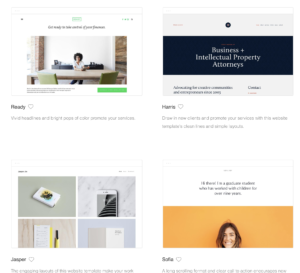
That said, Squarespace is definitely the best-designed option in the lineup. WordPress is slightly more complex, but it offers more custom features and tons of themes.
Squarespace example templates

We should mention, too, that visual assets come into play, as well. Obviously, this isn’t a problem for designers, but writers may have some trouble picking images that don’t feel cliche.

Search for “freelance writer websites” and you’ll see a lot of typewriters and close-ups of vintage letterpresses. If you’re looking for free stock photo sites, Jeff Bullas has put together a good, long list. We’ve got our own list.

Alternatively, Clippings, a portfolio site for journalists and online writers presents a way for writers to quickly put together a decent-looking portfolio without all the stress of setting up the visual elements that go with a traditional website. Contently is another good option.

Beyond the work — key elements every portfolio site needs

A portfolio is more than a collection of work.

Rather, it’s a curated collection of samples and information that makes clear how you can help a client reach their specific goals. Take Samar Owais’ home page, for example. There’s not much writing, but it’s instantly attractive and gets right down to business.

copywriting portfolio example

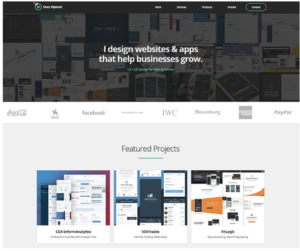
Or look at Matt Olpinski’s site. He’s clearly laid out what he can do for prospective clients looking for a UX/UI designer:
freelance portfolio page

Your “about” page is more about your education, your background, and who you are. The rest of the site should focus on how you can help clients accomplish their goals.

If you’re a copywriter, it makes sense to highlight specific metrics — you’ll triple conversions and increase email open rates, for example.

Beyond playing into the emotional side of the business, you need to spell out exactly what services you provide.

If you’re a writer, mention your areas of expertise: do you cover fashion, food, Apple products? Spell it out.

Beyond niche, what types of services do you provide? Do you write social media captions, blog posts, eBooks, or web copy? All of the above? Make it clear what you provide and what you don’t. This way, you won’t be fielding a bunch of inquiries asking for video scripts if that’s outside of your wheelhouse.

Other important things to include:

  • Call to action: How do you make prospective clients’ lives easier?
  • Lead capture form
  • Contact information
  • Social media links
  • A way to display your projects and any required descriptions

Don’t forget about portfolio rights

Before you begin a relationship with your new clients, you’ll want to set up a contract. Ideally, you’ll want a contract that explicitly states that you can use their non-confidential work in your portfolio.

In some cases, the client might retain rights to your content/design, but it’s smart to build this into the process, as this will provide a steady stream of updated material to use to grow your business.

Know your worth: 5 best salary comparison tools

Are you being paid what you’re worth? Here’s how to find out.

salary comparison

Are you making less than your coworkers? Undercharging clients? Bummed out by wage gap statistics.

Well, you’re definitely not alone.

But making changes requires some research into market rates, experience, and preparing for negotiation.

It literally pays to arm yourself with information, otherwise, you could be leaving some serious cash on the table.

Setting on a number and making the case for it, however, is no easy feat. With that in mind, we’ve put together our shortlist of the best salary comparison tools that provide more insight into how much you should be getting paid for your hard work. Let’s take a look.

5 best salary comparison tools online

Payscale

Payscale

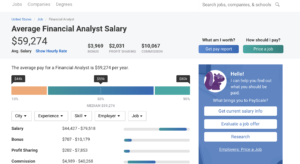
Payscale is a salary calculator that offers a free salary report in exchange for some information from you. The tool will ask you some questions about your background — location, skills, education, title, function, and information about extras like benefits, bonuses, and stock options.

The nice thing about Payscale is, it gives you a snapshot of how you stack up against your peers. There’s a gender breakdown, cost of living calculator, location comparison, and more. What we liked about this tool is — it’s free, yet still provides a lot of useful information about the factors that affect your pay.

LinkedIn Salary

Linked in salary tool

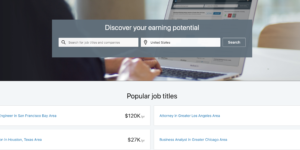
LinkedIn’s salary tool is relatively new, but it provides a long list of salary insights free of charge. Like Payscale, LinkedIn’s tool shows the base salary alongside stock options and bonuses.

The tool can be adjusted to reflect your experience, education, type of company you’re working for, industry, location, and more. According to LinkedIn, their tool is a bit different than the competition, because it provides more context into the why behind salary differences for similar roles.

What’s more, LinkedIn’s aim is to help professionals maximize earning potential by highlighting some of the steps they can take to increase their perceived worth. So, the tool might show that the biggest salary increases come by earning an MBA or taking a similar role in a different industry.

Salary.com

salary.com research tool

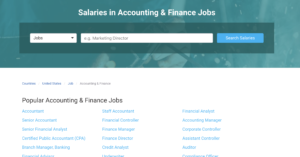
Salary.com is one of the most popular salary sites. The tool lists every position within a field and includes information beyond the cold hard numbers. You can review salaries by industry, career level, and region. The site is one of the older options and doesn’t have the polish you’ll find with some of the other tools.

Still, age is an advantage when it comes to data. The tool is ideal for learning more about similar positions in your area — i.e. how you compare with your peers, but a personalized report will cost you $29.95+. While you’ll get some useful info in that paid report, it’s probably not worth the cash — as LinkedIn and Payscale offer similar insights free of charge.

Glassdoor

glassdoor

Glassdoor is one of the best-known options on the web. The site hosts a comprehensive collection of company reviews and employee feedback, which prove invaluable for job hunters looking for red flags before the interview process is underway.

The platform also provides a solid look at salaries, though it’s a bit different than some of the competitors. Where Payscale and LinkedIn look at salary comparisons by region, field, and other factors, Glassdoor provides specific data for specific companies. What’s more, employees can share information about benefits, interview questions, and what the company culture is like.

SalaryList

SalaryList home

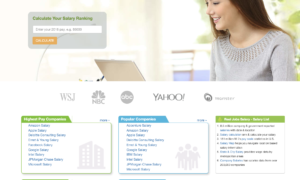
SalaryList gets its data from official company reporting or through the United States Department of Labor, so there’s no question of accuracy here. The site breaks salary info down into a variety of lists: which companies pay most, which roles come with the highest salary, and so on. You can enter your salary to see how it ranks nationally and enter a few more details for a free report.

Wrapping up

It’s a daunting task to determine what your time is worth. And that’s before negotiations and interview awkwardness come into play. Still, doing your research can serve you well. Instead of starting negotiations with an uninformed “I should be paid this much” approach, you’ll have data on your side.
And, when a company comes at you with a low offer, it’s smart to point back at one of the reports generated from any of the apps above. Once you know your worth, that’s where the work begins: perfecting that negotiation game.