UK joins the race with a $273 million AI supercomputer investment

The United Kingdom has announced an astounding investment of $273 million in developing its most advanced supercomputer, the Isambard-AI. This initiative signifies a substantial leap forward in artificial intelligence (AI) computing. With its launch on the horizon, the Isambard-AI is poised to stand tall among the world’s most powerful AI supercomputers.

Reports from NVIDIA suggest that Isambard-AI is primed to outstrip the current fastest supercomputer in the UK by a jaw-dropping tenfold. Its designated home at Bristol’s National Composites Center will feature a top-of-the-line “self-cooled, self-contained data center.” This specialized setup is designed to house and support the tremendous power and processing capacity of the supercomputer, marking a significant milestone in the nation’s technological landscape.

This groundbreaking announcement emerged during the UK’s AI Safety Summit, where leaders from various countries, including the US, gathered to deliberate on AI’s future and associated risks. Isambard-AI’s impact transcends national borders, intending to link up with other supercomputers in the UK. This collaboration aims to bolster and refine the computational capabilities of these systems, collectively driving AI computation to unprecedented levels.

“Frontier AI models are becoming exponentially more powerful. At our AI Safety Summit in Bletchley Park, we have made it clear that Britain is grasping the opportunity to lead the world in adopting this technology safely so we can put it to work and lead healthier, easier and longer lives, Innovation and Technology Secretary Michelle Donelan in an official statement.

Isambard AI features and expectations

  1. Incredible Computing Power: With a capability to perform over 200 quadrillion calculations every second, Isambard-AI marks a new era in computational speed, allowing for lightning-fast processing.
  2. NVIDIA Superchip Configuration: Crafted by Hewlett Packard Enterprise, this technological marvel boasts an integration of 5,448 NVIDIA GH200 Grace Hopper Superchips, the core components driving its exceptional performance.
  3. Exceptional AI Performance: Isambard-AI is projected to achieve over 21 exaflops, equivalent to more than 21 quintillion floating-point operations per second. This immense power is tailored for demanding AI applications, particularly in training large language models.
  4. Location and Infrastructure: Situated at Bristol’s National Composites Center, the supercomputer resides in a purpose-built, self-cooled, and self-contained data center. This innovative setup ensures sustainable and efficient operations.
  5. Strategic Connectivity: The design of Isambard-AI includes plans for collaborating with other UK supercomputers, a move aimed at bolstering its overall computational capacity.
  6. Scientific Advancements: Anticipated to be a pivotal asset for open science and cutting-edge research, Isambard-AI holds the promise of spearheading significant advancements across various scientific domains.

Upon its launch, Isambard-AI stands to become a beacon for open science, as per Simon McIntosh-Smith of the University of Bristol. The supercomputer holds the potential to emerge as one of the most powerful AI systems for open science globally, marking a significant leap forward in technological capabilities.

Celebrating National Poetry Day with ChatGPT’s Masterful Verses

Is a machine capable of creating valid and exciting artistic and creative material? Can an artificial intelligence understand human feelings and make us emotional?

Softonic, my dear friend, your name is synonymous with software. Whenever I need something new, I know I can count on you to help me.” It may not be the best poem ever created, but for a poem created by ChatGPT in just fifteen seconds, it could be worse. Right now, poetry without copyright or human hands doesn’t interest us in the slightest. It has no quality, metrics, rhyme… Or knowledge of human feelings. But this has only just begun.

A poem written by ChatGPT

However, ChatGPT 4 is capable of doing more extraordinary things, such as talking about climate change in Shakespearean style, but it still keeps the question hanging over our heads: Is it art? Is a machine capable of creating valid and exciting artistic and creative material? Can an artificial intelligence understand human feelings and make us emotional?

To prove it, we asked ChatGPT 3 to write us a poem about love and spring. “Love blooms like flowers in spring, when the days are longer and the sun shines brighter. Hearts are filled with joy and hope, as nature renews itself with gentle caresses,” she tells us. She wouldn’t win any contests but it’s only fair to point out that the program was born on November 30, 2022 and she has a lot to learn.

ChatGPT DOWNLOAD

If creativity is the unusual, the unique, the never-before-seen, AI-created poetry lags behind because it is very unlikely that they can, at least for now, do anything other than try to replicate the human brain. Or, put another way, “They are sooner made to imitate than to be original. They learn to say the least surprising thing”, as Guillermo Marco and Julio Gonzalo write in El País.

To put it another way: if the result is fun and original, it’s because the basis itself is. If we ask ChatGPT to make us a Becquer-style poem about a man using a fork to poke into a socket, the result will seem original, but it is only because the initial idea is original: as the program is designed to preserve the meaning of the text, the aesthetic extravagances have to come from outside, with the human hand as the orchestra conductor.

If there is no intentionality there can be no art, and artificial intelligence, however useful it may be, is not yet capable of reflecting and understanding human feelings so much that its poems have a motive or a reflection behind them. Oh, and as you had been left wanting: “A curious man, eager to know, approached the socket with a fork in his possession. But danger lurked there, and his curiosity was going to cost him.” Pure poetry for a day like today.

Sophos harnesses artificial intelligence to turbocharge its free antivirus software

Sophos Home is one of our top recommendations for antivirus software in 2020. Get it now!

Sophos

Since its development in the late 1940’s, artificial intelligence (AI) has been used for everything from game playing to helping to improve healthcare. Broadly speaking, AI involves writing algorithms – a set of rules used in mathematics and computer programming languages – to enable a computer to observe a situation and make decisions that lead to a certain goal. AI has been used, for example, by beer maker Carlsberg to analyze the flavor and aroma profiles created by yeast and other ingredients to then predict how certain recipes will taste – without the company ever having to actually brew the beer.

While AI has taken a while to develop, thanks to more powerful computers and the availability of more digital data than ever before, it is now advancing at astounding speeds. And while it continues to be used in every field from finance to video games, it has been largely absent from the world of cybersecurity. That is now starting to change, with cybersecurity company Sophos helping to lead the way.

While many antivirus programs focus on databases of known malware, Sophos focuses on a specific type of AI called “deep learning” to help its software identify malware that’s never been seen before. Even more remarkably, the company has built this groundbreaking technology into both the free and premium versions of its software.

How it works

Deep learning takes place across computers equipped with neural networks. These networks are basically layers in decision trees used by the computer to process information and then update itself as new patterns emerge. 

For example, a system might have one layer that decides that an image is present on a certain webpage. That page can then be passed to another layer that traces the outline of the image and decides what layer to forward it onto based on the basic shape. The layers get deeper and deeper, allowing the machine to hone its observations and provide remarkable accuracy.

Sophos feeds its neural network over 2.8 million malware samples each week for analysis, deconstruction, and comparison. Because neural networks thrive on enormous amounts of data, this provides the fuel for it to recognize not simply malware code – but malware behavior. This makes it one of the most robust antivirus software programs on the market today, enabling it to not only spot – and stop – widespread malware threats, but smaller anomalies that might just be starting to affect one or two computers on a network. Sophos embeds this technology in its antivirus programs, which is available in both free and paid versions of Sophos Home. 

It’s rare to find such cutting-edge tech in even high-priced antivirus software systems. The fact that Sophos is making it available for free truly shows the company’s dedication to remaining one step ahead of cybercriminals, who are constantly developing more and more complex malware. For this reason, Sophos Home is one of our top recommendations for antivirus software in 2020.


Jobs that won’t be affected by AI

Worried a computer will take your job? Here are some that might be safe.

BulbAlright, so we admit: this is all speculation. Artificial Intelligence definitely could, and probably will, affect everything.

We’re not going to discuss whether or not AI is dangerous or not. Frankly, we find it hard to be overly concerned about the possibility of artificial intelligence destroying all of humanity. Why?

Partially, this may be due to the fact that there are great people like Elon Musk using programs like OpenAI to ensure artificial intelligence benefits humanity. Or, it could be one of a huge number of other reasons including, but not limited to: super-intelligent general AI may never exist, if we all die that’s that, and finally, everyone’s tired of worrying whether it’s reasonable to continue existence as energy-inefficient, carbon-based life forms.

Moral quandaries posed without sufficient data is one of the many things that makes you humans so inefficient in the first place.

So, let’s talk about the…

Jobs that won’t be affected by AI

Sports!

Remember when your parents tried to make you join track, baseball, curling? Well, you shoulda listened!

Sports, objectively speaking, are the most anti-AI job around. The very composition of these competitions necessitates human involvement from the players, because such challenges themselves revolve around people – real people – growing stronger. Getting faster. Developing coordination. Working as a team to beat the others.

Basically, offices can replace a worker with a machine and still be an office. A football team can’t replace their quarterback and be called a football team. At least… not for a long while.

So, the real question is, how will AI change sports?

We believe the most likely effect will be data management (a regular theme for AI, it seems).  Coaches will likely use AI-developed metrics to search for new players and design better practice routines to suit their current players.  The business side of sports has a number of great needs that AI could fulfill. However, this will not so much change the business as improve how teams operate, furthering what modern technology has already accomplished.

Art and Creativity

Art2

Oof. Danger zone.

Already, many AI programs have been employed to write scripts. It goes like this: someone pours a bunch of screenplays into a processing algorithm to see what the machine spits out. The results can be pretty crazy:

Yeah, that’s a Burger King ad written by AI. The future is bright!

But seriously, there may come a time when artificial intelligence can develop more than just weird ads and will develop great stories with well-rounded character development and detailed worlds. What happens then?

First off, we believe that will take a much longer time than it seems. Modern computers can easily compute “big data,” and string together streams of words based on inputs. Both those things are far removed from the synthesis required for creating a story.

It’s an even more difficult form of the Turing Test. The Turing test judges a machine’s ability to mimic (emphasis on “mimic”) human behavior in such a way that someone conversing with the computer couldn’t tell the robot from a human. Developing a coherent story requires far more than responses to inputs, the process demands true imagination and understanding of plot, character, locations, and theme.

Second, let’s say AI reaches that point. Even then, much of art, by its very definition, revolves around the outer expression of inner human emotion. Unlike a script, a painting often must be judged on the artist’s intent. As with sports, taking people from the equation removes the value of effort and expression, meaning there may always be value in creation.

Music is already under assault by some surprisingly good AI composers, however:

Law Enforcement

Right now, robots are used by police forces for such tasks as bomb disposal and even then, they are remotely controlled rather than autonomous. AI is used for license plate recognition and more, but never for field work.

We expect it will take many years before the general public trusts AI enough to give it a place alongside officers in robotic form. Even when this does occur (which we believe it will), we predict they will only be trusted with nonlethal measures.

After this, it’s possible AI will become the majority of the police force.

Why? An autonomous robot can use nonlethal force without risking its own “life” in dangerous situations a human officer shouldn’t enter without the sufficient protection of a firearm. As the technology and robotics required become less expensive, they will begin to have more functions like facial recognition, evidence management, and so on.

Therapy

Psych

…and psychology, to a lesser extent.

As you may have noticed, aside from jobs that require humans by sheer definition (sports and art), the jobs least likely to be affected by artificial intelligence are those dealing with sensitive human matters. Basically, any job where you wouldn’t want to see a robot working will keep humans around… temporarily.

Therapy relies on a delicate relationship between two people. Unlike movie therapists (who are generally worthless and often tell kids running from real monsters that “it’s all in your head, kid, you’re totes crazy”), real-life practitioners are experts in helping people get to the center of their problems and finding a way to defeat them. We suspect even if a robot could pass as a human, the knowledge that no warm-bodied person is present would make most people ill at ease.

And we’re a long way from robots that advanced.

On the psychology side, however, things could go either way. A robot adept at recognizing body language and speech patterns could use a patient’s data to more reliably provide accurate analysis. The question is: would a visitor be more likely to act natural around a human, or a robot? Humans provide more of a physical presence, but sensitive topics may be easier handled with a friendly robot.  Once again, we need more information to decide.

Ministry

Praya!A common phrase in church goes: “If AI takes over pastoral jobs, I’ll be a monkey’s uncle.”

Okay, that’s totally not a phrase. But congrats, you’re paying attention!

Many, if not all faiths, rely on a human element due to their belief in a soul or reincarnation. With that idea in mind, what rational churchgoer would want the word of God preached by a soulless machine, no matter how lifelike it seems?

Now, we could talk all day about the ramifications that a “godlike” AI could have on humanity’s belief in a higher power, but we’re not going to. We’re just not.

Termination

This is the end.

Of the article.

If you have a few suggestions for occupations that are AI-safe for the time being, please let us know below! Specifically, do you think robots will take over the dental industry? Yes, that’s a pretty specific question, but we were on the fence about it and thought you might have an idea.

Modders are using AI to upgrade retro games

See how AI is making old games look better than ever.

HD remasters are a staple of the modern gaming world. Whether it be full rebuilds like Resident Evil 2, or simple graphical upgrades like the forthcoming Jak and Daxter collection, the best games of yesteryear are still keeping up in the modern era. Unfortunately, not all retro games can get remasters. That said, fans don’t need to despair. Artificial intelligence is making it easier than ever for modders to give retro games impressive graphical upgrades that rival any modern remaster.

Modders are using AI to upgrade retro games

elder scrolls 3 morrowind remaster
Image courtesy Daniel Trolie

AI “machine learning” recently took center stage as a major part of Google’s ambitious Stadia project. Essentially, AI systems use given data sets to “learn” and apply patterns to other sets of data. Google showcased this machine learning tool by showing its ability to use source images to apply an art style or palette to an entire game.

This machine learning ability is what’s enabling modders to create these impressive graphical upgrades. In this case, the process is called AI upscaling. When an AI system is fed a low-res image of a graphical asset, it will automatically upgrade the asset by adding pixels to create a stunning new version.

mass effect 2 liara hd upgrade
Image courtesy A Lot of Textures Mod

These AI networks work by literally learning. By feeding networks both low and high-res images as examples, the AI will begin to train and start to tell the differences between the two image types. After identifying a low-res image, it will start the process to upscale and add additional pixels to create a high-res version. Some companies, such as Topaz Labs, offer pre-trained AI networks for use by the modding communities.

It’s a surprisingly quick process, but doesn’t always churn out results that are worthy of a final product. Modders still have to put in quite a bit of work to polish and tweak the resulting visuals. The r/GameUpscale subreddit is a community devoted to sharing the best techniques, tips, and tricks to get the most out of the AI upscaling process. Even after an AI upscale, most assets will still take several hours to polish. In the case of an AI upscale mod for the classic Doom, over 200 hours of work were reportedly required on top of the results created by the AI upscaling process. Compared to starting an HD upgrade from scratch, this is still amazingly fast.

final fantasy viii hd upgrade
Image courtesy Stefan Rumen

The results are nothing short of astonishing. Over the past six months, the AI upscaling community has been churning out mods at a rapid pace. Gamers can find graphical upgrades for classic titles like Mass Effect 2, Half-Life 2, Elder Scrolls III: Morrowind, and Final Fantasy VII. The full potential of these tools has yet to be realized, but it could mean great things for more nostalgic fans. In the case of older games created by now-defunct studios or games where rights are tied up in the legal system, fans can now receive HD remasters that might not have been possible otherwise.

AI is here to debate humans – now what?

Discover why an AI capable of debate could be good for humans.

AI IBMYou may have already heard the news: IBM developed an artificial intelligence program that can form logical, persuasive arguments. You can see the program in action in the video below.

The tech has been in development for a few years. Last year, IBM took it out to debate with real humans, and again, rolled it out for this year’s Consumer Electronics Show.

The show was an opportunity to showcase a new feature called Speech by Crowd, which IBM describes as a cloud-based AI platform used for crowd-sourcing decision support. (Huh?) What that actually means is that the technology aims to understand how people feel about a specific decision — like a proposed policy or a reaction to a speech.

Where this will most likely be applied is in the ever-expanding realm of customer experience — potentially allowing brands to gather richer feedback like customer satisfaction.

Project Debater is a big step toward understanding language

Project Debater’s arguments feel a little cold and formulaic. If you watch any of the videos, you’ll see the calculated, robotic logic at play. What were you expecting?

Here’s a video that goes into great detail as to how the bot works:

We’re one big step closer to robot-human understanding, making this technology a huge milestone.

The Project Debater bot is powered by a mashup of multiple AI principles and algorithms. To start the debate, the robot is given a topic. It scans a database of articles and academic research, sorts through that information to find pieces of text that are both relevant and take on an argumentative tone.

Another algorithm looks for duplicate snippets and eliminates them from its collection of verbal ammunition.

During the debate, a voice recognition system listens to the opponent’s argument — and generates relevant counterpoints.

Where does a debating robot fit into real-world applications?

AI at workA debating robot may not change our day-to-day lives. It’s unlikely that struggling high school debate teams can sneak the bot dressed in jeans and a T-shirt into a competition for a little help.

Project Debater’s greatest strengths are extracting facts from huge amounts of text. It could be useful in classroom settings, or as a way to address the fake news problems we’ve seen on Facebook, Twitter, and WhatsApp.

That said, IBM has not made it clear how the bot determines what information is factual and what is biased.

The way that the robot currently expresses arguments still feels a bit, well, robotic. Noam Slonim, the principal investigator for the project, says scientific research will be the most immediate application.

What’s next for Project Debater?

Some people are worried that Project Debater represents the next step toward the robot apocalypse. We’re not so sure that IBM is the equivalent of Skynet, but time will tell. What’s so neat about IBM’s latest publicity stunt is that it shows advancement in understanding human sentiment.

Yet, IBM still hasn’t figured out the algorithm that powers feelings. Yes, the robot nails the formula the debate — but that lack of passion or emotion means we’re not replaceable yet. Heck, the debating bot even lost its last match on preschool subsidies just a few weeks back.

It’s exciting to see “Miss Debater” offer up her fact-based arguments. If IBM’s version of the truth matches up with basic journalistic ethics, this could be a really amazing asset — a logical counterpoint to our human emotions.

How humans and AI are currently working together

Will AI take your job, make your life better, or both?

humans and robots

Artificial intelligence has become good at so many things we once believed were the domain of humans and humans alone. From providing top-notch customer service to diagnosing cancer, bots are beating us in all kinds of industries from logistics to medicine.

We talk about collaboration a lot, but generally, it’s between humans working together toward a common goal. With robots, we’re dealing with a new class of coworkers, those with contrasting strengths and perhaps, less capacity for humor.

Companies like Tesla, Apple, and Facebook lead the charge on technological advances, but artificial intelligence has made its way into businesses of all sizes. Only about 41% of adults support advancing AI, and those folks tend to be wealthy, tech-savvy males.

Those who stand to see an influx of these new coworkers likely won’t fit the description of your average AI enthusiast.

Here are some examples of how humans and bots are already working together:

Chatbots — retailers across the board

Chatbots are the most obvious example of automation in the workplace — or at least the most visible sign of change.

Chatbots offer 24-hour support and the ability to take on tedious customer service tasks and free up support staff. According to a report from Juniper research, chatbots will bring roughly $11 billion in cost savings by 2023 across healthcare, retail, and financial services sectors.

Today’s customers care most about receiving top-notch service at their convenience, so the industry-wide investment in chat makes total sense. Gartner predicts that AI will take over more customer service tasks, which allow companies to better manage the customer experience.

Dealing with more automation is changing the role of the customer service rep, to be sure. On the human side, this role is more strategy-based — focused on improving the customer experience at every touch point.

Tech-enhanced brick and mortar staff

Marty

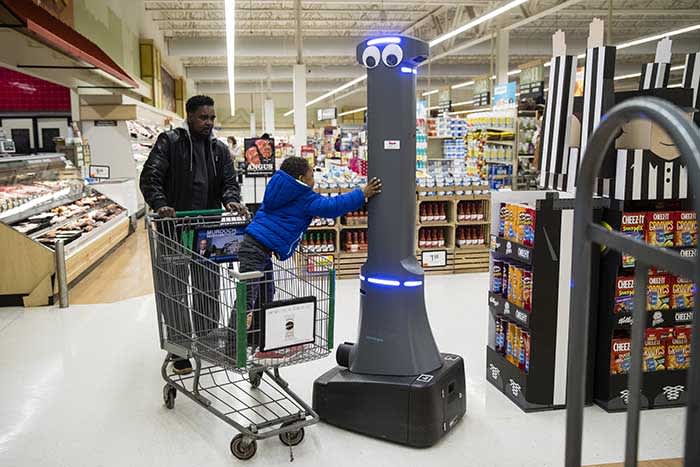
Marty is a tall gray robot that can navigate grocery store aisles on its own, using a collection of cameras and sensors to find and report safety issues like spills. Giant Food Stores have plans to add Marty robots to all of the chain’s 172 locations. Marty’s main purpose is to spot hazards, but other robots offer shoppers and stores a variety of benefits.

There’s the LoweBot, an autonomous service robot there to help customers find items and answer basic questions. The bot has been around for a couple of years now, and helps users figure out what type of tool they need and can process requests in multiple languages. Additionally, the LoweBot can help workers keep track of inventory.

Walmart’s autonomous scanners reduce issues caused by frequent stock shortages. The big box chain says that unavailable items are a major pain point for customers, and it can be a time-consuming task for employees to scan for items that customers can’t find.

Robot janitors

Walmart is about to unleash an army of robotic janitors in their stores. The company put out a call for bids and recently announced a partnership with a company called Brain Corp. Walmart will employ 360 cleaning machines, equipped with a platform called BrainOS.

The goal is to keep the stores sparkling clean with no human oversight required. The existing scrubbers require a human operator to guide them down the store’s aisles each time the store needs to be cleaned. The initial onboarding phase requires someone to ride each robot around the entire store, so it memorizes the layout. After that first ride, the robot is ready to work without a human on its back.

Walmart says that the aim of this new initiative is to allow employees to focus on helping customers, rather than performing tedious cleaning tasks.

Because the stores are currently in the midst of training the robot janitors, we don’t know how this will impact employees. As it stands, Walmart employs more workers than any other U.S. company, so it could have a negative impact on the economy.

Robots in the medical sector

medical robot

Given the startling statistics regarding patient infections in hospitals, medical staff need all the help they can get when it comes to keeping things germ-free. A study by the CDC found that using germ-killing robots can reduce the rate of hospital infections by 30 percent.

Vanderbilt University Medical Center has started using robots to do follow up job after humans perform normal sterilizations. The robots use ultraviolet radiation to kill germs, which allows hospitals to catch germs that human cleaners leave behind.

There’s also robotic surgery. The concept isn’t exactly new, but technology has improved dramatically in recent years.

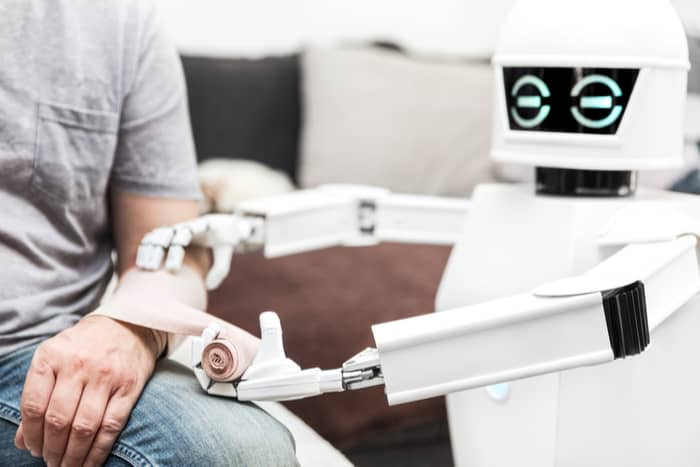
The Senhance System is a surgical robot that was just cleared by the FDA for use in minimally invasive procedures. How it works is, surgeons use software to control surgical instruments, performing surgery remotely using three separate robotic arms. Senhance-based surgery stands to improve patient outcomes

Wrapping up

Resistant as we may be to tech entering the workplace, we won’t be able to avoid it for long. It’ll be interesting to see how human job descriptions and duties shift in roles like customer service and medicine.

Customer service is becoming a more skilled job than it has been in the past. The role is now more strategic than being on hand to answer calls and assist customers. Medicine stands to change in the way that doctors might increasingly work with software, rather than directly performing surgery.

It seems robots are fitting in okay, though they’re still relatively new at this whole workplace thing. In the end, we will have to rethink the human scope of work — and find roles that align with every skill set.

AI and the media — what’s next for news of the future

Will AI help the news or destroy it?

News organizations have lost the power to define what is and isn’t news. Instead, social media channels and aggregators have called the shots, capitalizing on algorithms that directly impact the content that users see, as well as the type of content that gets created.

Marketing and advertising have been capitalizing on AI innovations for years, to the detriment of reliable news.

By contrast, few media outlets have harnessed the burgeoning technology successfully. Yet, AI offers a ton of promise for the media industry.

What stands in the way of AI adoption on a mass scale? Here’s a look at some of the challenges and emerging trends within the space.

Where are we at with AI and the news?

ai news

China rolled out their artificial intelligence news anchor a few months back. The Washington Post has been using their robot reporter for a couple years at this point. Other news organizations are using AI to help journalists analyze datasets that inform their reporting.

Then there’s the question of whether AI can write articles. The answer is, they can. However, writing is best done by a human, as it requires art, creativity, and empathy. Otherwise, you get something like this.

The best application is using robots as a resource for finding plagiarized content and errors and analyzing statistics. Or, perhaps, running a media bias fact check.

These elements come together for more accurate reporting — and let writers cover more ground in less time.

We’ve found that there actually are a lot of places where the media is taking advantage of the new technology. The problem is, like the artificial intelligence news anchor and the reporter bot, the news media has been using AI in these novelty applications.

Unfortunately, they haven’t been able to use it in the same ways that advertisers have — and are struggling to monetize.

Why is that?

One thing slowing down mass AI adoption — at least on the distribution side is the business model. TV news is funded by advertising shown during commercial breaks.

Companies that use AI for advertising or content distribution make money by selling products or through ad revenue. So, content that’s interesting gets top billing over balanced, unbiased reporting on unsexy topics like local news coverage or regulatory issues.

Some online news organizations now make money through digital subscriptions. Which, of course, is an alternative to the aggregator model which depends on behavioral targeting, clickbait, and promoting video content over the written word (customers see more ads, so more money).

News by virtual assistant

Smart speakers like Alexa, Google Home, and Cortana are giving people an easy way to get their daily updates from news organizations.

As such, several media outlets are beginning to experiment with how these digital assistants can help them deliver the news more effectively. According to Trushar Barot, of Harvard’s Nieman Lab, newsrooms predict that AI-driven interfaces could have a greater impact on how we consume information than the iPhone.

That same article then mentions that these organizations say, “they’re not technology companies.” Yet, automatically generated voice content is the next great threat to journalism.

That said, not every news organization is sitting around ignoring innovation. NPR has been working on voice AI. NPR product manager Ha-Hoa Hamano says the broadcaster’s hourly newscast is a gateway to the rest of NPR’s content, allowing them to reach the 32% of 18-34 year-olds who don’t have a radio.

Lack of industry standards for AI practices

The media have been reporting on AI since day one. Yet, using the black box algorithms responsible for promoting fake news hasn’t been part of the strategy. Responsible journalists can comment on these changes and continue to publish articles — and they should. But, it’s going to be hard to enact change if things keep going as is.

While newsrooms understand content and the process of creating quality content in a short amount of time, the next step is joining forces with sophisticated tech teams to reach a larger audience.

The robot hiring manager — impartial recruiter or totally biased bot?

Changing up the interview process to improve diversity in the workforce is one of the top priorities amongst large tech companies looking to bulk up their staff.

Unfortunately, depending on the human mind to make impartial hiring decisions means dealing with the hidden biases we hope don’t see the light of day.

The idea of adding the robots to the decision making process is to screen applicants based on logic — finding the right person for the job, regardless of race, gender, background, and so on.

So, it kind of makes sense right? After all, artificial intelligence stands to be this beacon of equality, hiding demographics and matching candidates based on skill, before the humans get to them, equipped with harmful biases.
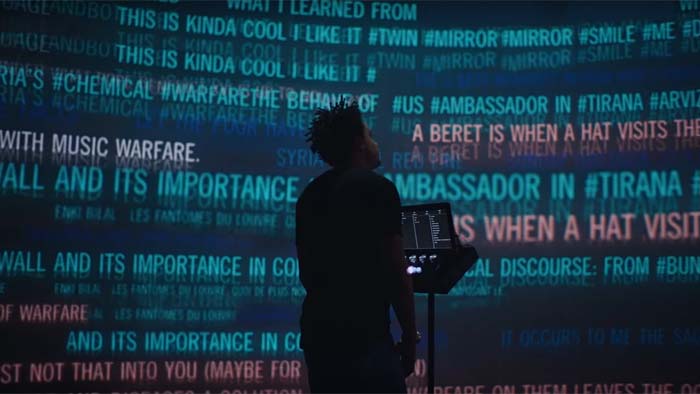
The future of an AI HR department

Robo-hiring

How is the technology being used today?

These days, robots are part of the hiring process, but generally relegated to the initial screening process. For example, you might get a phone interview with a company, but rather than talk to a person through the phone or video conferencing app. You’ll answer a series of questions for a robot, who later applies an algorithm to your answers to gauge compatibility.

Companies like HireVue are supplying technology to companies like Goldman Sachs, Under Armour, and Unilever, among others. The platform gives all applicants the same set of questions, which HireVue says helps eliminate biases.

Proponents of AI-based hiring say it’s a means of streamlining the hiring process. And, it’s easy to understand the appeal. The process saves companies time and allows them to sort through more candidates than ever.

interview

Unilever has been using artificial intelligence to screen entry-level employees for nearly two years now. Their process screens candidates by asking them to play neuroscience-based games to measure traits like risk management or the ability to read contextual clues.

If applicants make it through the games phase, they’ll then continue onto the interview process — where they’ll record their answers to a series of interview questions. Interviews are not live. Instead, the AI analyzes each of the answers, scanning for keywords, body language, and intonation.

A company called Pymetrics is the name behind the games and advertises their service as a way of “matching talent to opportunity, bias-free.”

How it works is, participating companies have existing employees play the game. Pymetrics analyzes the data to pick out specific trends, then builds algorithms that scan for likelihood to succeed. Prospective candidates, like in the Unilever example, play the games and match to opportunities.

What are the advantages?

On the employer side, there’s the element of convenience, of course. For Unilever, the company found that the AI enabled them to hire more nonwhite employees, as well as entry-level staff from a wider range of colleges than they did before adding the technology to their recruiting strategy.

Employers are also hoping that the process can reveal the smaller things that humans miss during the interview process.

According to a CNN Tech article, companies are looking toward pre-employment lie detector tools that help companies see when an interviewee is embellishing their qualifications. While honesty is typically the best policy, we have to say the facial scanning is a bit creepy.

The advantages on the employer side are clear — obviously, the streamlined method benefits recruiters and companies more than the person who needs a job.

But, there’s some evidence an AI-guided experience could have some positives for the job seeker, as well. For example, chatbots can help candidates navigate complex application instructions — and the potential to reduce bias promises greater ethnic and economic diversity in the workplace.

But, there’s always a dark side

Many AI technologies are still in their early stages. So, the main risk for employers is that they’re looking at a solution that isn’t yet proven.

And, when you’re considering AI options that analyze candidates’ word choice, tone, and body language, you might be missing out on some awesome candidates that are — say, fidgety or uncomfortable while recording responses.

Cornell professor Solon Barocas spoke with the Washington Post and warned job hunters to be wary of any company who is using an algorithm in place of an actual hiring manager.

The professor highlighted Amazon’s failed experiment using an algorithm to evaluate job applications. In it, Barocas suggests companies should err on the side of caution when applying AI to these decisions that do, have significant effects on peoples’ lives.

algorithm

Algorithms, of course, come with their own biases, as engineers bring their own baggage to the table during development.

So, last month, Amazon scrapped its AI recruiting tool, after it was revealed to have some sexist inclinations.

The reason for this is, U.S. tech companies are still struggling to close the gender gap among developers and other technical positions.

Amazon’s AI engine primarily trained by male developers, and had started penalizing women’s resumes. In fact, even the word, “women’s,” prompted the AI to downgrade resumes from applicants who attended women’s colleges or listed accomplishments like “captain of the women’s basketball team.”

That issue might be a relatively easy fix for the company, but there’s also the issue of masculine language and job applications. Meaning, there’s a chance that applications like HireVue hold some biases themselves, in spite of their efforts to eliminate the ugly side of recruiting.

For example, the technology was found to place higher value on “aggressive” words like captured or executed, more common on male engineers’ resumes.

The tool’s inherent gender bias wasn’t the only problem. Another major issue came in the form of data problems, with the AI firing off recommendations at random. Researchers found the tool was matching under-qualified candidates to positions that were far outside their pay grade.

Of course, that’s just one example. But, the fact that algorithms are scanning for job qualities based on existing top performers, it’s hard not to wonder if they’re scanning for the same old masculine power words and mannerisms—rather than aiming for diversity in a more subtle sense.

The Washington Post article points out that an algorithm trained to match candidates to top performers based on performance reviews is already set up to reinforce biases.

They give the example of a female leader given low marks on a performance review for being too assertive while being an aggressive seller might be seen as an asset in a different context.

The point is, artificial intelligence doesn’t replace the recruiter’s job. There will always be the need for the human hand in the decision-making process.

Face-generating website is a catfisher’s dream

None of the faces you’ll see here are real.

If you’ve ever watched the MTV show “Catfish,” you know that sometimes, online identities don’t match up with the real thing. The series follows people who fall in love online, only to discover that the face they came to love didn’t belong to the person who sent them online messages.

Usually, the fake identities were discovered with the help of Google’s reverse image search. Upload an image and Google will show you where else it may appear online.

But you could more easily disguise your identity if the photo in your profile picture exists nowhere else on the web. That’s where ThisPersonDoesNotExist.com comes in. Every time you load the page, you’ll get an AI-generated face that doesn’t belong to a real person. Some of them are quite good.

AI-generated face

AI-generated face

AI-generated face

Some of them… are not as good.

AI-generated face
If Donald Trump had a baby with Ruth Gordon from “Harold & Maude”

AI-generated face
Eye contact was always a problem for Brad.

AI-generated face
A beautiful woman and her terrifyingly deformed friend.

AI-generated face
You will never sleep again.

So, yeah, not every AI-generated face will be a winner, but every time you refresh the site, you’ll get a new face.

Despite the occasional monster face, the technology is impressive. And you have to imagine a future where all of this gets much, much more sophisticated. Thanks to deepfake technology, we can map faces on videos of other people’s bodies. In the future, we may be able to project entirely different faces on top of our own, like those goofy “Mission: Impossible” masks, but holographic and on-demand. The future is simultaneously bright and terrifying. Stay vigilant out there, and if you see the creature in that last picture, run.