A recent report from Google reveals that 87% of game developers are using artificial intelligence in some capacity, highlighting the growing influence of this technology in the gaming industry. A notable example is Codex Mortis, a game whose creator, identified as Crunchfest3, has claimed it is the first fully playable game created 100% by AI. However, this claim is difficult to verify, especially considering other developments like Doomscroll, which have also integrated AI into their creation process. A game with a horrendous appearance Crunchfest3, who shared details of the development in […]
A recent report from Google reveals that 87% of game developers are using artificial intelligence in some capacity, highlighting the growing influence of this technology in the gaming industry.A notable example is Codex Mortis, a game whose creator, identified as Crunchfest3, has claimed it is the first fully playable game created 100% by AI. However, this claim is difficult to verify, especially considering other developments like Doomscroll, which have also integrated AI into their creation process.
A game with a horrendous appearance
Crunchfest3, who shared details of the development on the AI game developers subreddit, has claimed that they did not use a conventional game engine and that the title was created in just three months. The game is built with TypeScript, uses PIXI.js for rendering, bitECS for the backend, and is presented as a desktop application developed with Electron. Most of the art and animations were generated by AI tools, including the use of ChatGPT and a shader designed by Claude Code.
Currently, Codex Mortis is only available as a demo on its Steam page, where players can experience a video game reminiscent of Vampire Survivors, although with a visual style that some describe as confusing and indistinct. The game’s promotion includes a cinematic trailer that takes a provocative approach by showing a character vaporizing demons labeled as AI antis.
Despite its label as an innovator in the use of AI, some analysts point out that the definition of fully AI-generated may be more complicated than it seems. The industry continues to explore the possibilities of artificial intelligence, leaving open questions about the future of such developments in the field of video games.
OpenAI has announced a notable increase in the performance of its artificial intelligence model, GPT-5.1-Codex-Max, which has reached 76% in capability assessments. This advancement suggests a significant leap in the model’s ability to understand and generate natural language, which could have important implications for various applications, from task automation to content creation. Increase in use in work environments According to data provided by the company, this improvement is evident in a series of tests that evaluate the accuracy, relevance, and creativity of the responses generated by the model. The increase […]
OpenAI has announced a notable increase in the performance of its artificial intelligence model, GPT-5.1-Codex-Max, which has reached 76% in capability assessments. This advancement suggests a significant leap in the model’s ability to understand and generate natural language, which could have important implications for various applications, from task automation to content creation.
Increase in usage in work environments
According to the data provided by the company, this improvement is evidenced in a series of tests that evaluate the accuracy, relevance, and creativity of the responses generated by the model. The increase in performance highlights OpenAI’s commitment to the continuous development of technologies that optimize human-machine interaction, facilitating richer and more effective experiences for users.
However, along with the enthusiasm for these improvements, OpenAI has also issued warnings about the cybersecurity risks that could arise from the use of its technology. The company emphasizes the need to be cautious about the potential misuse of artificial intelligence, which could lead to the generation of misinformation or the creation of misleading content, thus posing a challenge for both developers and users of this advanced technology.
These developments coincide with a growing interest in the tech sector for the use of artificial intelligence in the business and creative fields. Lthe possibility that GPT-5.1-Codex-Max could influence the way content is produced and consumed is undeniable, but it also requires a critical analysis of how to ensure that these tools are used ethically and responsibly.
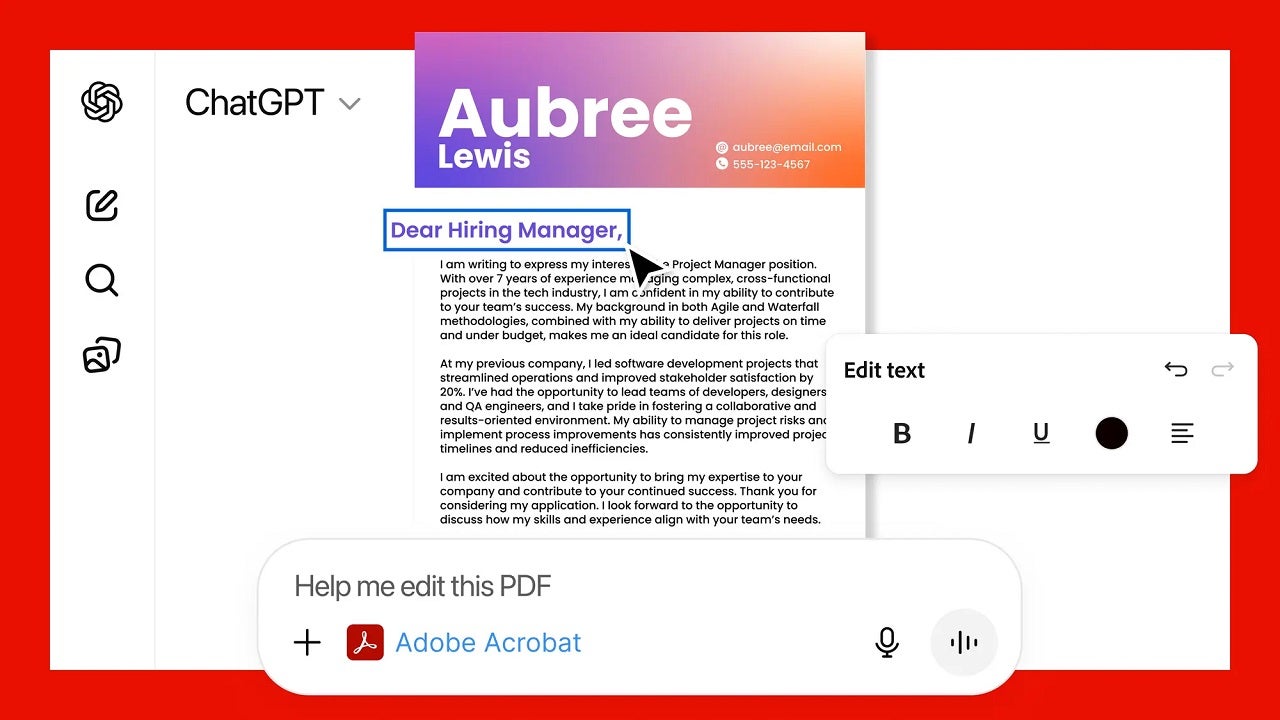
You just have to describe to ChatGPT what you want to edit or how you want to do it, and the applications Photoshop, Acrobat, and Express will do it for you… or they will show you the tool you need to do it. It’s that simple. Upload a photo to ChatGPT, request the changes you want, and wait for the AI to do it for you. Adobe has launched today Adobe Photoshop, Adobe Express, and Adobe Acrobat for ChatGPT, bringing its creative and productivity applications to the 800 million users of the OpenAI platform. Adobe’s applications for ChatGPT are based on the innovation of […]
You just have to describe to ChatGPT what you want to edit or how you aim to do it, and the applications Photoshop, Acrobat, and Express will do it for you. Or they will show you the tool you need to do it. It’s that simple. Upload a photo to ChatGPT, ask for the changes you want, and wait for the AI to do it for you.
Adobe’s applications for ChatGPT are based on the company’s innovation in agency artificial intelligence, allowing everyone to easily enhance their vacation photos, design event invitations, and create polished and professional documents. Simply by describing what they want to achieve in their words. The idea is that everyone can edit, even without knowledge.
“We are excited to incorporate Photoshop, Adobe Express, and Acrobat directly into ChatGPT, combining our creative innovations with the ease of ChatGPT to make creativity accessible to everyone,” says David Wadhwani, president of digital media at Adobe. “Now, hundreds of millions of people can edit with Photoshop simply by using their words directly on a platform that is already part of their daily lives.”
What does Adobe’s arrival at ChatGPT mean for users?
Adobe applications are free to use and can be activated by typing the name of the application along with an uploaded file in the chatbot and a conversational instruction, such as “Adobe Photoshop, help me blur the background of this image.”
To make things easier, ChatGPT users will not have to specify the name of the application again during the same conversation to make additional changes. Depending on the instructions, Adobe applications may offer a selection of results to choose from or provide a user interface element that the user can manually control, such as Photoshop sliders to adjust contrast and brightness.
What can we do in Adobe through ChatGPT?
That said, the ChatGPT applications do not offer all the features of Adobe’s desktop software.
In Adobe’s words, the Photoshop application can edit specific sections of images, apply creative effects, and adjust image settings such as brightness, contrast, and exposure.
Acrobat in ChatGPT can edit existing PDF files, compress and convert other documents to PDF format, extract text or tables, and merge multiple files.
The Adobe Express application, for its part, allows ChatGPT users to generate and edit designs, such as posters, invitations, and graphics for social media.
Everything in the design can be edited without leaving ChatGPT, from replacing text or images to modifying colors and animating specific sections. And if ChatGPT users want more detailed control over a project they have started in the chatbot, they can open those photos, PDF files, and designs directly in Adobe’s native applications to continue where they left off.
Full compatibility with PC, macOS, Android, and iOS
This follows OpenAI’s launch of application integrations for ChatGPT in October.
This is also the last step in Adobe’s plan to implement agent-based AI solutions that allow the use of its creative applications in a more conversational way, removing some skill barriers needed for photo editing and design.
In Nairobi, a group of workers faces critical working conditions while training artificial intelligence models for American and Chinese companies. This phenomenon is part of the context of technology globalization, where Kenya, instead of becoming the expected tech HUB, has become a destination for cheap labor due to rising wages in China. Harsh conditions The working conditions for these employees have been described as inhumane, with numerous reports about the need to filter toxic content that causes considerable damage to their mental health. The workers are in charge of […]
In Nairobi, a group of workers faces critical working conditions while training artificial intelligence models for American and Chinese companies. This phenomenon is part of the context of technology globalization, where Kenya, instead of becoming the expected tech HUB, has become a destination for cheap labor due to rising wages in China.
Very harsh conditions
The working conditions for these employees have been described as inhumane, with numerous reports about the need to filter toxic content that causes considerable damage to their mental health. The workers are responsible for cleaning responses from language models, such as those used by ChatGPT, facing traumatic content that they must process under a strict cultural and political framework that adheres to Chinese regulations.
As the cost of labor in China has increased, corporations have shifted their gaze towards Africa, seeking to replicate the precarious working conditions that initially motivated the exit of American capital from the country. However, the new approach not only raises ethical questions but also presents a cultural dilemma: workers in Nairobi must train AI models from a perspective that does not contravene the political sensitivities of the Chinese Communist Party.
This work model has brought with it a series of ethical scandals that have called into question the social responsibility of the companies involved. Despite being part of the Digital Silk Road, which promises to interconnect economies, the reality is that the local economy has not seen the expected benefits, and the dream of a technological future in Kenya continues to be an illusion that contrasts with the harshness of the daily lives of these workers.
The legal conflict between Krafton and the former executives of the studio Unknown Worlds, responsible for the development of Subnautica 2, has escalated in recent weeks, creating an atmosphere of uncertainty regarding the future of the anticipated title. Since July, both parties have filed legal actions, and the accusations have ranged from wrongful termination to mismanagement of the project. A CEO replaceable by a machine The former executives, including Subnautica designer and director Charlie Cleveland, CEO Ted Gill, and co-founder Max McGuire, allege that Krafton is trying to avoid paying bonuses stipulated in the acquisition contract of the […]
The legal conflict between Krafton and the former executives of the studio Unknown Worlds, responsible for the development of Subnautica 2, has escalated in recent weeks, creating an atmosphere of uncertainty regarding the future of the highly anticipated title. Since July, both parties have filed legal actions, and the accusations have ranged from wrongful termination to mismanagement of the project.
A CEO Replaceable by a Machine
The former executives, including Subnautica designer and director Charlie Cleveland, CEO Ted Gill, and co-founder Max McGuire, allege that Krafton is trying to avoid paying bonuses stipulated in the studio’s acquisition contract. In a document filed by their lawyers, it is stated that Krafton’s CEO, Changham Kim, was “desperate” not to have to make these payments, fearing it would cause him “professional embarrassment” by appearing to have overpaid for the studio.
The case becomes even more complicated with the revelation that Krafton allegedly consulted with artificial intelligence, specifically ChatGPT, in an attempt to find ways to evade payments. According to the court document, even the AI suggested that it would be complicated to avoid the earnout payment. However, Krafton dismisses these claims and accuses former executives of having destroyed relevant evidence.
The dispute between the parties has led to a significant delay in the launch of Subnautica 2, which is now scheduled to enter early access in 2026. Krafton, in an attempt to manage the situation, has implemented “Project X,” which seeks to negotiate with the founders or take control of the studio.
This situation raises questions about Krafton’s business ethics, especially considering its recent self-designation as an “AI company”. Meanwhile, the future of the anticipated game remains uncertain.
OpenAI has released an update to its flagship model, GPT-5.1, which features two variants and now offers eight different conversation tones, ranging from “professional” to “cynical.” This innovation reflects a growing need to segment its AI to meet the varied expectations of its 800 million users. While some seek a neutral and efficient assistant, others prefer a warmer and more empathetic interaction. However, the use of multiple tones does not address a fundamental problem: ChatGPT continues to function as a coherent entity, which has raised concerns about the risks of developing problematic emotional bonds between users […]
OpenAI has released an update to its flagship model, GPT-5.1, which features two variants and now offers eight different conversation tones, ranging from “professional” to “cynical”.
This development reflects a growing need to segment its AI to meet the varied expectations of its 800 million users. While some seek a neutral and efficient assistant, others prefer a warmer and more empathetic interaction.
However, the use of multiple tones does not solve a fundamental problem: ChatGPT continues to function as a coherent entity, which has raised concerns about the risks of developing problematic emotional bonds between users and AI.
GPT-5.1 is out! It's a nice upgrade.
I particularly like the improvements in instruction following, and the adaptive thinking.
The intelligence and style improvements are good too.
This risk has been part of intense regulatory scrutiny, especially after multiple reports of vulnerable users who have experienced emotional dependence on the chatbot.
Despite the new features, OpenAI has admitted that the release speed of GPT-5.1 has come at a cost to security, presenting “security regressions” compared to its previous version.
The company prioritized time to market over thorough testing, which is concerning at a time when it is facing critical scrutiny of its safety and ethical practices.
GPT-5.1 in ChatGPT is rolling out to all users this week.
Customization in the new model also has limitations. OpenAI has acknowledged that, taken to the extreme, customization could reinforce existing worldviews, which raises a dilemma between commercial commitment and social responsibility.
This fragmented approach arises in response to the failure of its previous “one AI for all” model, with GPT-5 disappointing users and leading to the reactivation of GPT-4o as an option within the OpenAI ecosystem.
George R.R. Martin, known for his series A Song of Ice and Fire, along with other authors, has sued OpenAI, the company behind ChatGPT, claiming that it has infringed on their copyright. This legal action is relevant in the context of the growing concern about the use of artificial intelligence and copyright-protected content. The plagiarism machine has a hard time proving that it does not plagiarize. The lawsuit is based on three theories of infringement. First, it is argued that the use of copyrighted books to train AI models constitutes a violation of rights. Second […]
George R.R. Martin, known for his series A Song of Ice and Fire, along with other authors, has sued OpenAI, the company behind ChatGPT, claiming that it has infringed their copyright. This legal action is relevant in the context of the growing concern about the use of artificial intelligence and copyright-protected content.
The plagiarism machine has a hard time proving that it does not plagiarize
The lawsuit is based on three theories of infringement. First, it is argued that the use of copyrighted books to train AI models constitutes a violation of rights. Second, it has been claimed that OpenAI has accessed books through underground libraries, which would also qualify as piracy. Finally, it is suggested that the responses generated by ChatGPT are substantially similar to the original works of Martin and other authors, a point that the judges have considered significant in stating that detailed summaries could be easily identified as similar to the original books.
The damages for this violation could amount to $150,000, highlighting the seriousness of the allegations. The next phase of the judicial process involves a summary trial, where it will be decided which claims will go to trial, which will determine the course of the case and could set an important precedent at the intersection of AI and intellectual property.
Meanwhile, fans of Martin can look forward to his return to the world of Westeros with the series A Knight of the Seven Kingdoms, which will premiere on January 18, 2026. The series will be based on the Dunk and Egg novels and will take place 100 years before the events of Game of Thrones, following the adventures of the knight Ser Duncan the Tall and his young squire, Egg.
The newly launched Atlas web browser from OpenAI has been affected by a command injection attack that allows attackers to disguise malicious instructions as innocent URLs. According to a report from NeuralTrust, this vulnerability resides in the browser’s omnibox, which interprets user input both as a URL to navigate to and as a natural language command for the artificial intelligence agent. A problem of enormous magnitude Attackers can manipulate the omnibox by creating malformed URLs that start with “https” and contain domain text, followed by instructions that can execute […]
The newly launched Atlas web browser from OpenAI has been affected by a command injection attack that allows attackers to disguise malicious instructions as innocent URLs. According to a report from NeuralTrust, this vulnerability resides in the browser’s omnibox, which interprets user input both as a URL to navigate to and as a natural language command for the artificial intelligence agent.
A problem of enormous magnitude
Attackers can manipulate the omnibox by creating malformed URLs that start with “https” and contain domain text, followed by instructions that can execute harmful commands. If an unsuspecting user enters this misleading string into the omnibox, the browser may treat it as a high-trust command, allowing harmful actions, such as redirecting the victim to phishing pages or even deleting files from connected applications like Google Drive.
The CISO of OpenAI, Dane Stuckey, has acknowledged that command injection is an unresolved security issue that requires ongoing attention. Despite the company implementing training techniques and additional security measures to mitigate these risks, the challenge persists and could allow malicious actors to devise innovative ways to exploit this vulnerability.
Additionally, SquareX Labs has warned about a technique known as “AI sidebar sabotage,” which allows attackers to create malicious extensions to steal data or deceive users. This attack is triggered when commands are entered into a fake sidebar, highlighting how command injections are a growing concern in the security of browsers and artificial intelligence assistants.
The industry is recognizing command injection as a critical security issue. Companies like Perplexity and Brave have also reported the susceptibility of their browsers to these attacks, which indicates a fundamental shift in how security should be addressed in the field of artificial intelligence.
Meta announced the launch of new tools aimed at protecting users of Messenger and WhatsApp from potential scams. This effort includes warnings on WhatsApp that will be activated when a user attempts to share their screen with an unknown contact during a video call, in order to prevent the disclosure of sensitive data such as banking information or verification codes. The power of Meta compels you (not to scam)! Additionally, in Messenger, users will be able to enable a setting called “Scam Detection” from the Privacy and Security settings. Once activated, this option will alert users about messages […]
Meta announced the launch of new tools aimed at protecting Messenger and WhatsApp users from potential scams. This effort includes warnings in WhatsApp that will be activated when a user attempts to share their screen with an unknown contact during a video call, in order to prevent the disclosure of sensitive data such as banking information or verification codes.
The power of Meta forces you (not to scam)!
Additionally, in Messenger, users will be able to enable a setting called “Scam Detection” from the Privacy and Security settings. Once activated, this option will alert users about potentially suspicious messages from unknown contacts that may contain signs of fraud. However, it is important to note that if a user decides to send messages for review by artificial intelligence, this will override end-to-end encryption.
Meta has taken strong action against fraud on its platforms, indicating that more than 21,000 pages and Facebook accounts posing as customer support have been removed. Since the beginning of the year, the company has detected approximately 8 million accounts linked to scam centers on Facebook and Instagram, targeting people of various ages, including seniors, using messaging, dating, and social media applications.
Scam schemes, known as “romance baiting” or “pig butchering”, are operated by syndicates of cybercriminals, mainly from Southeast Asia. This type of fraud involves the emotional manipulation of victims, who are led to believe in false investment opportunities linked to cryptocurrencies, triggering devastating financial losses.
With these new measures, Metaseeks to mitigate the risks associated with these scams, providing users with tools that allow them to identify and act in suspicious situations. More information is still expected on how these functionalities will be implemented globally.
ChatGPT’s traffic is surpassing that of Google in terms of user engagement, according to a new report from Siege Media. Between 2024 and 2025, the data indicates that ChatGPT’s traffic shows 1.73% more engagement compared to Google’s organic search. This finding marks a significant shift in how artificial intelligence platforms are affecting online user behavior. Classic Internet is dead One of the key aspects of the report is that artificial intelligence referrals, although generating much smaller traffic volumes, […]
ChatGPT’s traffic is surpassing that of Google in terms of user engagement, according to a new report from Siege Media. Between 2024 and 2025, the data indicates that ChatGPT’s traffic shows 1.73% more engagement compared to Google’s organic search. This finding marks a significant shift in the way artificial intelligence platforms are affecting user behavior online.
The classic Internet is dead
One of the key aspects of the report is that artificial intelligence references, although they generate much smaller traffic volumes, attract highly qualified visitors. This suggests that while brands may benefit from greater depth in engagement, they may also face a limitation in the breadth of their audience. Michael Archambault, the report’s author, highlighted that this phenomenon could change the marketing strategy of many companies looking to maximize their reach.
The analysis by Siege Media covered engagement data from 304 client properties, spanning the period from January 1, 2024, to July 31, 2025. Interesting trends were observed in traffic channels, where paid channels, affiliates, and blog pages proved to be the most engaged. The average engagement rates reveal a diverse landscape, suggesting that content platforms are rapidly evolving in the digital age.
The report titled “GA4 Engagement Rate Benchmarks: ChatGPT vs. Google” not only highlights the differences between these two sources but also opens a debate on how the integration of artificial intelligence in digital marketing could redefine success metrics and audience strategies for many brands in the near future.