Meet Snowflame: The DC Supervillain Whose Power Came from Cocaine

Little did the screenwriter imagine that at just turned forty he would create the strangest character of his entire career… or that that macarada would have a twist three decades later: this is the story of Snowflame.

The 80s were a very curious time in superhero comics. Sales were going through the roof on a continuous basis and the sagas were so powerful that the authors were stringing together successes, allowing themselves to do things that nowadays would be banned by hundreds of committees. For example, Len Wein, Gerry Conway and Steve Englehart created an unofficial crossover between Marvel and DC in the pages of ‘Strange Adventures’, ‘Justice League’ and ‘Thor’ in which they themselves (and Englehart’s wife) were talking to the superheroes.

Englehart, by then, was already a name of his own in comics: his are sagas such as The Celestial Madonna or The Serpent Crown in ‘The Avengers’, for example. But little did the scriptwriter imagine that at the age of forty he would create the strangest character of his entire career… or that this macabre story would have a twist three decades later: this is the story of Snowflame.

Marvel Unlimited DOWNLOAD

Feel the warmth of Snowflame!

Some people don’t realize how much publishers copied each other in the 80s. So much so, that DC had a group called Guardians of the Universe before Marvel came up with their galactic namesakes. This team was born in 1960 and was united with the Green Lantern Corps until a crossover changed everything (or so they thought): ‘Millennium’ began in 1988 and lasted eight weeks, in each of which a comic book from the main collection was released.

Throughout this crossover, Herupa Hando Hu, a Guardian, and Nadia Safir, a Zamaron (really, we understand you don’t read comics, it doesn’t seem simple at all) chose different heroes from around the planet to form a new team: The New Guardians. An Australian woman who became a cosmic force, a Peruvian man who was one of the first gay superheroes in history, a Chinese woman, a man-plant…
The eight members of the New Guardians were DC‘s way of opening up to a more diverse world. Characters ended up as everything from cosmic entities to robots to being bitten by white supremacist vampires with AIDS. No, we’re not making this up: The Hemo-globin was the first villain ‘The New Guardians’ faced. But the one that changed everything and made the series go down in history of infamy was the one in its number 2: Snowflame.

What a delight, what a pleasure, to be on cocaine

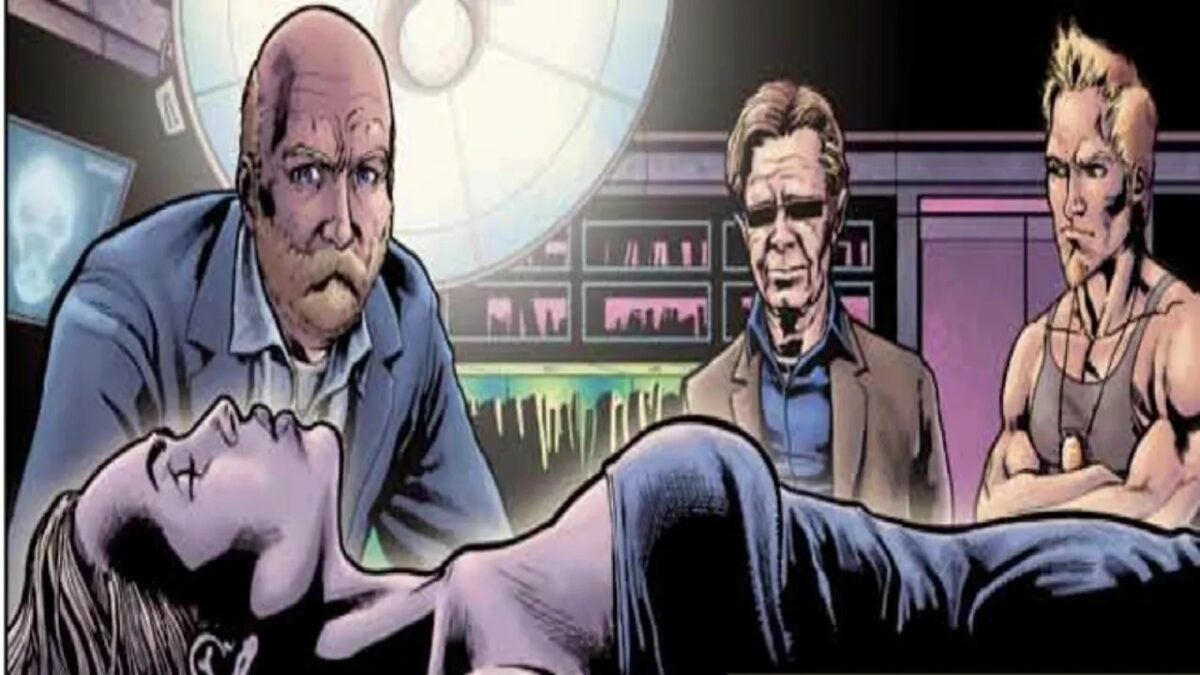
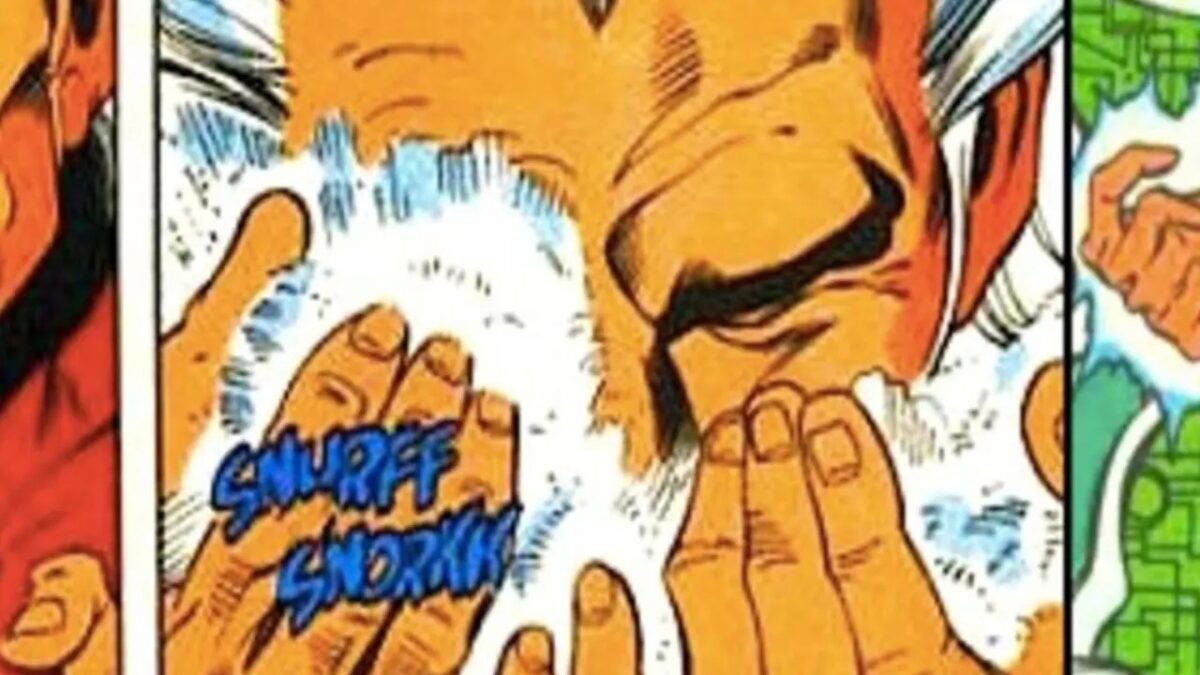
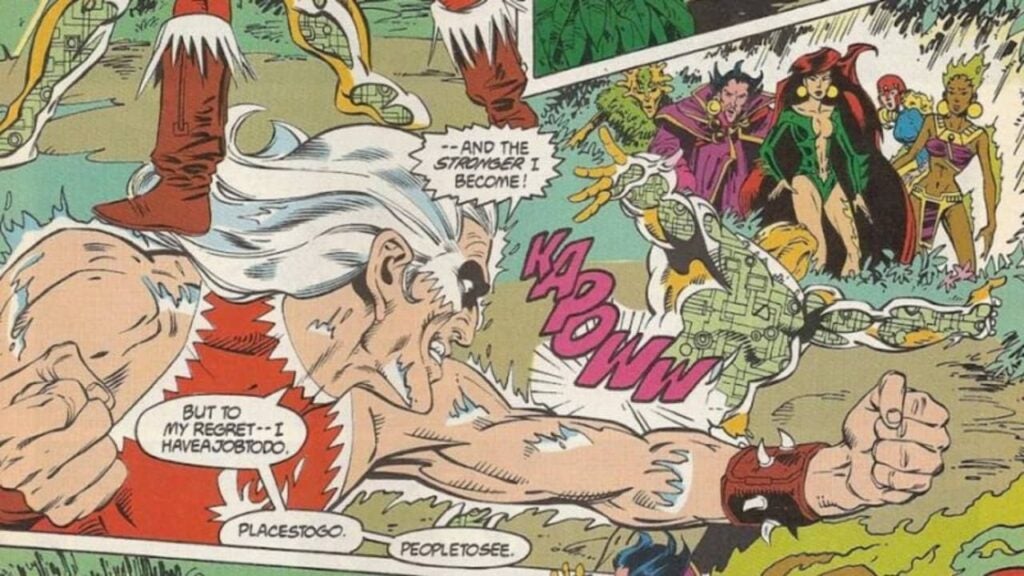
The comic began directly in the jungle with the group facing an enemy dressed in red with a white aura around him, who claimed “Cocaine is my god, and I am the human instrument of his will”. Subtlety flew out the window and the comic was just getting started: Snowflame was getting stronger and stronger as he snorted the power of the cocaine plant he was fighting over.
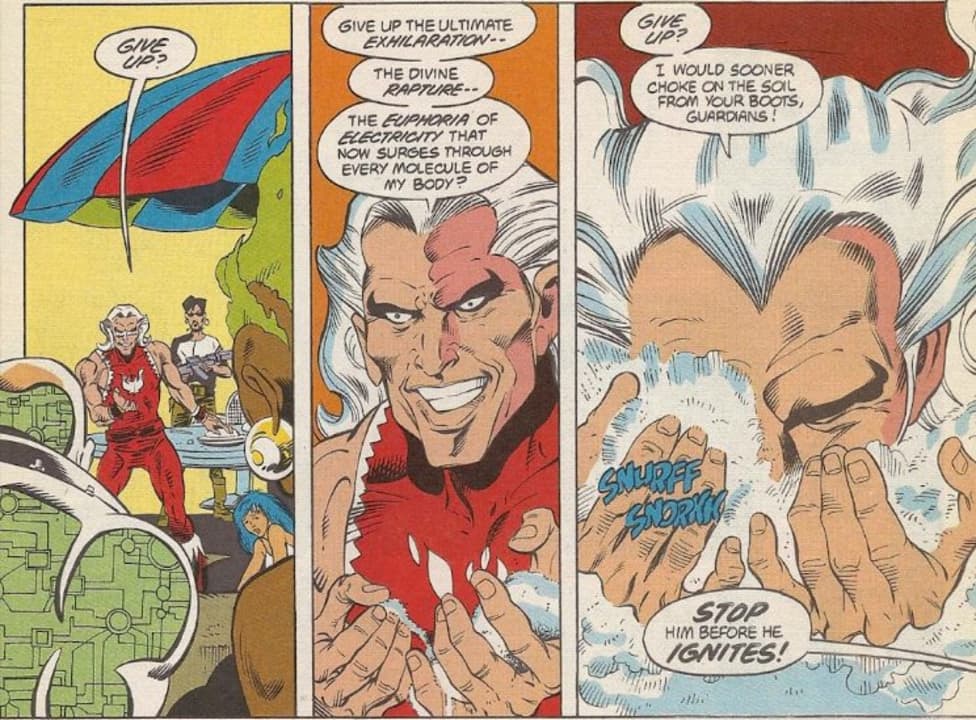
The villain’s mansion, in the middle of the jungle, had a swimming pool, girls dancing in their underwear and the character himself saying phrases like “Do you know how many bags we have to sell to the dealers to buy a Rolls-Royce? Ten, Manuel!”. In the background, characters appeared snorting straight away – in a DC comic! Think of the sheer lunacy of it all! What’s more, Snowflame himself was doing it to confront our heroes, no plants involved, claiming that he was in for “The ultimate exhilaration, the divine ecstasy, the euphoria of electricity now surging from every molecule in my body.” My goodness, ‘Vicious Bear‘ in muscle version.

Finally, the fire that enveloped Snowflame made him explode… And that was the end of his story. Well, a priori, or don’t you know that in superhero comics nobody lives or dies? They just transform. Let’s move 32 years into the future: September 2020. Society was secluded in their homes, afraid of the Covid. It was the perfect time for Blake Northcott and Sean Murphy to bring back the kids’ favorite supervillain.
He wasn’t dead, he was on a spree

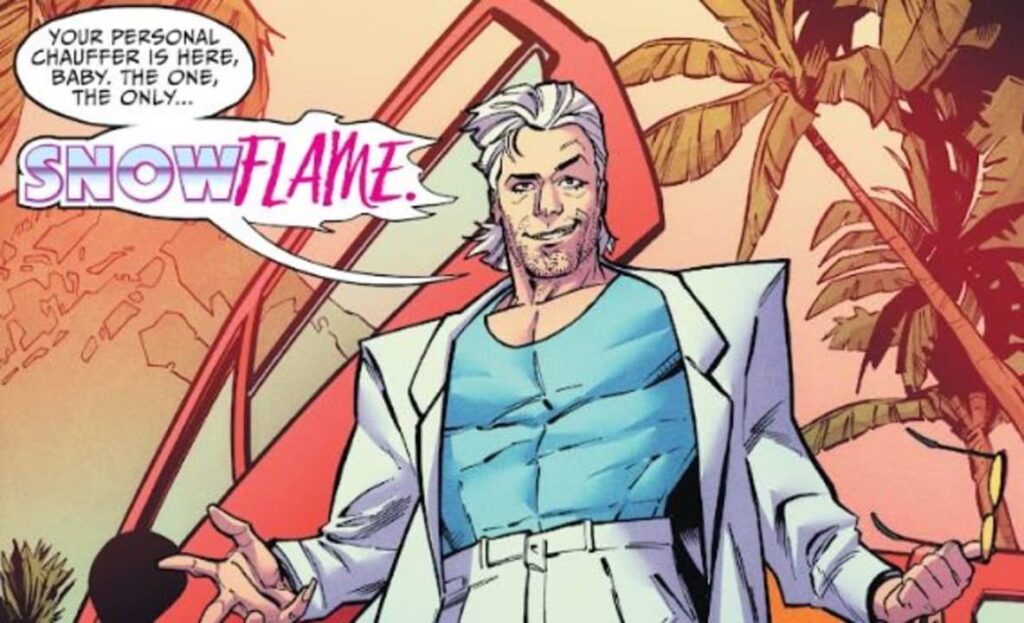
Issue 23 of ‘Catwoman’ volume 5. Selina travels to Nevada Island (subtle she certainly isn’t) to attend an auction hosted by – exactly – Snowflame, who explains how she got off years ago: “The key to faking your own death: explosions. If you blow enough people away, no one’s going to look through the mess to identify body parts.”

Mind you, he was far from reformed: he was still taking drugs (which he even offers to Catwoman), acknowledging that he’s “never quit long enough” to know whether the self-confidence is natural or cocaine-induced. Of course, Catwoman has to take down the entire drug cartel by confronting her old flame, Snowflame (because yes, they do let it slip that they were involved for a small period of time).
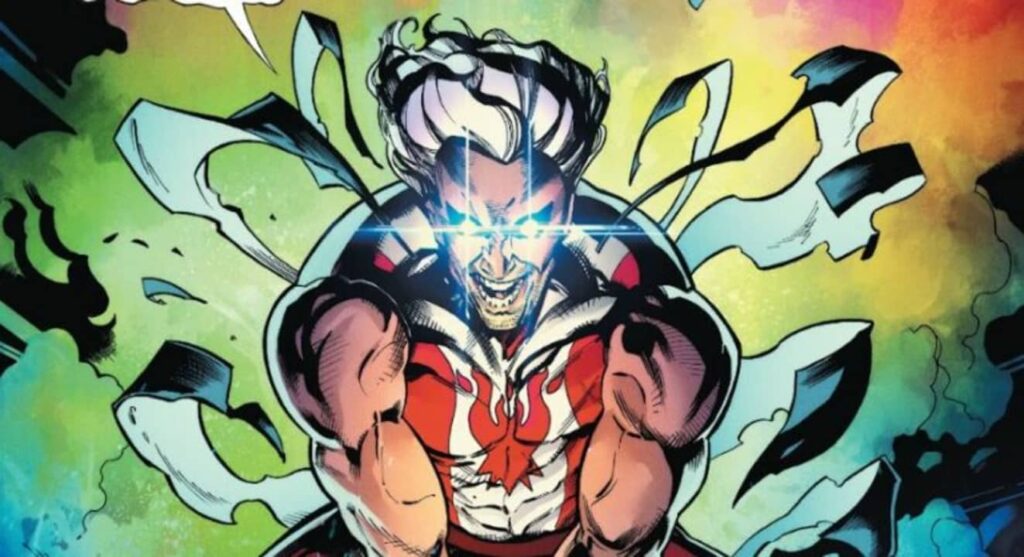
And indeed, power still comes from sniffing uncontrollably. Some things never change. The last we see of him is how a giant panther appears from the shadows to eat him, with his superpowers eliminated thanks to an antidote from the people of Isla Nevada. Since then, we haven’t heard from him again, but it’s possible that, seeing as he’s not even a worthy rival for Batman‘s girlfriend, he won’t be back in the pages of DC other than to be comic relief from time to time. Honestly? He won’t be missed much.
The Rise and Reign of The Machinery Smurfs: A Global Phenomenon

What is 'The Machinery Smurfs'? Where did it come from and how far were they able to go? Stay tuned, because this story is not expected.

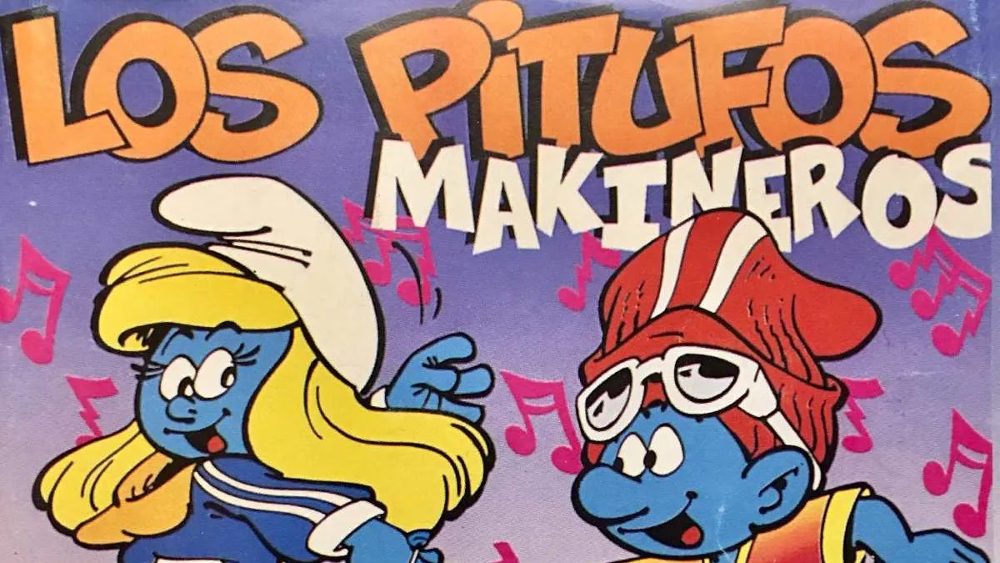
Whether we like it or not, we cannot control our childhood. We can make anyone who will listen to us believe that when we were kids ‘The Godfather‘ was the best thing that ever happened to us instead of ‘Yuppie Worlds’ or that in our car we listened to Oasis instead of The Makinero Smurfs. Ah, yes. That album that in 1995 appeared in Spain from absolutely nowhere, three years after the death of Peyo and that made a whole generation dance. But, what is ‘Los Pitufos Makineros’, where did it come from and how far were they able to go? Stay tuned, because you are not expecting this story.

Spotify DOWNLOAD
La aplicación oficial de Spotify para PC

Techno is cool

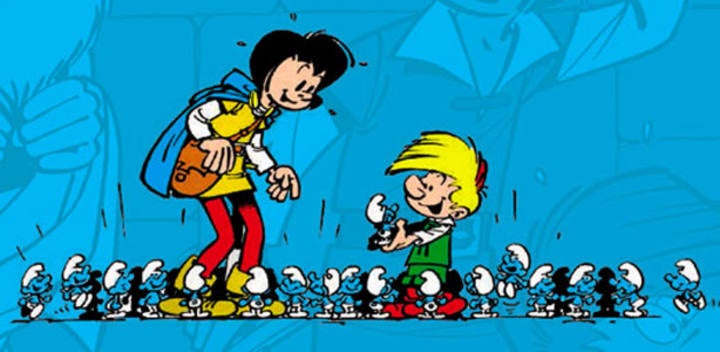
First, an introduction to The Smurfs: in 1958, Peyo had achieved success with the comic and epic adventures of a couple based on a brave man and his disastrous companion. Johan and Pirluit starred in 13 titles created by the author (and four others created after his death by other authors) and, unjustly, he is remembered for having seen the birth, in his ninth long story, of the Smurfs.

‘The Flute of Six Smurfs’ was, without knowing it, the beginning of the rest of Peyo’s life: after bringing them out as secondary characters in a couple more adventures of Johan and Pirluit, the village took on a life of its own and in 1959 ‘The Black Smurfs‘ and its mythical “¡Ñac!” had an unusual success that, after a good handful of comics, exploded with the American cartoon series that lasted from 1981 to 1990 for 258 episodes (quite decaffeinated for the most part, by the way).

It was around this time, in 1978, when The Smurfs made their first appearance in the world of music thanks to Father Abraham, the stage name of the Dutchman Petrus Antonius Laurentius “Pierre” Kartner (who died, by the way, last year), who made a song for the movie based on ‘The Six Smurfs’ Flute’. The single sold more than 400,000 units (although initially the lack of confidence made them print only 1000), and the subsequent album half a million. In Spain it arrived singing in our language in an album titled ‘El padre Abraham y sus pitufos’, with this song as an absolutely impossible advance.

Smurf makina

But it all ends: the Smurfs’ fame faded little by little as the TV series was increasingly considered a kitsch product and by the mid 90’s they were considered a rather finished franchise. But there was still one last attempt before spending a decade hibernating, and the key was not in Spain but, once again… in Holland.

EMI, owner of the franchise, no longer knew what to do with The Smurfs, and asked the Cat Music production team to do something, please, with the characters and some modern “Smurf” songs. At the beginning of 1995, a parody of 2Unlimited’s ‘No limit’ was the number one in Holland and opened the way: on April 6th of the same year ‘Tekkno ist cool’ was released in Belgium and Germany, with smurfed versions of Jam & Spoon or Maxx. The success was such that in September ‘Megaparty’ appeared, another album by Los Pitufos. In Holland, meanwhile, Irene Moors’ CDs with the Smurfs, such as ‘Ga je mee naar Smurfenland’ went double platinum. It was the beginning of a journey that would take them to cover ‘La macarena’ or the Spice Girls throughout Europe, where 8 million albums were sold between 1995 and 1998. We repeat: Eight. Millions.

And meanwhile, in Spain, what was happening in 1995? With the bakalao route in decline and dance and techno music opening up to all ages, it was only a matter of time before ‘Los pitufos makineros’ came to us, which had a different cover illustration than the rest of the European versions and in which songs like ‘Scatman’s world’ (‘Somos los pitufos’), ‘El tecno es guay’ (American Pie) or, of course, the ‘No limit’ that triumphed in its Dutch version, here as ‘Cumpleaños feliz’, were versioned. If you’re over thirty, it still resonates in your nightmares (“It’s your birthday, it’s your birthday, it’s your birthday”). This was just the beginning: success was assured.

Smurfs Mix

It must be taken into account that in the 90’s summer remix albums were an art form in Spain. Ever since ‘Max Mix’ opened the way in 1985, the different titles were making their way in the (then) turbulent Spanish market. Bolero Mix’, ‘Máquina total’ (which in 1995 sold more than in any other year with its seventh part), ‘Rumba total’ or ‘Ibiza Mix’ were what was played in every self-respecting summer beach bar. Los Pitufos makineros’ served not only as a parody but also as a children’s version for the whole family.

In 1996, Los Pitufos Makineros released ‘¡Vámonos a Ibiza!‘ with versions of ‘El tiburón’ (‘El campeón’), ‘Staying alive’ (‘¡Piérdete ya!’) or ‘Memories’ (‘El cole acabó’) as well as their own songs like ‘Pitufolimpiadas’ or ‘Futbolmanía’. The albums immediately abandoned the “makineros” with Spain and entered another more pop moment. Thus came out ‘Los Pitufos ¡van a tope!’ (1996) and ‘¡Viva Pitufos! Los Pitufos en directo’ (1997). This album was half a compilation of the three previous ones, but with new songs like the Smurf version of ‘Acompáñame’, the song from ‘Sorpresa, sorpresa, sorpresa’. The 90’s were definitely a thing.

From then on they tried to monetize as they could: ‘¡¡A bailar Pitufos!!!’ (1997), ‘Los Pitufos musicales’ (1997), ‘¡¡Corazón Pitufo! ‘ (1998) that versioned ‘Barbie Girl’ in ‘La pitufina’ or ‘Desátame’ in ‘Pitúfame’ or ‘Los Pitufos 2000’ (1999), with versions of ‘Mambo No 5’ (‘Vivo Pitufando’) or ‘Baby one more time’ (‘Juega otra vez pitufo’). The arrival of the 2000s did not remove the annual album from the team: ‘Los pitufos.com’ (2000) opened the range to explicit songs like ‘Sex bomb’ (‘Pitufos on line’) or ‘The bad touch’ (‘Todo al revés’). This was the last one edited by Arcade, which gave way to Divucsa and versions of exclusively Spanish songs, abandoning the international practices.

The albums continued until 2006: ‘Fiesta Pitufa’, the double ‘Festival Pitufo’, ‘Los Pitufos te desean un cumpleaños feliz’, ‘Los Pitufos ¡no paran! ‘ (with a bonus DVD containing the episode ‘Smurf buccaneer’ from the TV series), ‘Mola pitufar’ (with a CD of Christmas carols and karaoke included), ‘Mola pitufar’ and, finally, ‘Pitufando éxitos’, which included seven interactive games on a CD-ROM and which already showed a new musical style in songs such as ‘Me mola el rumbatón’, which parodied ‘Pa mi guerrera’.

Fourteen albums in eleven years and impossible versions of ‘Aserejé’, ‘Zapatillas’ or ‘I want it that way’ made Los Pitufos Makineros (and, later, Los Pitufos) one of those nostalgic milestones that are a bit embarrassing to remember. The good part is that we were not alone: in Hungary albums were released until 2011 and in Finland more than 19 different ones were sold. In the Czech Republic, in fact, their equivalent to our Makinero Smurfs was the best-selling album between 1994 and 2006.

There is only one international consolation left in the face of musical shame: no country could afford to cover ‘Wonderwall’: Oasis very explicitly requested that ‘Wondersmurf’ should not appear on any of these albums. Smurf it, Gallaghers!

The disturbing case of Blake Leibel: Comic book writer turned killer

There is a screenwriter who decided to go one step further… And he committed, based on his own comic, one of the worst crimes in Hollywood history.

In 1994, issue 54 of DC‘s Green Lantern featured an image that eventually became unfortunately iconic: Kyle Rayner’s girlfriend, who had been killed by Force Majeure, had her body stuffed in the fridge. This moment gave name to a comic book cliché coined by Gail Simone: women in refrigerators. The list of names of female characters killed, tortured or mutilated in comics is endless, ranging from Elektra herself to Gwen Stacy. However, as terrible as this topic is, there is a scriptwriter who decided to go one step further… And he committed, based on his own comic book, one of the worst crimes in the history of Hollywood.

Warning: if you are very squeamish, it is better not to read any further because the story of ‘Syndrome’ is worthy of a true crime.

The wealthy screenwriter

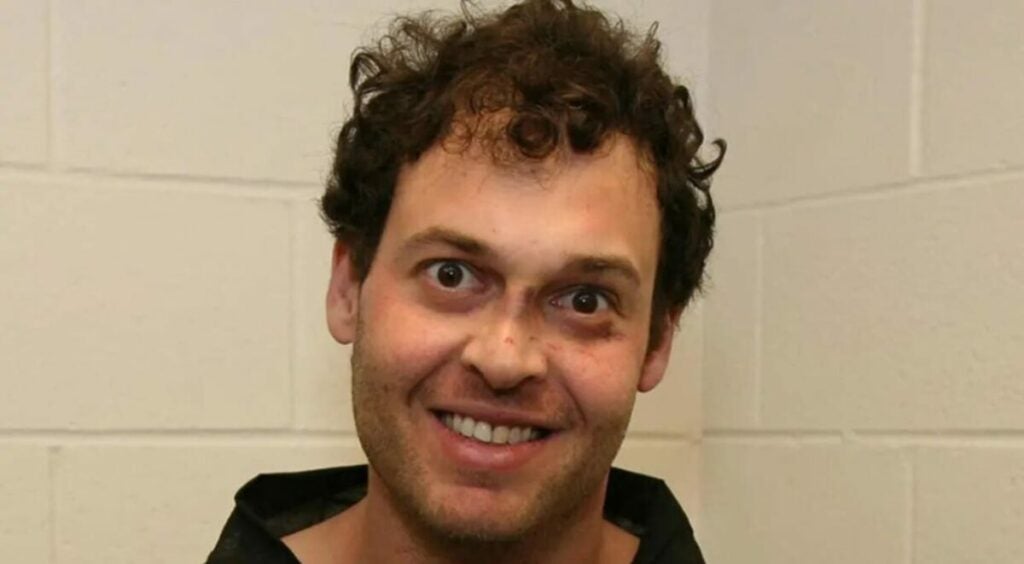
If there are two words that don’t usually go together in real life, it’s “screenwriter” and “rich.” Yet Blake Leibel was. Born in 1981, his family was one of the most powerful in all of Canada. His father was a construction magnate. His mother, meanwhile, was part of the Chitels, founders of one of Toronto’s most powerful plastics factories. Everything was going well, until one day they decided to separate and both siblings split up with their parents.

Blake stayed with Eleanor, while Cody went to live with his father (who, interestingly, was the first Olympic sailor to test positive for doping in 1976). Blake’s salary when he came of age in 1999 was 18,000 euros a month. Nothing, about the same as any of us. So, he wouldn’t have much of a problem moving to Los Angeles and pursuing a career as an artist, not even as a hobby.

The thing is, he had some luck: in 2008 he became the director of three episodes of the animated series of ‘The Mad History of the Galaxies’ and in 2009 he was able to direct and script ‘Bald’, a film promoted with the slogan “No money. No hair. No shame” in which a college student started an erotic website with the hottest girls on campus to earn money and give a hair transplant to his roommate. In fact, it’s described as if “the worst parts of Annie Hall met the worst parts of American Pie.” But we’re not here to judge her career, we’re here to understand how and why she became The Comic Book Killer.

Comics Book Reader DOWNLOAD

The boundary between fiction and reality

Leibel had already written some comics before 2010, such as ‘When Kingdoms Collide’, ‘Operation: Redux’ or ‘United free worlds’. These were ultra-violent comics, but nothing out of the ordinary. Other authors like Mark Millar also recreate themselves in violence and in their real life they are still good people. However, Blake Leibel was no Mark Millar. When in 2010 he released ‘Syndrome’, a graphic novel created by him, scripted by Daniel Quantz and RJ Ryan and illustrated by David Marquez (who has gone through Marvel, DC and anywhere you can imagine). None of his co-workers noticed anything unusual about him despite the gruesome nature of the story.

The first page of the comic posed the question “Why should we spare the life of an unrepentant murderer?”, to which the answer was given “Because you don’t do good by doing evil”. Throughout the comic, grotesque situations (a beheaded woman, a whole family murdered, a person hanged and bled to death…) are intertwined in a story about a serial killer and the obsession of four characters.

The comic didn’t have much of a run (it didn’t matter, Leibel launched it with his own publishing house and let’s remember that he received $18,000 a month to cover any expenses). Four years after his departure, Iana Kasian, a young Ukrainian woman, emigrates to the United States to work as a model in California. There she meets Leibel, who had just broken up with his wife, Amanda Braun, after a few erratic weeks: fate, it seemed, had brought them together. Expensive gifts followed (including a Mercedes convertible), the two moved in together, and finally, on May 3, 2016, their daughter Diana was born. 23 days later, Iana would be dead.

Taken from the vignettes

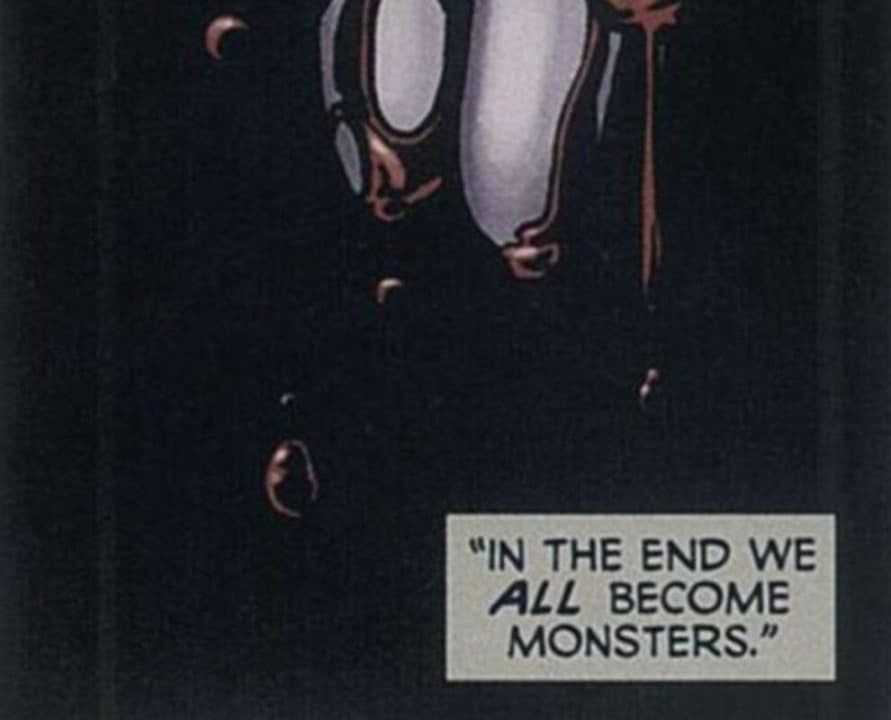
“They kill. We kill. In the end we all become monsters”. Another person to meet in this story is Constance Buccafurri, Leibel’s mistress (of whom Iana, of course, knew nothing). In mid-May, with their newborn daughter, the screenwriter went to his lover’s house and sexually abused her. It all happened in a single day: he got out of jail by paying $100,000 but by the time he returned to his apartment, the Ukrainian woman had left with her daughter and her mother, who was visiting, to a nearby hotel.

Imagine for a moment the life of Blake Leibel, a person who had always had absolutely everything: money, career as a screenwriter, women… who is suddenly thrown in jail and, when he gets out, discovers that his girlfriend has refused to see him. The man feigned repentance and insisted on spending more time with her, asking her to come back to the apartment to sort out their problems. Luckily, Diana and Iana’s mother stayed at the hotel waiting for him to return. But she never ever came back.

We won’t go into details because they are too gruesome, but suffice it to say that on May 24 Leibel committed an agonizing and brutal murder that seemed inspired by those in ‘Syndrome’. He drained the blood from her body and scalped her: that was only the beginning of the horrible torture Iana Kasian suffered. When the police arrived, alerted by Iana’s mother, the screenwriter told them she was fine, just resting. On May 26, finally, a patrol car broke down the door and entered a house that instead of a floor had blood on it. Blake, who had shielded his room with closets and mattresses, sat in shock next to a mutilated, grotesque corpse.

As luck would have it, Leibel ended up in jail sentenced to life in prison without the possibility of review, despite maintaining that he was innocent. The coroner stated, in examining the facts, “I’ve never seen anything like this before. And I doubt if any coroner in this country or beyond has ever seen anything like this outside of, perhaps, wartime”. The prisoner is serving his sentence in California, thus putting an end to one of the blackest episodes in the history of comics… And, probably, of Hollywood.

Some of the links added in the article are part of affiliate campaigns and maand represent benefits for Softonic.

From Invisibility to Power: The Evolution of Sue Storm in Marvel Comics

How has he survived to this day as the most important and powerful character in Marvel’s First Family?

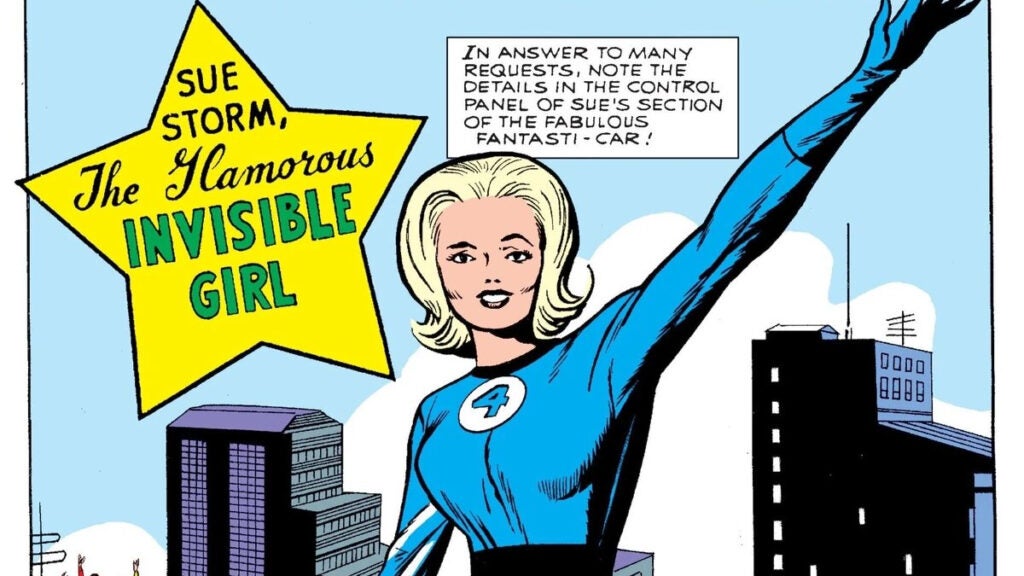
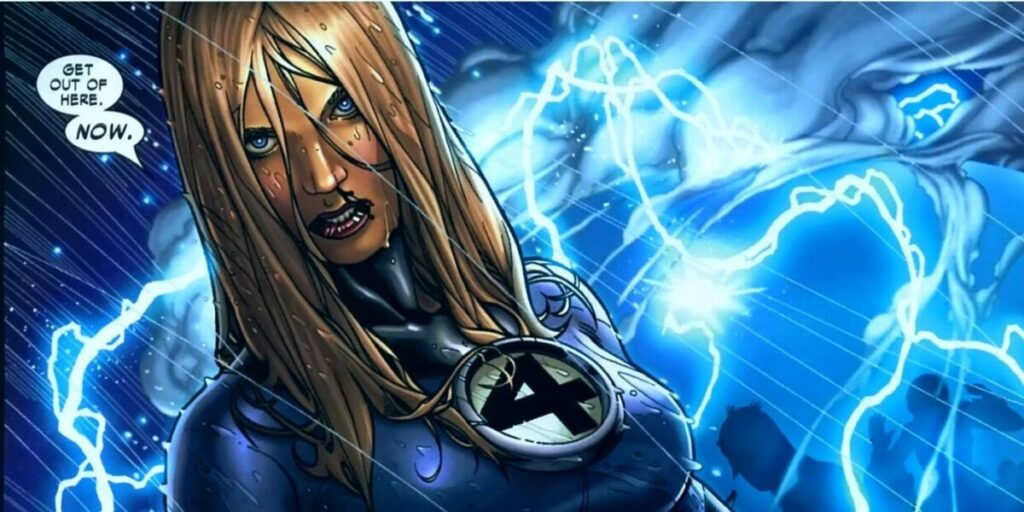
“Sue Storm, The Invisible Girl. Favorite hobbies: fashion, cooking, cosmetics and reading romance novels“; “If she marries, will she leave The Fantastic Four? Your guess will be as good as ours – it’ll probably depend on who she marries!”. The first annual Fantastic Four comic book created a profile of the girl in the group that even at the time gave some pause. Stan Lee didn’t know what to do with the character, her power was the weakest and readers didn’t want her on the team. So how has she survived to this day as the most important and powerful character in Marvel’s First Family?

Having tea and looking at dresses

The Fantastic Four were born in 1961, at the height of the Yankee economic boom: World War II had ended fifteen years earlier and Vietnam was still an exotic country that most Americans had never heard of. Superman had been flying over the skies of Metropolis for 23 years and in the offices of Marvel, a company that had just changed its name from the classic Timely, Jack Kirby and Stan Lee were preparing the first comic book of a collection that would change everything.

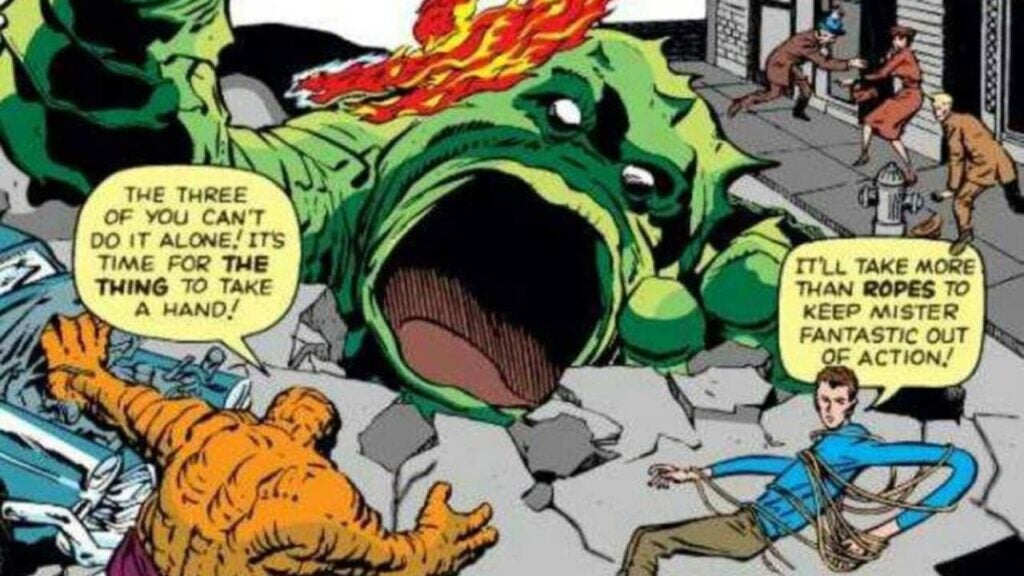
The Fantastic Four is the first superhero comic in which the heroes are, within their capabilities… human. They show imperfections, they are everyday people and, in addition, they fight against strange alien villains or, in a propaganda twist that bordered on the absurd, from beyond the Iron Curtain. A family of superheroes. Reed Richards, the adult; Johnny Storm, the teenager; Ben Grimm, the bronco… And Susan Storm, who under Stan Lee’s rule had the personality of “the girl”.

Do you know why Sue gets into the space trip that would later give them powers? Because Reed “is her fiancé, and where you go, I go.” In her day, with a female stereotype sustained by I Love Lucy and romance comics, this was what was expected of her. A woman who, paradoxically, made herself… invisible. While her companions could boast extravagant powers (the Human Torch, Mister Fantastic, the Thing), she stood aside, usually adopting the role of damsel in distress. And the public began to take notice.

You should throw her out

On the mailing page of issue #6 it’s a Martin Ross who opens fire on Sue: “She’s the greatest! But I think you should kick Susan Storm out. She never does anything”. These two lines – who said Twitter invented being a hater? – led to an explosion of people for and against that culminated in a little story where the characters read the letters and tried to explain that she was essential to the group.

“Some readers say I don’t contribute enough, that you’d be better off without me! And maybe they’re right,” Sue lamented before Reed and Ben set the record straight, comparing the superheroine to Abraham Lincoln’s mother, culminating with “If you want to see women fighting, go watch women’s wrestling!” and presenting “our favorite sidekick” with a birthday cake. Not before leaving her not knowing what to say and the Thing surprised (“First time I’ve ever heard a woman say something like that!”). It was the time.

Marvel Unlimited DOWNLOAD

Sue Storm was gaining importance in the plots, especially as the focal point of the love triangle between Reed and Namor, but mostly as a comic counterpoint who always made references to cleaning or buying high-end dresses. Sue was a superheroine in a world of heroes where she could only be compared to The Wasp, Ant-Man’s sidekick. She could save the day from time to time, but not even the advancement of women’s rights could prevent that, once she gave birth to Franklin in 1968, no one at Marvel knew what to do with her.

The invisible woman

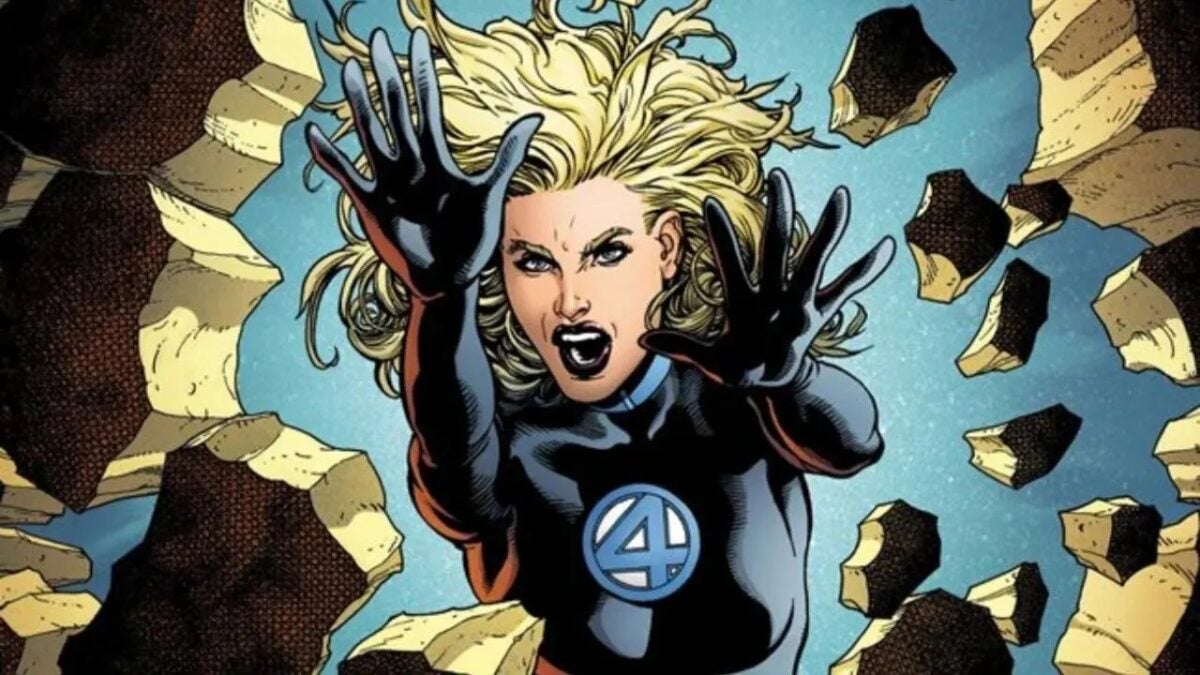
Sue became a housewife, a character who listened to others and who, at any given moment, could change the course of a battle with her force fields or her psionic rays, but it took John Byrne to turn everything upside down and give her the role she deserved in the Marvel Universe. Not as a mother or a wife, but as one of the most powerful women in the world.

The Invisible Girl became The Invisible Woman, her powers grew in intensity, she began to develop her own personality beyond Reed and Johnny… And finally, in Civil War, they decided to turn her into everything she was and more. Confronted in the superheroic battle, Sue ended up writing a letter to Reed where she made her intentions clear: “Johnny and I will be working underground from now on, and obviously there is no room for Franklin and Valeria. That’s why I’m leaving you to look after them and asking you to give them the time you’ve so often denied them in the past.” Boom.

Civil War may not have been the best comic book in the world, but it was, 45 years after its creation, the final awakening of a character who would never again wear an apron and keep quiet behind her husband. From the teenager obsessed with dresses to the independent woman, dozens of writers and cartoonists have shaped her over the years. The submissive Sue of the early 60s made sense in her context, but we live better knowing that the Invisible Woman was always the most fantastic of the four. Now it just remains to be seen if the next Marvel movie will be able to understand that.

Kevin Conroy to play live action Batman

Maybe the most famous version of Batman will finally step into the spotlight.

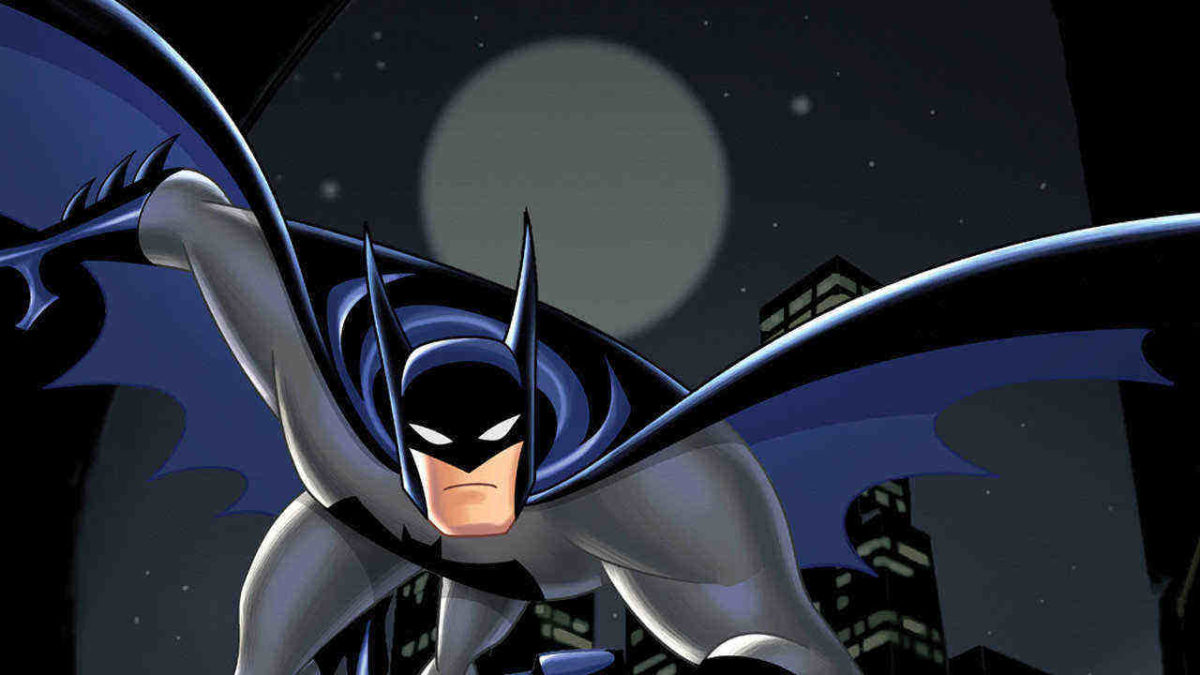
If you ever watched Batman cartoons growing up, were a fan of the Justice League TV series, or played any of the games in the Arkham or Injustice series, you’ve heard Kevin Conroy. His deep, sonorous, honorable voice has become practically synonymous with the vengeful, brooding Dark Knight, and at this point, if someone besides Conroy is behind the mic, it doesn’t feel authentic.

After over 25 years of playing Batman he’s taken the character practically anywhere there is to go. He’s even done musical numbers. Despite all the work Conroy has done as Batman, he’s never played the caped crusader live before – until now.

The CW recently announced that Conroy has been cast to play an older Bruce Wayne in the upcoming “Crisis on Infinite Earths,” a series that will span two quarters and consist of “Arrow,” “The Flash,” “Supergirl,” “Legends of Tomorrow,” and “Batwoman.”

The crossover series will air between December and January, and is set to be five episodes total.

While it’s unlikely we’ll get to see Conroy donning a bat suit, seeing him play an older, more grizzled Bruce Wayne will be incredibly cool. As always, we can’t imagine better casting for the part.

Are you looking forward to “Crisis on Infinite Earths?” Let us know in the comments below if you’re planning to tune in for the even, and stick with Sofonic for more Batman news!

‘The Walking Dead’ comic series is over

A leak shows that the next issue of “The Walking Dead” will be the last one!

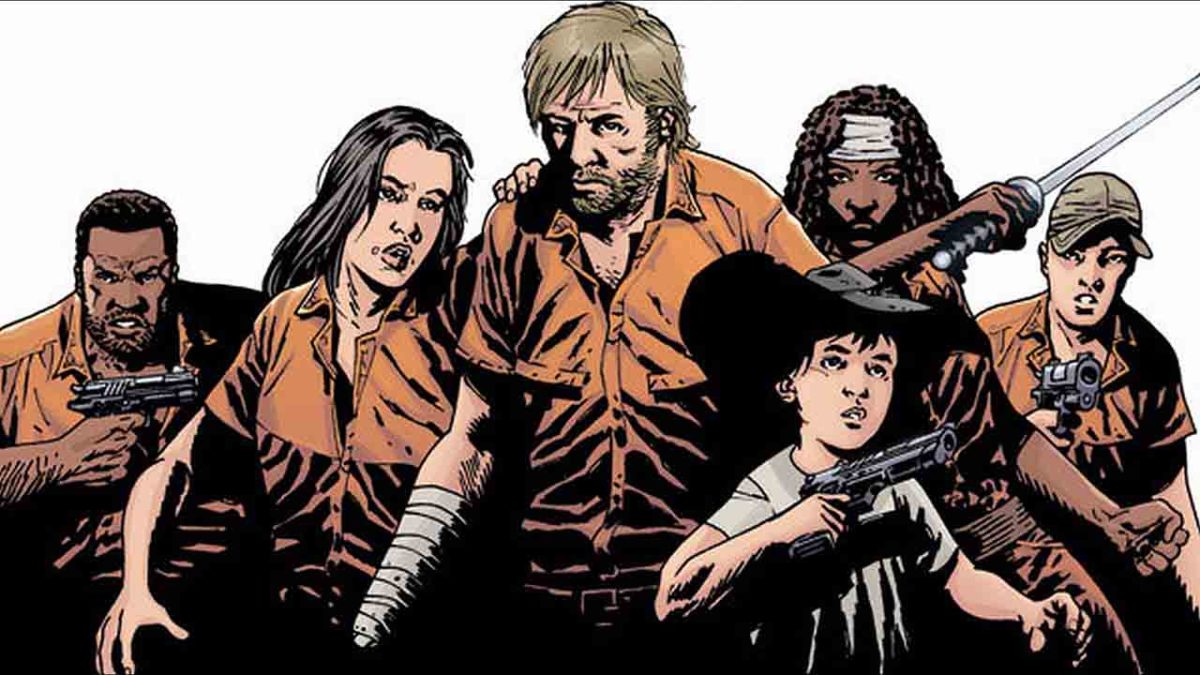
Walking DEadIn a surprise to fans of the series, Walking Dead creator Robert Kirkman has ended “The Walking Dead” comic series. An essay about this will be on the back of the next issue of “The Walking Dead” which will be the final issue.
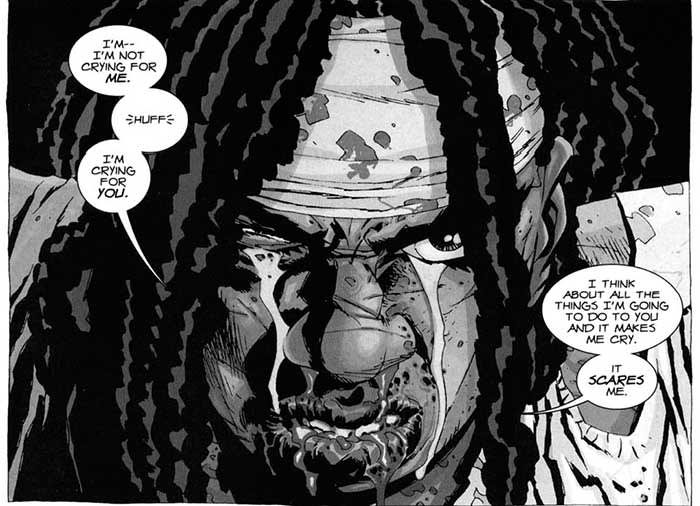
After the shocking key character death in issue #192, fans have been clamoring to see what will happen next. However, in a shocking twist, Kirkman has said that not only will this story arc end with issue #193, but so will the entire series.

“This is the end of The Walking Dead,” Kirkman writes. “That’s it… it’s over… we’re done. I’m sure you have a million questions… and I’m sure you feel as emotional about all this as we do… if not more so. I’m completely willing to bet some of you are angry over this. I get it… I do. I mean… WHY didn’t we announce this so that fans would have some time to prepare? Well… personally… I hate knowing what’s coming. As a fan, I hate it when I realize I’m in the third act of a movie and the story is winding down. I hate that I can count commercial breaks and know I’m nearing the end of a TV show. I hate that you can FEEL when you’re getting to the end of a book, or a graphic novel.”

The end of an era

Michonne

At more than 15 years old, “The Walking Dead” has erupted with popularity. From video games to multiple TV series to a long line of action figures, it has absolutely saturated the market.

TellTale's The Walking Dead Play now ►
8

Heck, the show is so popular that even the videos of fans reacting to scenes garner millions of views on YouTube.

However, fans can all agree that the series has run its course. In the late 2000s, zombies were everywhere. From movies like “Zombieland” to games like “Dead Rising,” zombies were around every corner. Basically, we have been getting a little sick of zombies and of “The Walking Dead.”

It looks like Kirkman seems to get that:

“As I worked to come up with ways to expand the story, none of it felt right,” Kirkman writes. “Everything felt like an unnecessary detour… it was, for lack of a better word, filler. The harder I tried to come up with new places to go, the clearer it was to me that this is what this story needed… it needed to end.”

So how do we want it to end?

SPOILERS BELOW

NeganRick Grimes is dead.

As hard as it is for us fans to accept that, we need to realize that Rick will not be receiving a happy ending. However, there is still hope for his son Carl.

Although Carl died in the TV show, he is still alive and eyeless in the comics. As he struggles to decide whether or not he should kill Sebastian, his father’s murderer, we hope he takes a page from his father’s book and chooses peace.

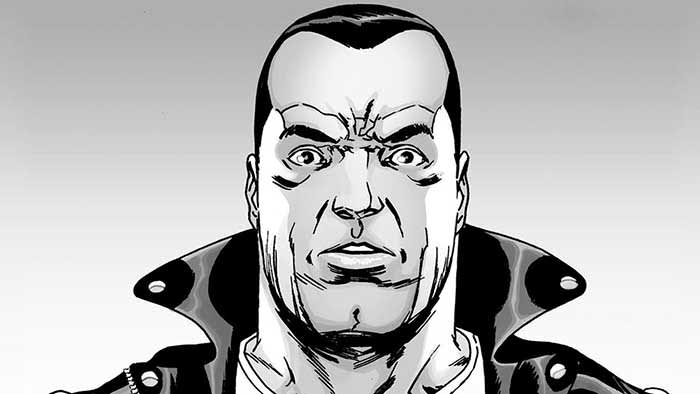
This is where we think Negan will make an appearance.

We haven’t seen Negan in about 20 issues. The last time we saw him, Maggie spared his life, and Negan rode off into the sunset. Our guess is that Negan might come back and do something to prove to Carl and the group that Rick was right to spare his life. As Carl realizes that peace can be an option, he will spare Negan and take over Rick’s role as leader of the group. 

Wrapping up

We are sad to see the series go, but we understand that it has run its course. We hope that the show might run its course soon too as there isn’t much left to keep our interest.

We’re bracing ourselves as we have no doubt that we will be staining the pages of the final issue with our tears. Who would’ve guessed that this little story about zombies would do so much to the world of comics?

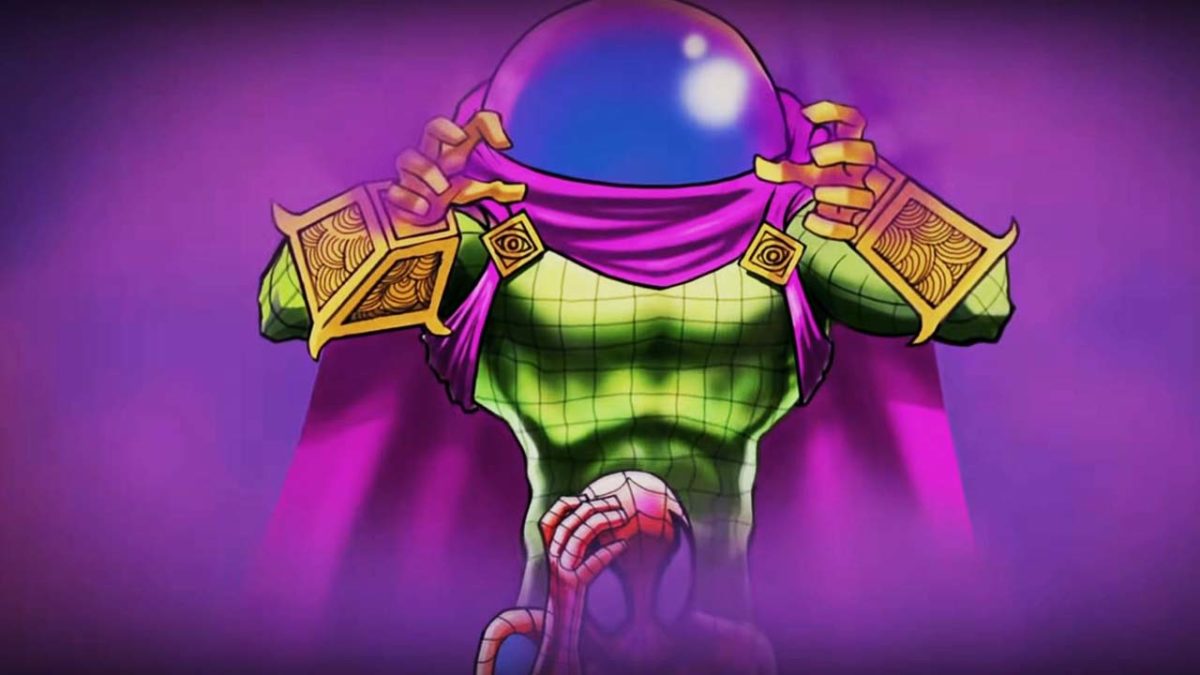
Who is Mysterio in Spider-Man?

Before you see “Spider-Man: Far From Home,” get to know the man behind the fishbowl!

Mysterio

Don’t let his foreboding presence fool you; most of what makes Mysterio threatening is just smoke and mirrors. 

The new MCU film “Spider-Man: Far From Home” is giving fans their first on-screen appearance of Mysterio, a staple villain in the world of Spider-Man

Despite “Spider-Man: Far From Home” being Mysterio’s first major on-screen appearance, he has had a rich history in many incarnations of Spider-Man.

Mysterio’s origin

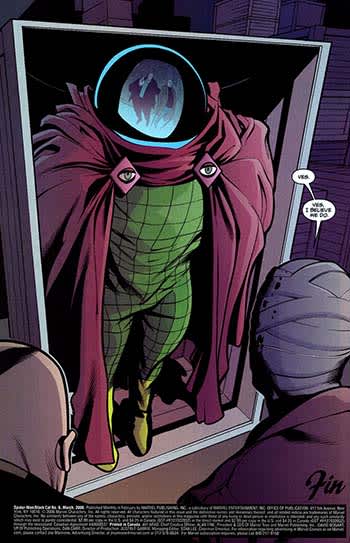
Mysterio first appearance
Mysterio’s first appearance

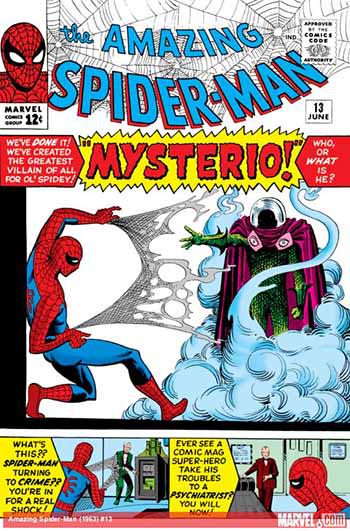
Mysterio made his first appearance in 1964 in the comic “The Amazing Spider-Man” Issue #13. He was made by legendary creators Stan Lee and Steve Ditko.

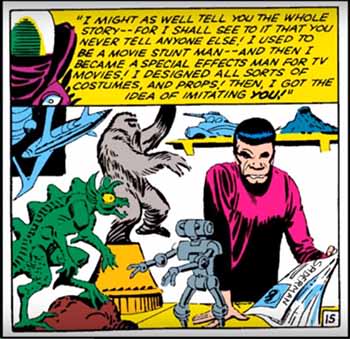
In the comics, Mysterio’s alter-ego is a man named Quentin Beck. Beck is a stuntman and special effects wizard. He had dreams of being a star, but he met with failure at every turn.

Quentin Beck

Eventually, he came up with a new idea: becoming a superhero. However, Spider-Man was hogging the limelight. As a result, Beck came up with a plan to frame Spider-Man for crimes, and make himself out to be the hero under his new persona, Mysterio. Mysterio claims to be from an alien world, and it is his mission to save the planet (or destroy the plane,t depending on what adaptation you’re checking out).

Spider-Man eventually proved his innocence and defeated Mysterio (as Spidey often does) but that wasn’t the last time we saw him…

Personality

Mysterio is pretty much a total loser.

Daredevil Mysterio
Daredevil just ended this man’s entire career.                                         Source: Daredevil: Guardian Devil

Mysterio is never really taken all that seriously in any adaptation. Sure, he causes some mischief and definitely gets on Spidey’s nerves, but he is simply not much of a threat. 

Compared to villains like Green Goblin or Venom, Mysterio is a walk in the park. He has a cool costume, but he often lacks the power or evil genius to back it up.

Most of his plans have been done previously by more qualified bad guys. He basically brings the same bag of tricks to each fight and gets his butt kicked each time.

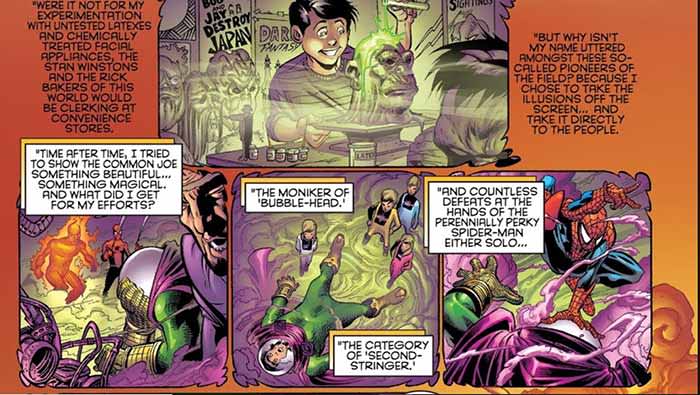
Mysterio’s motivations constantly lie in him trying to make a positive name for himself. He feels like his work has gone unappreciated and that he has been cheated out of fame, fortune, and recognition.

Mysterio personality
Source: “Daredevil: Guardian Devil”

Mysterio’s powers and abilities

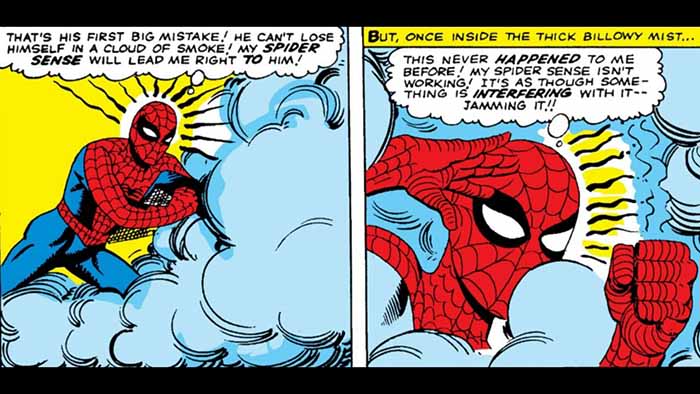
Mysterio has no superpowers. All of his tricks stem from his shrewd mind and homemade gadgets. He’s basically a much less cool Iron Man. His gadgets come from his work in special effects and the movie industry. He often uses smoke and gases to create illusions, disappear, and attack the human mind. 

To be completely fair, Mysterio is one of the only people to stop Spider-Man’s Spidey Sense in its tracks.

Spider-Man Spidey Sense
Source: The Amazing Spider-Man #13

The Sinister Six

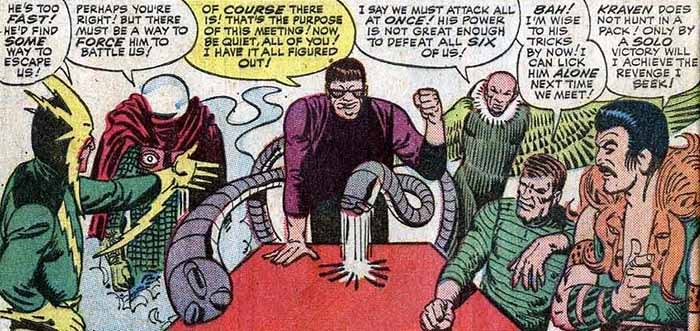
Eventually, Mysterio becomes one of the founding members of the original Sinister Six. The Sinister Six was a band of villains in the Spider-Verse who made it their goal to defeat Spider-Man. Along with Mysterio, other members included Doctor Octopus, Electro, Kraven the Hunter, Sandman, and Vulture. 

However, in their first battle with Spidey, their hubris was their demise. Rather than working together to take him down, the Sinister Six refused to work as a team and instead decided to fight Spider-Man one by one.

Sinister Six
Should’ve listened to Vulture, idiots.                      Source: “The Amazing Spider-Man Annual” Issue #1

Spidey whooped all of them one-by-one while mocking them for not attacking him all at once. Mysterio went on to reappear with the Sinister Six in other comics with pretty much the same results each time.

Plan to defeat Daredevil, and his suicide

Mysterio death
Source: “Daredevil: Guardian Devil”

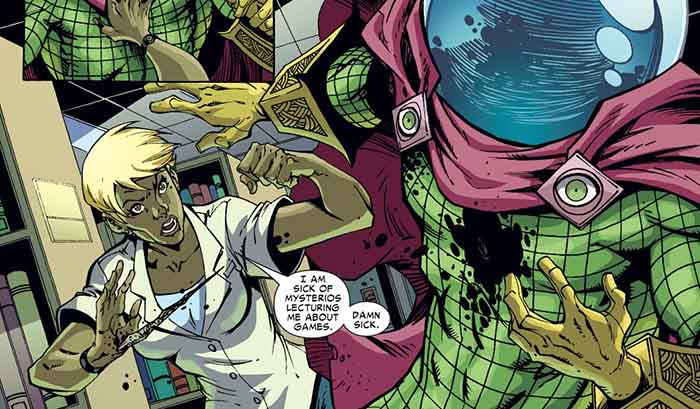
After being diagnosed with both lung cancer and an inoperable brain tumor, Mysterio decides that he wants to go out with a swan song. Unfortunately, he discovers that Spider-Man is merely a clone of his real self, so he turns his attention toward Daredevil in the series “Daredevil: Guardian Devil.”

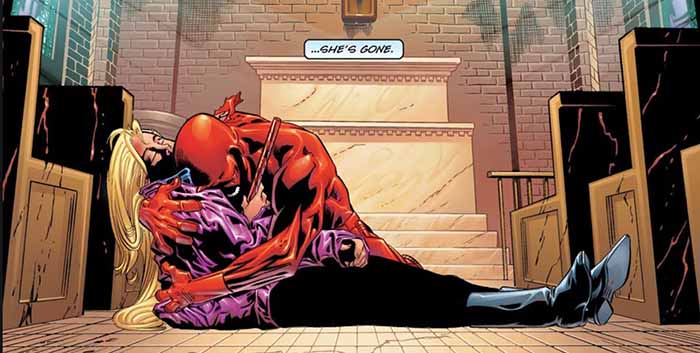
To give him credit, Mysterio actually accomplishes some messed up stuff in this series. He artificially inseminates a 15-year-old girl without her knowing, and works to convince Daredevil that the baby is the antichrist. From there, he fakes an HIV diagnosis for Daredevil’s love-interest Karen Page, blaming it on the antichrist. After that, he drugs Daredevil’s friend Foggy Nelson and frames him for murder. Eventually, Bullseye kills Page at Mysterio’s order.

Karen PAge Daredevil
Source: “Daredevil: Guardian Devil”

The rapid downward spiral in Daredevil’s life makes him question his life, morals, and even his Catholic faith.

However, things don’t go well for Mysterio in the end…

Daredevil
All the king’s horses and all the king’s men couldn’t put Mysterio back together again.

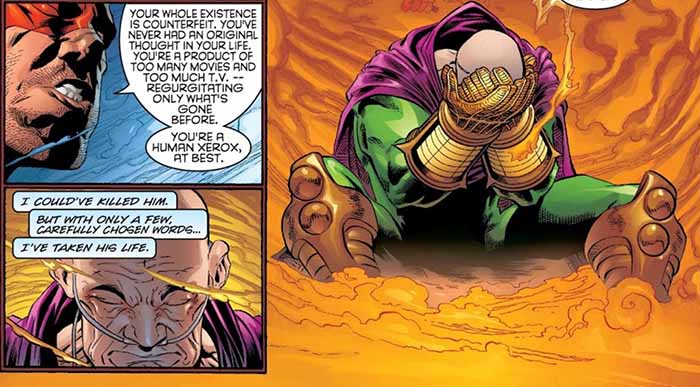
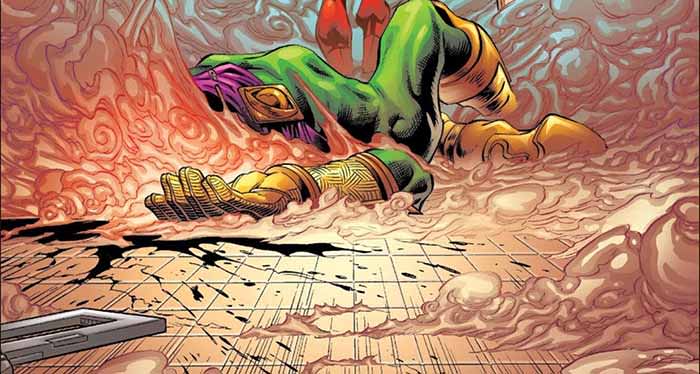
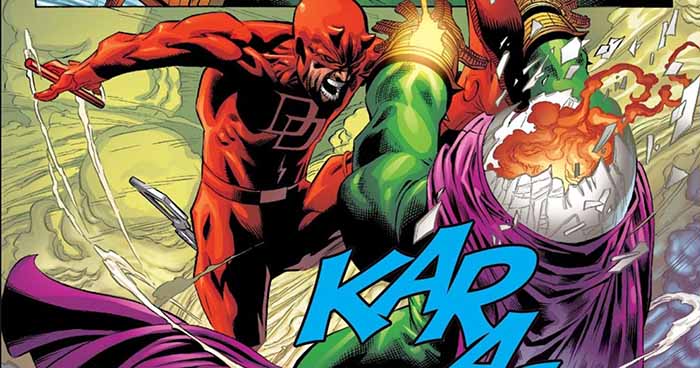
In the end, Mysterio tries to get Daredevil to fully succumb to his inner darkness by killing Mysterio in cold blood. However, Daredevil doesn’t kill him. He beats the living crap out of him but doesn’t kill him.

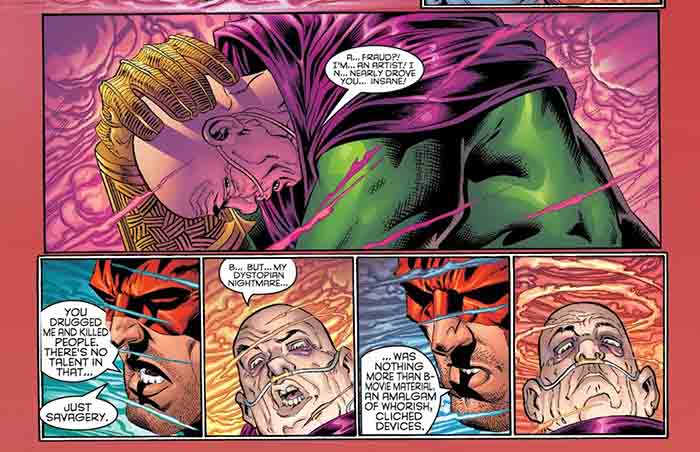
Instead, Daredevil mocks Mysterio, stating how Kingpin had tried to break him before, and it didn’t work. He also mentions how Mysterio tried a similar plan before to J. Jonah Jameson, and that didn’t work either. After coming to the conclusion that his life is a joke, Mysterio turns a gun on himself and commits suicide.

Mysterio loses
Daredevil kills Mysterio without firing a single bullet.

Other people who became Mysterio

Although Beck is the quintessential Mysterio in almost every adaptation, a few others have donned the fishbowl helmet.

Danny Berkhart

Danny Berkhart Mysterio
Source: “The Amazing Spider-Man” #142

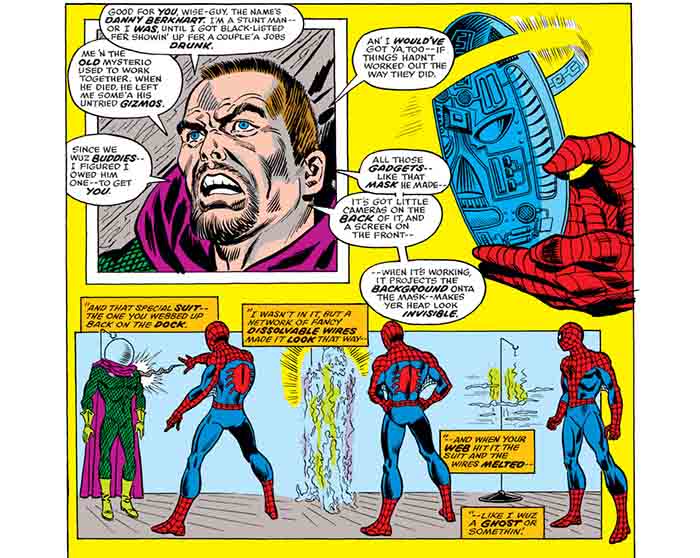
After the Quentin Beck’s supposed death in the original Spider-Man comics, a man named Danny Berkhart approached J. Jonah Jameson with a proposal.

Berkhart had the idea to fool Spider-Man into thinking that he was the ghost of Mysterio. He even had the old Mysterio’s gadgets. A thrilled Jameson promptly paid him to do so. As you might have guessed, Spidey figures it out and has Berkhart arrested. Jameson gets Berkhart a lawyer as long as he promises not to mention his name to the police.

Francis Klum

Klum Myterio
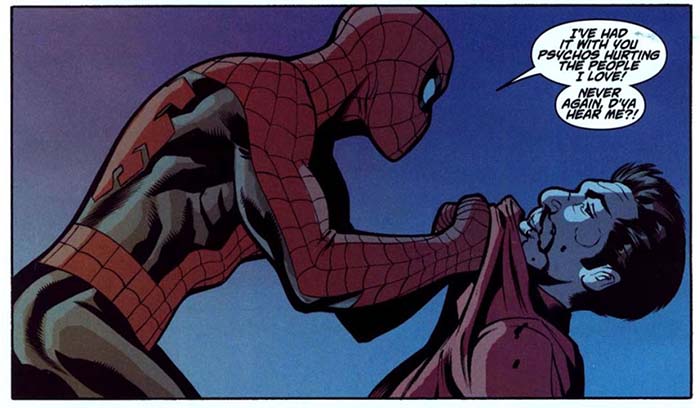
Note: He does this to the puny teenager who’s having a conversation with Black Cat, but doesn’t do this to the slew of other villains who actually threatened his loved ones.  Source: “Spide-Man/Black Cat: The Evil Men That Do”

Francis Klum is probably the weakest iteration of Mysterio, which explains why we haven’t seen him since the early 2000s.

Klum is a mutant who has been abused throughout his entire life. He has teleportation abilities that have caused him more harm than good in his life. After confiding with Black Cat, Spider-Man’s foe-turned-love-interest, Spidey mistakes the meeting as a threat to Black Cat’s life. He proceeds to beat the snot out of Klum and threatens his life. Klum manages to get away, but only after suffering major injuries.

Klum contacts Kingpin, who gives him the late Mysterio’s old costume. Klum gets the idea to attack Spider-Man while in costume to make Spidey think that he is merely fighting Mysterio. However, Klum would then use his teleportation powers to get the upper hand, and then kill Spider-Man.

Klum MysterioDoes his plan work?

Nope! Through a series of weird events, Beck actually reappears after somehow surviving shooting himself in “Daredevil: Guardian Devil.” With two Mysterios running amuck, Spider-Man is prepared for anything and has his guard up. Klum proceeds to not even get a few licks in as Miss Arrow stabs him before he can do anything.

Mysterio stabbed
Source: “Friendly Neighborhood Spider-Man” Issue #13

The Mysterio we almost got in ‘Spider-Man 4’

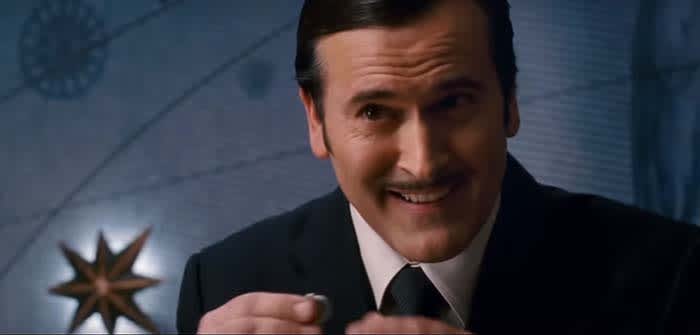
Bruce Campbell Mysterio

As you well know, the original Spider-Man movie trilogy was made by the ever-so-talented Sam Raimi. In all three films, Raimi had Bruce Campbell, his good friend from the “Evil Dead” films, make a small cameo appearance.

Although the film never saw the light of day, Campbell was supposed to have a much bigger part in “Spider-Man 4.”

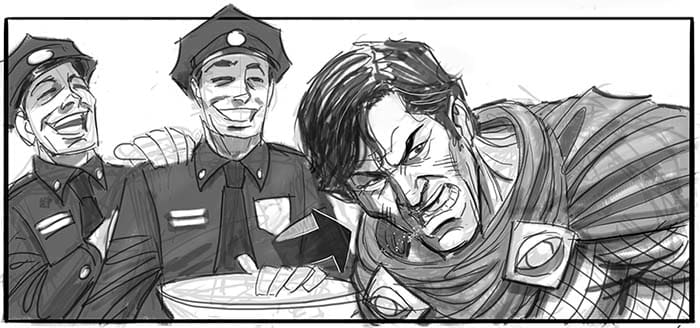
Bruce Campbell Mysterio
Art by Jeffrey Henderson

What you are looking at above is a piece of art from the official “Spider-Man 4” storyboard. This story was supposed to begin with Spider-Man walking Mysterio into the police station. After the police removed his fishbowl helmet, it was to be revealed that Bruce Campbell was playing Mysterio. 

Fans have speculated for years that during the course of the three Raimi Spider-Man films, Campbell had been playing Mysterio the entire time. Furthermore, fans guessed that Mysterio was watching Peter Parker, and was waiting for his moment to strike. Although this has never been confirmed by Raimi, this would have made for Campbell’s funniest cameo yet in the series.

As funny as this would’ve been, we think it would be better to have Campbell’s legendary character Ash make an appearance with the Avengers.

 Jake Gyllenhaal in “Spider-Man: Far From Home”

From what we have seen in the trailers, Jake Gyllenhaal’s Mysterio looks similar to the classic Mysterio.

Rather than saying he is from a different planet, this Mysterio is claiming to be from an alternate universe. 

Yeah, sure.

As cool as a live-action Spider-Verse would be, we’re guessing that Beck is once again full of it. It’s in his character to be a liar who uses his silver-tongue to come off as cooler than he actually is. However, we will just have to see once the movie is released.