
What the hell happened to Instagram over the holidays?

Instagram briefly introduced horizontal scrolling and it was horrible.

instagram

You may have missed it, but Instagram had a bit of a meltdown over the holiday period. For a period of a few hours, everything went a little crazy over at Instagram HQ when a small test was accidentally released to a wider audience. People were not happy, and it wasn’t long before the whole incident was trending on Twitter. Let’s take a look at exactly what happened in a bit more detail.

Instagram Download Instagram
7

Instagram briefly introduced horizontal scrolling and it was horrible

It was Thursday, December 27, and poor unsuspecting Instagram users were picking up their phones to check what their buddies had been up to the night before. What they found was an alternate-universe Instagram that totally sucked. After they’d looked at that first post, sitting gloriously atop their Instagram timeline, rather scrolling down as normal, their timelines scrolled horizontally to the left.

It was worse than that. Instagram was pushing instructions telling them to tap through the posts on their timeline, just like they do when they are looking through Instagram Stories. Users double-checked to make sure that they weren’t in fact looking at Instagram Stories, and then panicked. It wasn’t a mistake. It was all really happening. Their beloved Instagram had mutated beyond recognition. If they wanted to see all of the posts in their timeline, they’d have to deal with nausea and scroll from right to left.

I have to admit, I was one of those poor Instagram users who was completely thrown by this ridiculous curveball. I didn’t know what to do with myself, so I took to Twitter to vent my frustration, but never got the chance. I quickly found the #instagramupdate, which was the number trending hashtag in the U.S. and my fellow Instagrammers cheered me up with their outrage.

The most hilarious thing about the whole affiar is that what annoyed everybody the most was the fact that the new horizontal scrolling forced them to actually pay attention to other people’s post, rather than mindlessly scrolling from top to bottom.

Then, before I even had a chance to post my own thoughts on the matter, Instagram had fixed the issue, put everything back the way it should be, and released a statement, saying, “Due to a bug, some users saw a change to the way their feed appears today. We quickly fixed the issue and feed is back to normal. We apologize for any confusion.” It was all over before it had ever really started.

The ironic thing about the whole episode is that Instagram was likely testing the new feature as a way to battle the mindless scrolling that users rushed to Twitter to defend.


Facebook is packing a lot of cool new features into the tiny Messenger Lite app

Messenger Lite gets animated GIF support and other features from the full-size app

facebook and messenger lite

Facebook has grown exponentially since it first burst onto the scene. It has grown so much that it needed to split its main services into two apps: the Facebook app handles all of the classic social network activity while Facebook Messenger handles all of the direct messaging activity.

Then, in true Facebook style, both of these apps have grown and grown since that fateful split occurred. They’ve grown so much that they themselves needed to be split. We now have the full Facebook and Messenger apps and the much more limited Facebook Lite and Messenger Lite apps, which only take up a few megabytes and offer very limited versions of their respective experiences.

With such a history behind the Lite Facebook apps, it should probably come as no surprise that they themselves are due to grow and take on new features.

Messenger Lite is getting animated GIF support and other features from the full-size app

In a recent blog post, Facebook outlined a number of changes and few new features coming to the Messenger Lite app. New features coming to a Lite app could mean that it becomes a little less “lite”, but according to the blog post, even with the new features crammed in, Messenger Lite still comes in at less than 10MB. So, let’s look at these new features in a little more detail.

Messenger Lite Download Now
9

Messenger Lite has always had GIF support, but they’ve never been animated. All you could send was a frozen screenshot. Now this has changed. Speaking in the blog post announcing the update, Product Manager, Krish Gali, Said, “While you could receive GIFs in Messenger Lite for some time, they were not animated. Starting now, people can express themselves more in chats with family and friends by sending and playing animated GIFs… To send a GIF, use a third-party keyboard (such as the Google keyboard), search for GIFs in their library, and send a more expressive message.”

The other features coming to Messenger Lite, that mirror recent changes to full Messenger app, include more customization options for chats and groups. When the update drops, Lite users will be able to change the color schemes of chats with different people and groups and will also have access to more emojis.

All-in-all these changes mark a positive upgrade on the very basic Messenger Lite experience. Although it is impressive to see how much Facebook has squeezed into the Lite versions of its two main apps, they do both offer rather basic, and sometimes frustrating, experiences. As long as added features don’t slow down app performance or take up a lot more space on users’ phones, they’ll always be a welcome addition. Top work on the new features, but more growth for the Lite apps please Facebook.

Social media worse for mental health than we thought

Discover how Instagram erodes self-esteem and how to fight back.

social media depression

The link between social media and our collective mental health has been the focus of news coverage since Tom’s My Space was the biggest name in the game.

But, many of these worries have been more speculation than fact. Social media is still relatively young, so its full-blown effects remain something of an unknown.

But, as it turns out, social media can do a number on our brains.

A recent study from the University of Pennsylvania found that Instagram, as well as Facebook and Snapchat, might not be so good for our well-being.

In fact, the research revealed a causal link between the time we spend on social media and an increase in loneliness and depression.

Here’s a look at how, if we’re not careful, social media can affect our overall mental health.

The impact of social media on mental health

Why is Instagram the “worst” social platform?

is instagram the worst social channel?

What’s interesting about the ill effects of Instagram is, it’s supposed to be a positive force. It’s all bright colors, beautiful food, and many of the top posts boast messages of self-love or inspirational affirmations.

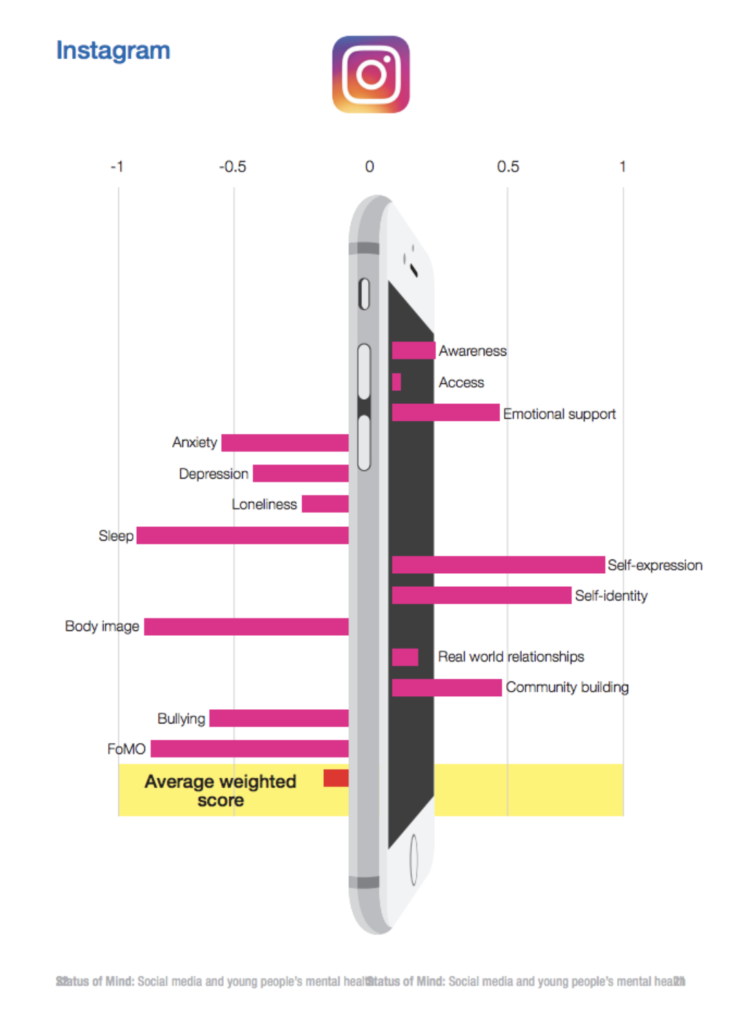
But that may well be the big issue with the platform. In 2017, the Royal Society for Public Health, a nonprofit focused on well-being found that of the top social platforms, Instagram had the most negative impact on 18-24-year-olds.

Participants in the UK survey stated that the photo-sharing app came equipped with a negative impact on sleep and a hefty dose of FOMO.

Instagram’s emphasis on positivity has resulted in a platform of users that use the tool to present the best version of themselves. Users edit pictures, selected from a lineup of rejects, and upload vacation highlights, #fitspiration, and their prettiest meals.

As such, those scrolling at home feel as though all of their friends are off living this glamorous life—without them.

Body image is just the beginning

body image

The combination of face-tuning, fit-spiration, and glamorous influencers has undoubtedly had an effect on body image–particularly for girls and young women.

This Dazed Digital article cited research from Carmen Papaluca, a researcher from the University of Notre Dame in Australia, who focused her Ph.D. on Instagram and its effects on 18-25-year-old women. Inspired by studies suggesting the platform’s risk factors, Papaluca wanted to dive deeper into how the visual platform and its effects on overall well-being.

She found that the girls were dealing with more than the common issue of wanting to look like someone else; it was more about wanting someone else’s life altogether.

The University of Pennsylvania study we referenced above uncovered similar results as Papaluca’s research. Their experiment split student participants into two groups–with one group limited to 10 minutes of social media activity per day, while the other group going about their social business as usual.

The students who limited social media use saw a reduction in symptoms of anxiety and depression. One participant said they felt much better about themselves during the three-week experiment, as they no longer were comparing their lives with others.

The FOMO factor is strong

The fear of missing out–FOMO–concept sounds a bit silly, but its effects are the real deal. With social media, we now have this portal into our friends’ lives, and often, we see them spending more time with other people than they do with us.

Two studies from the University of British Columbia looked closely at the effects of FOMO. One found that 48% of student participants believed that their friends had more close friends than they did themselves.

The second study found that those students who felt less social than their friends had a lower sense of wellbeing and belonging.

On a positive note, researchers mentioned that the negative feeling could motivate students to get out there and socialize.

Censoring yourself takes a toll, too

self-censorship online

In general, we think before we speak. And, with social media, we often overthink before we type. According to researchers from Carnegie Mellon University and Facebook, 71% of surveyed users self-censored at least one post or comment over a 17-day period.

While this may sound like a good thing—and perhaps more of us should do this before blasting out our opinions on social media—there’s also a downside.

We’re tailoring our comments to fit into what we assume our audience wants to hear. So beyond trying to use language that won’t offend (probably good) we’re also trying to conform to a set of standards that may be at odds with our sense of self.

Final thoughts

As we spend more time on social media, we’re beginning to understand more about its impact on our mental health and wellbeing.

The RSPH report found a lot of positives associated with social media—from emotional support to community building, so it’s not like it’s all doom and gloom. And, according to their report, YouTube’s only real negative effect was that participants stayed up too late watching videos.

However, between bullying and body image issues, as well as anxiety, depression, and loneliness, we may need to start arming future generations with a better toolkit for mitigating the ill effects linked to Instagram, Facebook, and the rest.

For those of us already entrenched in FOMO hell or sad scrolling, it may well be time to rethink how we approach our use of the platforms. Follow real friends only and skip the influencers, save for a few pet accounts. And, perhaps consider imposing your own 10-minute limit on use.

WhatsApp voice notes get a great new feature

WhatsApp ‘Consecutive voice messages’ feature will allow users to play voice notes back to back

WhatsApp voice notes have grown in prominence over the last few years. Voice notes started as quite a niche feature, but they’ve now been widely adopted by many users. Whether we’re sending small voice notes when we can’t be bothered to type or we’re sending epic 15-minute-long podcasts, we all use voice notes in different ways. It is the hands-free nature of voice notes that makes them so popular. For both sender and recipient, voice notes are easy to use because there is no fiddling about required. You simply hit record or play and away you go.

WhatsApp Messenger Download WhatsApp ►
8

That is, of course, unless you have just received a stream of multiple voice notes. If that is the case, you have to hit play to start each of them individually. This slight annoyance is in WhatsApp’s sights and there seems to be an update on the way that will do away with the need to hit play every time one voice note ends and you want to start the next one.

WhatsApp ‘Consecutive voice messages’ feature will allow users to play voice notes back to back

Thanks to another leak by the writers over at WABetaInfo, we can bring you details of this new feature for WhatsApp voice notes. Code for the new Consecutive voice messages feature has been spotted in the latest beta version of WhatsApp for Android.

The feature still has a way to go, however, before public testing will begin but the code for the new feature and various screenshots showing the feature in action have been published. When it finally does roll out, the feature will allow multiple voice notes to play continuously without the receiver having to hit play. It will work automatically whenever two or more voice notes are detected by WhatsApp.

Image via: WABetaInfo

Whenever you receive multiple voice notes, you will only have to hit play on the first voice note. After that, all other messages will begin playing automatically after the one before it has finished playing.

Interestingly, we might be about to start hearing brand new WhatsApp tones. The WhatsApp Web notification has become one of the most recognizable notification tones out there and the new consecutive voice note tones may be set to join it. There will be two new WhatsApp tones introduced with this feature. The first will let you know that the voice note you’re listening to is finished but that you have another one to follow it. The second tone will let you know that the final voice note has finished and there are no more to come.

This feature is yet to arrive on the WhatsApp beta, but it doesn’t look like WhatsApp beta users will have to wait long before they get to give it a try. The rest of us, however, will have to wait much longer for this feature to receive a wider roll-out. Make sure you stick with us to stay up to date with all the latest news relating to WhatsApp and your other favorite apps.

Instagram gives you greater control over who sees your Stories

Instagram rolls out ‘close friends’ so that you can share your Stories with smaller groups

beach selfie

Instagram, like all social networks, is a digital place for getting together with friends. Like all social networks, however, Instagram is a place where we’ve all built up networks of people that aren’t our actual friends. We can find ourselves sharing our posts with people we barely know. For people who value their privacy, this is a real problem and for months Instagram has been working on a solution to this problem, a solution called ‘favorites.’ Now, after over 18 months of testing, the hip social network is ready to roll out the feature to everybody.

Instagram Download Instagram
7

Instagram rolls out ‘close friends’ so that you can share your Stories with smaller groups

The new feature will only be limited to Instagram Stories. This means that anything you post to your profile will still be shared with everybody. Instagram hopes that the new limited groups of close friends will encourage users to share more.

Instagram update close friends for Stories
Image via: Instagram

When you post your Stories, you’ll be given an option to create a list of close friends that represent your inner circle. Instagram will suggest friends based on your prior interactions but ultimately, it’ll be up to you who you add to your list. According to Instagram, during the testing phase, people usually added around two dozen people to their list.

How to use Instagram close friends

When you’ve created an Instagram Story you want to share, you’ll notice a green circle with a white star on it. Clicking it will bring you to the “close friends” list where you can decide who will and won’t make the cut. As well as the friends Instagram suggests, you’ll also be able to search for friends using a search box. When you’ve completed your list of close friends, you’ll then be able to share your Stories exclusively with them by clicking the green circle before you hit share.

From the other end, whenever your friends receive a Story that has only been shared with close friends, they’ll see a green ring around the Story as it sits in the tray at the top of their feed. This means whenever you see a Story with a green ring instead of the typical pink ring, you will know that it is something personal that has come from a close friend. Other than the green ring, your close friends will receive no notifications telling them whether they’ve been added to or removed from your close friends list. This is because Instagram wanted to make sure there was no social stigma attached to the process of adding or removing friends from your list. (Shout out to memories of the MySpace Top 8.)

This is a positive move from Instagram that should encourage people to share more via Instagram Stories. As our Followers lists grow and we add more and more transient acquaintances to our social networks we become less and less likely to be as open. Adding close friends takes social networks back towards one of their main original purposes. Putting us in closer contact with the people we care about the most.


You definitely want to avoid this WhatsApp “update”

You need to ignore all invitations to receive to update to WhatsApp Gold

whatsapp gold martinelli fake update scam

There has been a scam making the rounds on WhatsApp and it is very important that you don’t fall for it. We’re always trying to keep you informed about WhatsApp scams and fake updates and we first reported on this scam back in 2016, but it seems to be back again. The scam is called WhatsApp Gold and it is spreading across WhatsApp via Status updates and chats forwarded from other users.

You need to ignore all invitations to receive to update to WhatsApp Gold

Downloading the fake WhatsApp Gold update will infect your phone and compromise your data. According to those who have been targeted, the WhatsApp Gold fake update is now being linked to another WhatsApp hoax called Martinelli. People have been receiving a strange message in their inboxes saying that a video called Martinelli will be released and, if opened, it will install a virus on the victim’s phone. The message is quite confusing and says:

“Today the radio was talking about WhatsApp Gold and it is true. There is a video that will be released tomorrow on WhatsApp and is called Martinelli. Do not open it. Enter your phone and nothing you do will fix it. Spread the message if you know someone. If you receive a message to update Whatsapp Gold Do not open it! They just announced that the virus is serious. Send it to everyone.”

The Martinelli video warning made the rounds on social media last year. Warnings were sent around telling people not to open the video as it would infect their phone. It turned out to be a complete hoax, however, as no video actually existed. It seems that the real WhatsApp Gold threat has, for some unknown reason, become attached to the fake Martinelli video warning.

The key here is to ignore any messages you might receive about WhatsApp updates. The real threat in this situation is the fake WhatsApp Gold update, which will install malware onto your phone if you install it. Any updates that ask you to download an apk file, to manually install on your device, are fake. WhatsApp updates occur automatically, so you never have to download or update anything.

Furthermore, you should make sure you only get your downloads and news about software updates from trusted sources like Softonic. We’ll bring you regular updates about WhatsApp from trusted sources like the official WhatsApp blog or WABetaInfo. To stay ahead of the news in a safe and secure way, sign up to our email newsletter by putting your email address in the box at the bottom of the page.


Instagram cracks down on fake followers

Instagram fights back against fake accounts.

Instagram

Fake followers seem more like a myth than reality, since most celebrities and high profile people don’t need fake followers since they have so many real ones. In most cases, however, these aren’t the people who are paying for fake followers. The people who do try to get fake followers are typically easy to spot, since they’ll have thousands of followers and very little likes or views on their actual content. There are tons of apps and sites specifically dedicated to giving you followers (for a price). It may not seem like a big issue, but Instagram has decided to crack down on these apps, and the fake accounts that they use.

These “inauthentic” accounts, as Instagram calls them, are being targeted by a new software that Instagram has created specifically to hunt out inauthenticity. Accounts who are suspected to be using third party apps to increase their follower count are being contacted by Instagram with a request to change their password.

According to Instagram’s blog post on the subject, they believe that inauthentic accounts are bad for their community, and have upgraded their auto-detection and removal software to crack down. 

If you don’t know anything about fake followers and inauthentic social media activity, there have been a few YouTubers who have covered this topic. They also explain why these inauthentic activities aren’t as helpful to the user as third party apps try to make you think they are. It is not very difficult to spot inauthetic behavior, and it doesn’t help your statistics on most social media sites.

One can assume this crack down on fake accounts was spurred in early November, when Facebook announced they had removed 30 fake Facebook accounts and 85 fake Instagram accounts to curb digital interference in the midterm elections. Clearly, Instagram had a much larger portion of inauthenticity, which may have led to Instagram’s improvement of their auto-detection system.

Google Maps: Look out for this scam targeting your bank

Hackers are changing the contact details of banks on Google Maps to try and catch you out

Scammers targeting banks on google maps

We recently learned exciting news about a Google Maps update that makes it easier for you to contact the businesses you need to use from inside the Google Maps app. Messages is a brand new feature that opens up a whole new world of functionality to Google Maps and pits it against other big apps like Facebook Messenger and the fairly new WhatsApp Business. Now we have to bring you news of new way that scammers are targeting banks on Google Maps

Google Maps Download Google Maps
7

Hackers are changing the contact details of banks on Google Maps to try and trip you up

Google Maps allows users to submit changes and corrections to listings on the navigation app. This allows fraudsters to change the contact details of financial institutions like banks so that when customers try to call or message their banks the fraudsters can intercept the correspondence. With the first interactions with financial institutions always being confirming security details on the account, this leaves customers very vulnerable to having their accounts compromised.

This scam was first reported in India and picked by local newspaper The Hindu. After receiving more than three complaints from the Bank of India, Police in the state of Maharashtra notified Google and put out a local warning relating to the scam. There is nothing stopping scammers in other parts of the world from trying the scam in their area.

In the story reported by The Hindu, Google acknowledged the problem but didn’t mention any specific fix. A Google spokesperson said, “Overall, allowing users to suggest edits provides comprehensive and up-to-date info, but we recognise there may be occasional inaccuracies or bad edits suggested by them. When this happens, we do our best to address the issue as quickly as possible. The Google Safety Center outlines tips to help consumers stay safe online.”

There doesn’t seem to be any sort of automatic defense against this problem in development, but Google will act quickly whenever an incident comes to its attention.

How to stay safe

This all means then that we need to be extra careful when we’re searching online for contact details to financial institutions like banks. If you do find yourself looking for a phone number online, don’t trust it unless the number is also listed on the bank’s official website. Should you come across the number through Google Maps or some other third-party website, a simple Google search including the number and the name of the financial institution in question should yield the contact page on the official website. If it doesn’t, you should suspect the number in question and think about reporting it.

For more tips on consumer safety online, check out the Google Safety Center here.

If you miss Vine, you’ll love byte

Don Hoffman, co-founder of Vine has announced byte, a follow up to Vine that will launch in spring 2019

6 second videos with byte

One of the main criticisms thrown at the internet is that it is constantly distracting us. We’re now distant introverts constantly trying our hardest to not check our phones for notifications, no matter the social situation we are in. One of the main culprits in the destruction of our attention span is Vine. Its six-second looping video format meant we could be genuinely entertained in less time than it takes most of us to finish a sentence. Vine didn’t last. But you can’t keep a phenomenon down.

Don Hoffman, co-founder of Vine,  announced byte, a follow up to Vine that will launch in spring 2019

Vine was originally founded by Dom Hoffman, Rus Yusupov, and Colin Kroll back in June 2012. Twitter bought Vine before its official launch but competition from the likes of Instagram, Snapchat, and other more traditional video platforms like YouTube led Twitter to stop new videos from being uploaded in 2016. Yusuprov and Kroll went on to found the now-famous interactive game show app HQ Trivia, but Hoffman stated that he was working on a Vine V2 app that wouldn’t be affiliated with Twitter.

It looked as though Hoffman’s project wasn’t going to see the light of day though, when he posted on the V2 community forums that the project was being indefinitely postponed, citing “financial and legal hurdles.” This all changed just a couple of days ago, when Hoffman tweeted that he would be launching a new looping video app called byte in Spring 2019. We’ll have to wait to find out more details about byte, but if it will be based on Hoffman’s published plans for V2, it should be a place for publishing videos between two to six-and-a-half seconds.

The short length of Vine videos forced users to be creative in ways never seen before. Vine might have helped shave minutes off of our attention spans, but it did it bring something fresh to the internet. When Twitter choked off new uploads, it left a hole that needed filling. Hopefully, when byte launches next Spring, we’ll start to see a whole raft of new creators rising to internet stardom.

To find out more about byte you can head over to www.byte.co and sign up for updates. If you’d like updates about all your favorite apps and programs, sign up to our newsletter by entering your email address in the form below.

Some of our favorite Vine creators

ProZD

Thomas Sanders

David Lopez

iOS WhatsApp users can now see into the future

There is now an official public beta version of WhatsApp on iOS

WhatsApp

Here at Softonic, we’re constantly trying to keep you updated on all the big news relating to your favorite apps. We scour the beta versions of apps to try and figure out which new features are on the horizon. We now have some very interesting news relating to the beta version of WhatsApp, which Facebook uses to test new features.

WhatsApp Messenger Download WhatsApp ►
8

There is now an extended official public beta version of WhatsApp on iOS

There has been an official beta version for Android users of WhatsApp to test out upcoming features for quite some time now. Even the classic Windows Phone operating system had a beta version. For iPhone, however, the beta testing program, which forms an important part of the development process for new features, was always limited to select users. This has now changed with WhatsApp opening its iOS beta program to more users.

How to sign up for WhatsApp beta for iOS

  1. To join the WhatsApp beta for iOS program, you will need to download an app called TestFlight. TestFlight allows users to test various beta apps on iOS, tvOS, and watchOS devices.
  2. Once TestFlight is installed, click this link to request an invite to the beta testing program.
  3. After requesting your invite, you’ll be redirected to the appropriate TestFlight page, where you’ll be asked to accept your invite to the WhatsApp beta for iOS program.
  4. Before hitting install, it is a good idea to back up all of your chat history, even though installing the beta version of WhatsApp shouldn’t delete your chats.

The whole point of the beta testing phase is for the developers to receive real-world feedback on the new features they are testing. This means that the apps could well be unstable and cause issues on your phone. Also, and this is a very important point, if you do decide to join the beta program and then experience a technical issue, you should contact the developers to let them know. As you’re reporting on an app known to be in the test phase, the developers will pay more attention to what you are saying.

In the WhatsApp beta for iOS program app, all you have to do to report an issue is hit Contact Us in the settings menu and then give a brief description of the issue you faced.