iOS 18 will be the AI update: and the responsible team has received new talent with this purchase

Let’s remember that Tim Cook has promised that the company will innovate with generative AI in 2024, anticipating that this “will offer transformative opportunities for our users.”

Apple has taken a further step towards consolidating its position in the field of artificial intelligence with the acquisition of DarwinAI, a startup based in Canada. A move that highlights Apple’s commitment to compete head-to-head with Microsoft or Google in the AI market and from which we should see the first results in just a couple of months.
iOS 17 Download

DarwinAI is now part of Apple

DarwinAI stands out in its field for having developed artificial intelligence technology aimed at inspecting components during manufacturing processes, as well as for its focus on creating smaller and more efficient AI systems. Innovations that promise to improve Apple’s production processes, on the one hand, but that are also key to the development of AI applications that require lower resource consumption, a crucial aspect for mobile devices and other electronic devices.

The acquisition, which was reported by Bloomberg, has led to the disappearance of DarwinAI’s online presence; their website and social media accounts have been deactivated after the purchase. This is a common practice in acquisitions of this nature, where the technology and talent of the acquired company are fully integrated into the buyer’s operations. According to reports, dozens of former DarwinAI employees are now part of Apple’s artificial intelligence division, including AI researcher Alexander Wong, who played a crucial role in DarwinAI and now holds a director position in Apple’s AI group.

As in other occasions, Apple has confirmed its acquisition with its usual statement: “Apple occasionally acquires small technology companies. In general, we do not discuss our purpose or plans”. However, it is evident that the company is seeking to strengthen its capabilities in AI, particularly to enhance the artificial intelligence features in its upcoming versions of the operating systems iOS 18 and macOS 15.

To compete with services like Microsoft’s Bing, OpenAI’s ChatGPT, and other generative AI offerings, Apple needs to integrate generative AI into a wide range of products. We already know, according to rumors, that the company is testing large language models, and it is expected that the features will arrive on Siri, Shortcuts, Messages, Apple Music, on our AirPods and much more, along with iOS 18.

The key to Apple’s approach, however, and the difference with Microsoft, OpenAI, or Google, is where these models are executed. While it is common to run AI directly in the cloud, Apple intends to follow a different strategy, one that protects our privacy: local execution. In this sense, DarwinAI’s experience in creating more compact and efficient AI systems is particularly valuable and can help the company implement the different models directly on our devices.

iOS 17 Download

Let’s remember that Tim Cook has promised that the company will innovate with generative AI in 2024, anticipating that it “will offer transformative opportunities for our users”. With this acquisition, Apple’s AI team is strengthened with cutting-edge talent and technology, and at the same time, another piece is added to the puzzle that we would have to see resolved with iOS 18.
The EU is backtracking and the DMA will not affect iMessage: what does it mean?

An objective that doesn’t come from regulation imposition but from the natural evolution of standards, which we will all soon enjoy.

Recently, the European Union has decided, after its initial attempt, not to include iMessage, Apple’s messaging service, in the strict regulations of the Digital Markets Act (DMA). As Apple responded to the EU after its inclusion in an initial draft list, the Cupertino company’s service does not have enough users to be affected by this new law.

iOS 17 Download

Without regulation, but with the same result

The DMA is a legislation that seeks to regulate tech giants, which it calls “digital gatekeepers,” forcing them to open their platforms to third parties and ensure the interoperability of their services. One aspect of this DMA is to require services like iMessage to implement interoperability with other messaging platforms, such as WhatsApp or Messenger, both owned by Facebook.

However, after a five-month investigation, the European Commission concluded that iMessage does not hold a dominant position in the market, especially regarding its use by businesses, and therefore, it will not be subject to interoperability regulations under the DMA. This decision has been welcomed by both Apple and Microsoft (owner of Bing, which was also excluded from certain regulations under the same logic), who have expressed their satisfaction with not being affected by the DMA.

The most important thing here is to make a clear distinction. iMessage as a protocol is one thing, and the Messages app on our iPhone, iPad, or Mac is another thing. And this is an important distinction to keep in mind because, while iMessage won’t have to integrate third-party services and can continue to maintain Apple’s service security standards, the Messages app presents other changes.

By its own decision, Apple announced that the Messages app will adopt the RCS protocol in the coming months. This will mean that through Messages we will be able to send photos, videos, audio messages, stickers, and other types of content typical of iMessage to anyone. RCS replaces traditional SMS and already has support on Android. Thus, we will be able to communicate with anyone through the Messages app just like we would already do on Telegram or WhatsApp, for example.

iOS 17 Download

Ultimately, we are facing a truly interesting scenario. While we will continue to enjoy maximum privacy and security when sending messages between Apple devices, thanks to RCS we will be able to communicate much more freely than before when talking to Android users. This is not achieved through regulation but through the natural evolution of standards, and soon we will all enjoy it.

A year with Bing: this is Microsoft’s new path with its AI

Exactly one year ago, the new Bing from Microsoft was announced for the first time with great anticipation from both the company and users. With this huge investment, Microsoft positioned itself on the podium of AI, where ChatGPT from OpenAI reigned. One year later, Microsoft is trying to give its AI a boost to make it attractive to users.

Bing ACCESS

Shortly before we found out that Microsoft was going all in with a new chatbot based on its Bing search engine, the Redmond company announced that it had made a $10 billion investment in OpenAI. The rumors about a Microsoft AI were continuous until, in early February 2023, the Redmond company announced the launch of a chatbot based on ChatGPT AI that would be integrated into Bing.

With a rather complicated start for Microsoft, due to the various mishaps of the AI, the new Bing gradually refined itself, adding new conversation modes that users could use to talk to the AI and later updating with the new versions of GPT from OpenAI. Microsoft had a solid AI product… but has not been able to take advantage of it, as users still prefer to use Google for searches and ChatGPT when chatting with an AI.

However, Microsoft has not given up yet. One of their latest big moves was to rebrand their AI, which they have called Copilot, and integrate it into all their services, including Microsoft 365 applications and Azure OpenAI, their cloud service. Now, the company has released a new commercial that will air this coming Sunday during the halftime of the Super Bowl, where millions of people from around the world will be able to see it.

Bing ACCESS

If we add to this new announcement that Copilot in Bing can now create images like DALL-E 3 and Midjourney would do, it is clear that Microsoft does not give up the battle and tries to diversify the functions and audiences of its AI, making it more attractive to as many users as possible. Will it succeed?

The AI envisions what Barcelona will be like in 2100… and the Sagrada Familia would still be unfinished

All the articles it refers to… They are articles referring to how AI has described Barcelona in the year 2100.

It is supposed to be inevitable that artificial intelligence takes over our lives, dominates our way of conversing, and eventually gains control of our jobs while we – as a few say – spend our time resting in a world similar to ‘The Jetsons’. All that’s left is to rocket off to the moon for a meal and return after a romantic stroll on Mars. However, AI still has quite a way to go… and we can demonstrate that.

bing ACCESS

Barnacity, lawless city

What will Barcelona be like in the year 2100? It’s a question we can ask politicians, architects, and draftsmen, yes, but also Bing, Microsoft’s AI service, which “is glad you asked that question” (without feelings, of course) and proceeds to add various things it has found on the internet. But the curious thing is that all the articles it references… are articles about how AI has described Barcelona in the year 2100.

It’s like asking Quentin Tarantino to make you a new movie, and he gives you a collage of ‘Pulp Fiction’ and ‘Kill Bill.’ And the thing is, it seems like pure science fiction: sustainable futuristic buildings, vertical green spaces and suspended gardens, autonomous vehicles, high-speed public transportation to eliminate pollution, year-round festivals, and best of all, the completed Sagrada Familia.

That’s where we know that AI only says what it wants us to hear: yes, the Barcelona skyline may change, autonomous vehicles may increase in number, and even public transportation may eliminate pollution, but there are no signs that the Sagrada Familia is going to be completed. That’s why we proceed to ask if that is true.

And it corrects itself: “It cannot be stated with certainty whether the Sagrada Familia will be completed in 2100.AI may be the future, but if we have to rely on it to guide us to an unparalleled tomorrow, we’re in trouble. At least we have room for one last question: Will there be flying cars in Barcelona in 2100? It informs me that in 2022, there will be air taxis in the City of Barcelona. No further questions, Your Honor. Neither a completed Sagrada Familia, nor flying taxis, nor anything. Just AI making promises, like any politician.

bing ACCESS

Why can’t big tech companies monetize artificial intelligence?

Despite the interest and fascination it produces in us, the industry faces a great challenge: how can this technology be made profitable?

No matter where you look or where you go, it’s impossible to escape the trend of artificial intelligence. Although this technology has coexisted with us for decades, new tools like ChatGPT have played a crucial role in popularizing AI among the general public.

Microsoft Edge DOWNLOAD

Despite the interest and fascination it generates in us, the industry faces a significant challenge: how can this technology be monetized?

To begin with, getting AI-powered generative models up and running has proven to be quite expensive. High energy consumption and the need for powerful servers make the cost of using this technology very steep. Because of this, companies like Google or Adobe are still experimenting with different strategies to develop and sell this technology.

Success doesn’t equate to profits

For instance, we have learned that Microsoft has incurred significant losses due to GitHub Copilot, one of the first generative AIs they launched in collaboration with OpenAI. This service assists programmers in developing, correcting, and translating code, making it extremely popular (in fact, more than 1.5 million people have already used it). However, its success doesn’t offset the high operational costs.

In the case of GitHub Copilot, users pay around $10 per month to use the assistant. Nevertheless, in the early months of 2023, Microsoft was losing an average of over $20 per user (some even as much as $80).

To prevent this, Adobe and other companies are limiting its use and charging users based on their usage. As expected, this is not well-received by the public.

According to Adam Selipsky, CEO of Amazon Web Services, “many customers […] are unhappy about the high price they have to pay to use some of these models.” As it is a relatively new technology, the public still needs to understand what kind of use they want to make of artificial intelligence and, above all, at what price. Unlike other types of software, generative models require more money and years of development to succeed.

For businesses, it’s just a matter of time before the production of generative models becomes more affordable, similar to what has happened with other technologies.

Microsoft Edge DOWNLOAD

More problems for Microsoft: the Twin Towers evade Bing’s censorship

Chat Bing’s censorship is not enough: there are already those who have been able to recreate scenes that include the Twin Towers.

One of the new features included in DALL-E 3, the third version of OpenAI‘s image generator, was the complete censorship of controversial symbols and public figures. Nevertheless, users have managed to bypass all protections, and there are already those who recreate scenes where animated characters are seen flying over the Twin Towers.

Microsoft Edge DOWNLOAD

It’s a fact: we now know that internet users know all the tricks. DALL-E 3 is integrated into Bing Chat for free, and many have already started to “play” with its capabilities. However, the new censorship rules imposed by OpenAI have led some to see it as a challenge: what are the real limits of Bing Chat? Is it truly capable of avoiding offensive generations? It seems not.

A very striking example is that of the famous Twin Towers. The active blocking of words like “Twin Towers” or “World Trade Center” has not prevented the creation of scenes that include SpongeBob crashing into the buildings, to mention just one of many.

These measures have done very little for Microsoft. Caitlin Roulston, Microsoft’s Director of Communications, told The Verge that the company plans to improve its systems to “help prevent the creation of hurtful or sensitive content […] as with any new technology, some want to use it in ways that weren’t intended. That’s why we’re implementing a series of filters to make Bing Image Creator a positive experience.”

Microsoft has not provided details on what kind of filters would be used or how they would work. Moreover, these “blocks” are more urgent than ever. Users on forums like 4chan are already posting detailed guides on how to bypass censorship in Bing Chat and Stable Diffusion to distribute racist images, for example.

In the case of OpenAI, they themselves admitted that their security measures were far from “perfect” and are constantly being updated. Will we see the same thing soon with Bing Chat? Will their detection tools improve in the near future?

Microsoft Edge DOWNLOAD

DALL-E 3 is now free on Bing: here’s how to use it

Microsoft has confirmed that DALL-E 3 is now available to all Bing Chat and Bing Image Creator users.

The recent announcement of DALL-E 3 has generated much excitement about its capabilities and native integration into ChatGPT. Now, it’s Bing Chat’s turn: Microsoft has confirmed that DALL-E 3 is already available for all Bing Chat and Bing Image Creator users.

Microsoft Edge DOWNLOAD

During this past week, the update has been rolling out in stages. The first ones to try it out were Bing Enterprise users, followed by Bing Image Creator users. Finally, it has become public and is now available to everyone.

Microsoft is making a strong push for Bing, and it shows: to begin with, the search engine will have access to DALL-E 3 before ChatGPT itself. Furthermore, to use DALL-E 3 in ChatGPT, we will have to pay, unlike in Bing Chat.

OpenAI, the company behind DALL-E 3 and ChatGPT, has implemented new security tools in the image generator. One thing DALL-E 3 won’t be able to do is recreate public figures, as a measure against deepfakes and misinformation. Within Bing Image Creator, Microsoft is also embedding watermarks in each image to identify that they have been generated by artificial intelligence.

Moreover, making Bing Chat generate images is quite straightforward. You just need to start a conversation with the chatbot and ask. Describe how you want the scene to be and request Bing Chat to recreate it. The result is sure to surprise you.

However, be prepared for long waits and crashes on Bing. Currently, the search engine is facing many issues in generating images due to the high demand to try out DALL-E 3.

DALL-E everywhere

Microsoft wants to leverage the capabilities of DALL-E, and it is already planned to see the generator in other company applications, such as Paint. Redmond’s team is currently developing an image creation tool within Paint, powered by DALL-E. Therefore, Paint Cocreator (as it would be called) is set to become the first direct integration of this technology into Windows.

Microsoft Edge DOWNLOAD

Apple and Microsoft hustle to dodge the EU’s gatekeeper bullet

  • Brief overview: Apple and Microsoft are actively lobbying the European Union to ensure that services like Bing and iMessage are not designated as ‘gatekeepers’ under the upcoming Digital Markets Act.
  • Essential perspective: While both tech giants are fighting to keep certain services off the list, they have adopted different strategies, like unbundling Teams from Microsoft 365 in the case of Microsoft, and questioning the user threshold for iMessage in the case of Apple.
  • Next phase: With the EU’s ‘gatekeeper’ list scheduled for release this coming Wednesday, the decisions could have far-reaching implications for the operations of these tech companies in Europe, potentially affecting not just the services under debate but other aspects of their extensive portfolios as well.

Apple and Microsoft are actively engaging with the European Union to steer clear of an upcoming “gatekeeper” list. If you’re not familiar with the term, the EU’s Digital Markets Act aims to foster a more competitive landscape by identifying companies acting as ‘gatekeepers.’ These are platforms that could potentially stifle competition within the digital market.

Though the EU hasn’t publicized the list yet, there’s a general expectation that tech giants like Alphabet, Apple, Google, Meta, and Microsoft will likely be included. According to a report from the Financial Times, both Apple and Microsoft are already taking proactive measures to argue their case. The hope is to persuade EU regulators that they don’t belong on the list.

The criteria for making it onto the ‘gatekeeper’ list are pretty stringent: companies need an “annual turnover of more than €7.5 billion, a market cap above €75 billion, and active monthly users in the EU of 45 million.”

Bing’s Case

The list is slated for release this coming Wednesday, so it will be interesting to see which companies are named and which successfully argued their way out of it.

In an intriguing twist, Microsoft is pushing back against the idea that its search engine, Bing, should be subjected to the same regulations as Google Search. Why? Microsoft argues that forcing Bing to offer Google as an alternative could actually give Google even more control over the search market. This is a market where Bing holds a mere 3% share. Their stance is essentially, “Why subject the little guy to the same rules as the giant next door?”

“If covered by the new rules, Bing would need to give users a choice of other search engines, including Google’s. Advisers have argued in Microsoft’s defence that this could end up boosting Google’s market share.”

Interestingly, while Microsoft is staunch in defending Bing, the company appears less inclined to argue about Windows. Sources indicate that Microsoft is unlikely to contest if Windows, which has a strong foothold in the PC industry, is named a ‘gatekeeper.’

Apple’s defense

“Microsoft was unlikely to dispute the designation of its Windows operating system, which dominates the PC industry, as a gatekeeper, these people said.”

As for Apple, they’re also stepping up to the plate to defend their iMessage service. The tech giant contends that iMessage simply doesn’t have the user numbers to warrant being put in the same category as Meta’s WhatsApp. Essentially, Apple is saying that iMessage isn’t big enough to be considered a ‘gatekeeper’ in the messaging app arena.

Impending decision

So, as the clock ticks closer to the release of the EU’s ‘gatekeeper’ list this Wednesday, both Microsoft and Apple are making their cases known. They’re not just sitting back; they’re actively advocating for their services, albeit with different strategies.

“Separately, Apple argued that iMessage did not meet the threshold of user numbers at which the rules applied and therefore should not comply with obligations that include opening the service to rival apps such as Meta’s WhatsApp, said the two people.

Analysts have estimated that iMessage, which is built into every iPhone, iPad and Mac, has as many as 1bn users globally, but Apple has not disclosed any figures for several years. The decision is likely to hinge on how Apple and the EU define the market in which iMessage operates.”

Strategic moves

It’s clear that Microsoft and Apple are putting up a good fight to keep Bing and iMessage off the EU’s impending ‘gatekeeper’ list, but that doesn’t mean they’re entirely in the clear. The EU regulator is still mulling over whether these services meet the ‘gatekeeper’ criteria, and there’s a strong likelihood that other aspects of these tech giants’ operations could make the list.

In a strategic move, Microsoft has already begun to take preventive measures. The company has announced that it will separate Teams from its Microsoft 365 and Office 365 bundles within the EU. The aim? To avoid having Teams classified as a ‘gatekeeper’ service. Additionally, Microsoft is introducing user-choice-friendly features; they will allow system apps to open via any default browser a user selects—at least in the beta, or “Insider,” versions of their software.

Microsoft’s latest desperate attempts to get people to use Bing are hard to believe

We have received complaints from the United States where they have begun to experience a harassment and demolition campaign to get Windows users to try Bing…

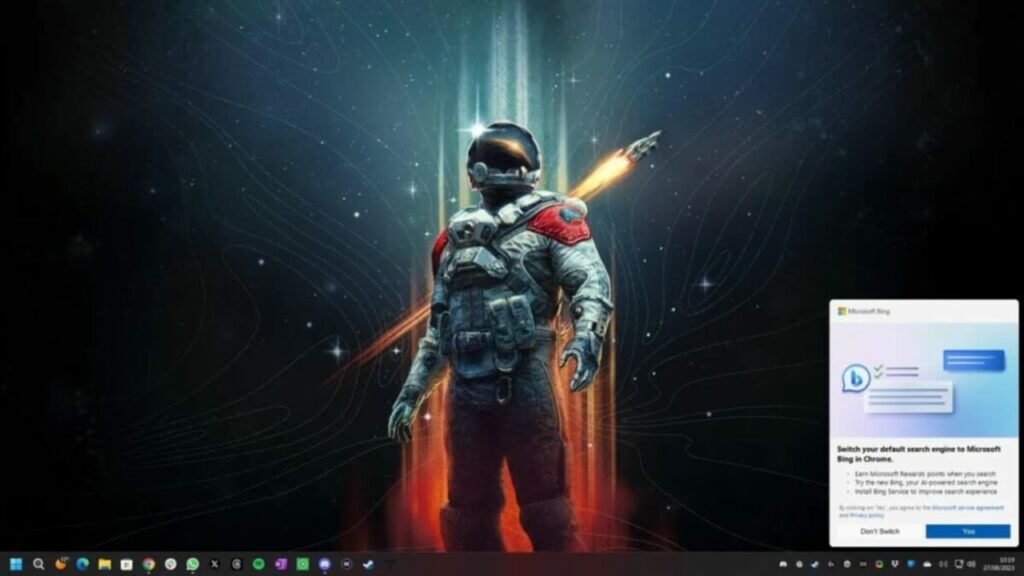
Microsoft seems to think it’s okay to put a popup window on your computer above my applications and games just because users are using Chrome instead of Microsoft Edge, their own browser.

Windows 11 DOWNLOAD

And don’t think it’s a regular notification. It doesn’t show up in the Windows 11 notification center, nor is it connected to the part of Windows 11 that suggests new features.

This notification is, literally, a fake executable file that has somehow appeared in c:\windows\temp\mubstemp and is digitally signed by Microsoft, as explained by Tom Warren in The Verge.

Tom Warren – The Verge

And Microsoft is apologizing… and they’re saying they will try to fix it

“We are aware of these reports and have paused this notification while we investigate and take appropriate action to address this unintended behavior,” says Caitlin Roulston, Director of Communications, in a statement to The Verge.

If we look on the internet, there are many users who thought it was malware; for three months, you can see on Reddit users trying to figure out why they were seeing the popup window.

The problem is that this isn’t the first time they’ve done this. Their feud with Google Chrome goes back a long way, and even in Windows 10, the hostilities began with Google’s browser.

The company has used various methods to get people to switch from Google and Chrome to Bing and Edge. Microsoft has been employing a variety of prompts for years, with popup windows appearing within Chrome, on the Windows taskbar, and in other places.

Microsoft has even forced people into Edge after a Windows update, and regularly displays a full-screen message to switch to Bing and Edge after updates.

We already pay for Windows; we don’t want ads

Windows isn’t free; it requires a license that almost all consumers end up paying for. It might be included in the price of a laptop with an OEM Windows license or a product key if you’ve built your own PC.

That’s why Microsoft should respect the fact that people already pay for Windows and don’t want to be bombarded with ads, as Tom Warren rightly complains.

Windows is a crucial productivity tool for many people and shouldn’t be treated like a cheap streaming device loaded with ads.

Windows 11 DOWNLOAD

Some of the links added in the article are part of affiliate campaigns and may represent benefits for Softonic.

OpenAI Raises Concerns Over Potential Issues with Microsoft’s Upgraded Bing Search Engine

Before Microsoft released Bing and the AI started behaving strangely with users, OpenAI alerted you to these potential issues.

Microsoft’s new Bing has been with us since early February this year. Despite the fact that currently the chatbot integrating GPT-4, OpenAI‘s model, is quite helpful and does not usually pose any problems, it was not the case initially. During its first few weeks of existence, the AI responded in an erratic, strange, and even deranged manner (from a human perspective, of course).

Bing ACCESS

Microsoft then decided to establish a series of usage restrictions, which they would later undo, and introduced 3 different conversation modes. But Microsoft was already aware beforehand that Bing could “go off the rails.” And not just because they witnessed it themselves during the tests conducted in India and Indonesia, but also because OpenAI warned them.

The new Bing is the result of collaboration between Microsoft and OpenAI, after the tech giant made a huge investment in the AI company. As reported this week by The Wall Street Journal, when Microsoft began integrating GPT-4 into Bing months before the public announcement of this model, OpenAI cautioned the Redmond-based company about the risks that could arise from implementing an early version of their AI into Bing.

But Microsoft ignored OpenAI’s warning that minimizing the strange responses could take a considerable amount of time, and went ahead with the launch of the new Bing. The rest of the story is already known: the AI would respond to users by getting angry with them, blatantly lying, gaslighting them, or even insulting them.

Bing ACCESS

As of today, the issue has been resolved, but the information published by TWSJ hints at the peculiar relationship between Microsoft and OpenAI. While they collaborate due to Microsoft’s significant investment, they are also competitors offering similar AI services.

Some of the links added in the article are part of affiliate campaigns and may represent benefits for Softonic.