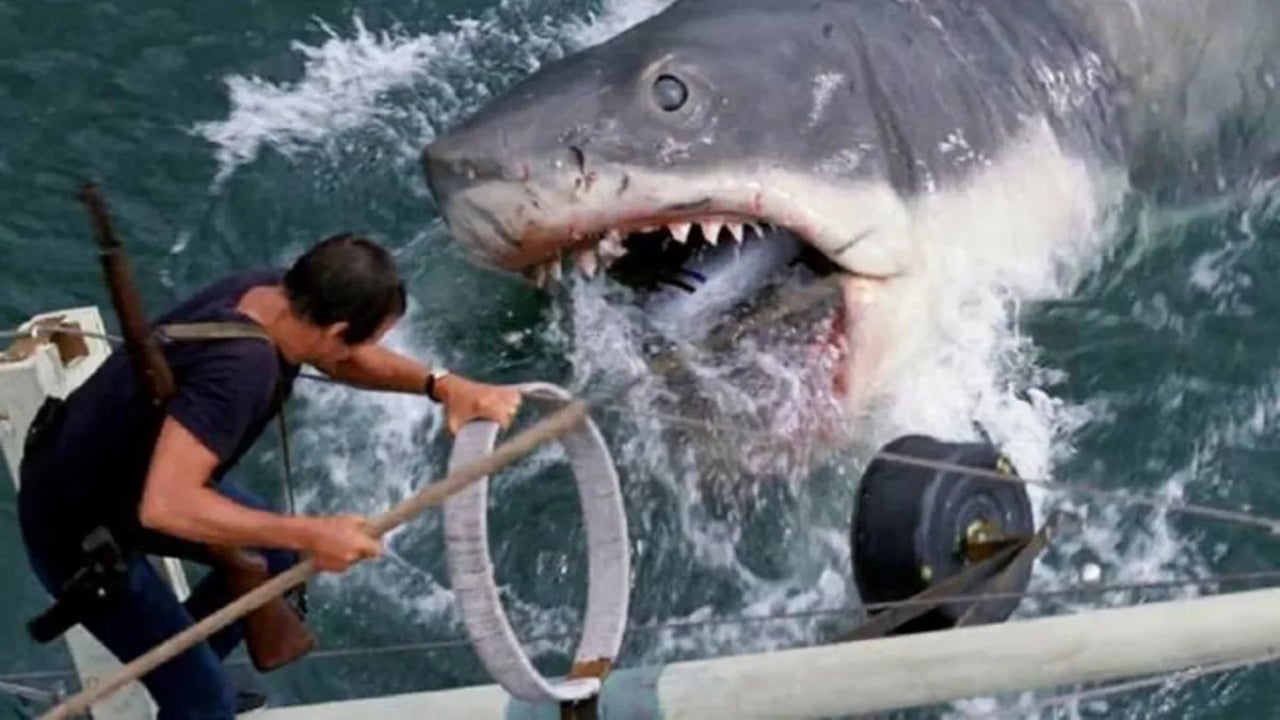
In a year marked by the celebration of cinematic milestones, Steven Spielberg’s Jaws stands out as it celebrates 50 years since its release. Considered by Quentin Tarantino as the best film of all time, this masterpiece of horror cinema has not only left an indelible mark on the audience but has also forever changed the Hollywood industry. Its release in 1975 established the model for summer blockbusters, becoming a cultural phenomenon that continues to resonate to this day. A film that still gives goosebumps The movie is not only characterized by […]
In a year marked by the celebration of cinematic milestones, Steven Spielberg’s Jaws stands out as it reaches its 50th anniversary since its release. Considered by Quentin Tarantino as the greatest film of all time, this masterpiece of horror cinema has not only left an indelible mark on the audience but has also forever changed the Hollywood industry. Its release in 1975 established the model for summer blockbusters, becoming a cultural phenomenon that continues to resonate to this day.
A movie that still gives you chills
The film is not only characterized by its iconic mechanical shark, known as Bruce, but the technical problems that arose during production heightened the suspense, turning an obstacle into an effective narrative tool. This contributed to the creation of a tense atmosphere that culminates in an exciting climax. The combination of drama, action, and horror has led many critics to consider Jaws not just as a horror film, but as one of the best works in Spielberg’s filmography.
Upon its release, Jaws became the highest-grossing film of all time, marking a turning point in the way film premieres were conceived. Now, with the possibility of watching the movie on platforms like Netflix, Disney+, and Movistar Plus+, new generations of viewers can experience this work that has influenced countless subsequent titles about sharks and sea creatures.
Despite the differences of opinion on what the best movie of all time is, Jaws deserves to be in the conversation, not only for its box office impact but also for its masterful direction, its memorable soundtrack by John Williams, and its ability to intertwine human drama with the imminent threat of the shark. Thus, the film remains a must-see reference for cinema and horror lovers.
Paul Thomas Anderson has allocated 115 million dollars to the making of One Battle After Another, a film that has generated a mix of expectations and concerns. The first reactions have been very positive, raising hope around this nearly three-hour cinematic epic. The renowned director Steven Spielberg, after moderating a Q&A session in Los Angeles, expressed his fascination with the film, stating: “What a crazy movie, oh my god. There is more action in the first hour than in the rest of your movies combined. Everything is really incredible” A movie […]
Paul Thomas Anderson has allocated 115 million dollars to the making of One Battle After Another, a film that has generated a mix of expectations and concerns. The initial reactions have been very positive, raising hope around this nearly three-hour cinematic epic. The renowned director Steven Spielberg, after moderating a Q&A session in Los Angeles, expressed his fascination for the film, stating: “What a crazy movie, oh my god. There is more action in the first hour than in the rest of your movies combined. Everything is truly incredible“.
One Movie After Another
Spielberg also highlighted the comedic effect that the film has on viewers, saying that there are moments that provoke laughter, creating a need to release the tension of the narrative. This mix of action and humor has resonated with critics like Brett Arnold from Yahoo, who describes it as “the funniest movie by Anderson” and predicts that Sean Penn could be a strong contender for the Oscar awards for his performance.
Despite the praise, fears persist about the film’s profitability. Given its high production cost, some experts claim that the film may face challenges in recouping its investment. Grace Randolph, another critic, initially expressed doubts about the film, describing it as ridiculous at first, but acknowledged that over time she has started to view it more positively.
Nevertheless, the anticipation continues to grow as its premiere in Spain approaches, scheduled for September 26. With a mix of laughter and action on the horizon, One Battle After Another is shaping up to be a major contender in the upcoming awards season, managing to capture the attention of both critics and the public.
Jeffrey Voorhees, known for playing Alex Kintner, the second victim in the iconic movie Jaws, continues to generate income at 63 years old thanks to his brief but memorable appearance in Spielberg’s classic. Although his screen time was short, the impact of his character has allowed Voorhees to receive annual checks for royalties every time the movie is broadcast on television or purchased on streaming platforms and physical copies. An absolute career success in film In a recent interview, Voorhees shared that he not only benefits from […]
Jeffrey Voorhees, known for playing Alex Kintner, the second victim of the iconic movie Jaws, continues to generate income at 63 years old thanks to his brief but memorable appearance in Spielberg’s classic. Although his screen time was short, the impact of his character has allowed Voorhees to receive annual checks for royalties every time the movie is broadcast on television or purchased on streaming platforms and physical copies.
An absolute career success in cinema
In a recent interview, Voorhees shared that he not only benefits from royalties. He also makes appearances at fan conventions, where he charges around 10,000 dollars per event. During those appearances, he not only signs autographs but also shares stories and memories from his experience on the film set, which creates a notable euphoria among attendees. “If this makes some people so happy, you catch a bit of that euphoria,” the actor commented.
Aside from his participation in conventions, Voorhees has created a website where he sells signed photos, t-shirts, and other collectible items. His merchandise includes an iconic yellow raft with the shark bite mark that has attracted the attention of many fans. In an anecdote that reflects the demand for Jaws memorabilia, a copyright receipt he had thrown away in 1981 was sold on eBay for the astonishing amount of $80,700.
This phenomenon not only highlights the lasting connection that fans have with certain movie characters, but also demonstrates how an actor can capitalize on a fleeting moment in their career, transforming their legacy into a sustained source of income over the years.
SkyShowtime is a streaming platform from which you can stream series, movies, and entertainment programs in video on demand (VOD) format. It is an ambitious project by SkyShowtime Limited, available in Spain and 20 other countries in the European Union and its area of influence, such as Norway or Bosnia and Herzegovina. SkyShowtime aims to carve out a niche in the market thanks to its very competitive prices. Thus, they will compete with services like Netflix or Disney +, two similar platforms that have increased their prices recently.
The Olympics are about brotherhood, human achievement, and celebrating the will of the human spirit. Unfortunately, it is also the perfect occasion to perpetrate notorious acts of terrorism. With basically all the countries of the world represented there, with the best athletes in the world gathered in one place, there is no moment when more people will be looking at a single point at a given time than during the Olympics. And everyone knows that. A questionable massacre This became evident during the Munich massacre, during the 1982 Olympic Games. The terrorist group […]
The Olympics are about brotherhood, human achievement, and celebrating the will of the human spirit. Unfortunately, it is also the perfect occasion to perpetrate notorious acts of terrorism. With basically every country in the world represented there, and the best athletes in the world gathered in one place, there is no moment when more people will be looking at a single point at a given time than during the Olympics. And everyone knows that.
A Questionable Massacre
This became evident during the Munich massacre, during the 1982 Olympic Games. The terrorist group Black September, a faction of the Palestine Liberation Organization, kidnapped several Israeli athletes demanding the release of 234 Palestinian prisoners in Israeli jails, as well as the founders of the Red Army Faction, Andreas Baader and Ulrike Meinhof, imprisoned in West Germany.
The rescue attempt was an absolute disaster. With eleven athletes and coaches dead, a fallen police officer, and five of the eight members of Black September killed, the police operation was an absolute disaster. And the reprisals from the state of Israel, in their own way, were not much better, organizing Operation Spring of Youth and Operation God’s Wrath, where hundreds of Palestinians died.
This context is important because it arrives on streaming September 5. A film that narrates these events, choosing a very particular point of view: that of the ABC Sports news team that decided to cover the kidnapping and the resulting police operation minute by minute.
Using many archival images from ABC itself, the film contemplates the limits of journalistic information. And it does so with actors in a state of grace. Peter Sarsgaard, John Magaro, Ben Chaplin, and Leonie Benesch are some of those involved in the film, giving a more than evident weight to a movie very aware of the gravity of the events. And they are walking in the footsteps of a previous film: Munich, by Steven Spielberg, released in 2005.
The difference between both films is that, while Spielberg was more interested in the political side of it, Tim Fehlbaum, director of September 5, is more interested in the journalistic aspect. Without judging or wanting to weigh in on the motivations of the terrorists or the state of Israel, it invites us to think about what the role of journalism should be in these dramatic moments of history.
The Perspective of Journalism
Considering how the situation in the Gaza Strip has worsened and the relations between Palestine and Israel, the film is not only more relevant now than at the time of its release on August 29, but it also serves to reflect on the role of journalism regarding the current conflict. If there is really good work being done in how the acts of terrorism from Palestine are covered, but also the reprisals, in the form of state terrorism and, probably, genocide in the face of history, of the nation of Israel.
September 5 is a tough but tremendously interesting film that is now available for streaming on Paramount. And you shouldn’t miss the opportunity because few films have managed to better capture the underlying conflict in all journalistic work between the duty to inform and the awareness that, perhaps, what is being done is part of the problem.
Paramount+ is the app for the streaming platform of the same name from ViacomCBS. It offers hundreds of episodes of TV series, shows, and movies of all genres.
The collaboration between Steven Spielberg and Liam Neeson has been the subject of speculation for years, especially after the success of their masterpiece, Schindler’s List. This film, considered the best in the filmography of both on FilmAffinity, has marked the only point of connection in their careers, as they have not worked together on any project since then. However, the story behind their last collaboration is more complex than it seems. Neeson does not have a Lincoln inside him In 2012, Neeson was very close to playing Abraham Lincoln in the eponymous biopic […]
The collaboration between Steven Spielberg and Liam Neeson has been the subject of speculation for years, especially after the success of their masterpiece, Schindler’s List. This film, considered the best in the filmography of both on FilmAffinity, has marked the only point of connection in their careers, as they have not worked together on any project since then. However, the story behind their last collaboration is more complex than it seems.
Neeson has no Lincoln inside him
In 2012, Neeson was very close to playing Abraham Lincoln in Spielberg’s eponymous biopic, but surprisingly decided to step down from the role. The actor confessed that he felt he was not suitable to portray him. This decision came after a period of personal mourning for the death of his wife, which undoubtedly affected his motivation to take on this iconic challenge. Neeson was involved in the project for four years, but a reading of the script alongside other actors made him realize that he could not bear such a great responsibility. “I shouldn’t be here. This is over,” Neeson recalled about his reaction at that moment.
After his resignation, Daniel Day-Lewis was chosen as his successor and, shortly after, received the Oscar for Best Actor for his work in Lincoln, a fact that Neeson considers an excellent choice. Despite what it may have meant for his career, Neeson shows no regret and has expressed his satisfaction that a good friend has taken his place and achieved such recognition.
Currently, Liam Neeson is in full promotion of the reboot of Get Smart, which premieres in Spain on August 22, marking his return to comedy after a long period focused on action and drama roles.
A script for Gremlins 3 is currently on Steven Spielberg’s desk, suggesting that the long-awaited project is taking its first steps. This revelation came from actor Zach Galligan, known for his role in the first two installments of the saga, during his appearance at Comic-Con Manchester. Galligan expressed his enthusiasm and highlighted the longevity of the franchise, stating that 35 years have passed since the release of Gremlins 2: The New Batch, which underscores the anticipation surrounding this third film. A sequel 35 years in the making The Gremlins saga, which […]
A script for Gremlins 3 is currently on Steven Spielberg’s desk, suggesting that the long-awaited project is taking its first steps. This revelation came from actor Zach Galligan, known for his role in the first two installments of the saga, during his appearance at Comic-Con Manchester. Galligan expressed his enthusiasm and highlighted the longevity of the franchise, stating that it has been 35 years since the release of Gremlins 2: The New Batch, which underscores the anticipation surrounding this third film.
A sequel 35 years in the making
The Gremlins saga, which began in 1984 under the direction of Joe Dante, has generated a cult following over the decades. The first installment, with its mix of horror and comedy, quickly became a Christmas classic, while the sequel, although more polarizing, also achieved its own iconic status. The possibility of a third installment has been a recurring topic of conversation among fans, and the announcement of a script in development has unleashed a wave of excitement and nostalgia.
Galligan, who played the charismatic protagonist Billy Peltzer, expressed optimism about the future of the movie, although not many details about the plot or cast have been revealed. Rumors suggest that the return of the original characters could be a possibility, but an official confirmation is still awaited. With renewed interest in the gremlins’ story, it is the perfect time for new and old fans to reconnect with this quirky franchise.
The idea of Gremlins 3 is promising, and many hope that the team behind the project can capture the magic that made the previous films a success. As details begin to emerge, it will be interesting to see how this story unfolds after so many years.
Quentin Tarantino has caused a stir by declaring that he considers Indiana Jones and the Last Crusade to be the worst film in the famous saga, even worse than the criticized Indiana Jones and the Kingdom of the Crystal Skull. These statements were made during an episode of the ReelBlend podcast, where the director shared his view, which contrasts notably with the general opinion of the public and critics. A film very beloved by critics and the public Despite the filmmaker’s outbursts, Indiana Jones and the Last Crusade is well received, boasting a rating of 84% on Rotten Tomatoes […]
Quentin Tarantino has caused a stir by declaring that he considers Indiana Jones and the Last Crusade as the worst film of the famous saga, even worse than the criticized Indiana Jones and the Kingdom of the Crystal Skull. These statements were made during an episode of the ReelBlend podcast, where the director shared his view, which notably contrasts with the general opinion of the public and critics.
A film highly regarded by critics and the public
Despite the filmmaker’s outbursts, Indiana Jones and the Last Crusade is well received, boasting a rating of 84% on Rotten Tomatoes and an 8.2 on IMDB. This positions it as one of the most valued entries in the franchise, only surpassed by Raiders of the Lost Ark from 1981. However, Tarantino is not impressed, calling it boring and comparing it to Stop! Or My Mom Will Shoot, a film by Sylvester Stallone considered a failure in 1992. This comparison could be offensive to many, as The Last Crusade evokes feelings of nostalgia and is regarded as a masterpiece by numerous film enthusiasts.
In the hierarchy of Indiana Jones deliveries, Tarantino’s favorite is, surprisingly, Indiana Jones and the Temple of Doom. According to his statements, this movie is not only his favorite of the saga, but it is also one of Steven Spielberg’s best works. Furthermore, Tarantino highlighted that it was thanks to this film that the PG-13 rating (not recommended for children under 13) was established, a feat that, according to him, Brian De Palma has not managed to achieve with his efforts. Thus, the controversy surrounding Tarantino’s opinions seems to open a renewed debate about the perception and legacy of the legendary adventure saga.
Tom Hanks and Steven Spielberg, two titans of the film industry, joined their talents again after the success of Saving Private Ryan to create Band of Brothers, a miniseries that redefined the genre on television. This series has become a benchmark, combining history, emotion, and memory over ten episodes that depict the journey of Easy Company, a group of American soldiers who fought in Europe during World War II, from D-Day to the fall of the Third Reich. A work that seeks to recreate what the experience of war is like […]
Tom Hanks and Steven Spielberg, two titans of the film industry, joined their talents again after the success of Saving Private Ryan to create Band of Brothers, a miniseries that redefined the genre on television. This series has become a benchmark, combining history, emotion, and memory throughout ten episodes that portray the journey of Easy Company, a group of American soldiers who fought in Europe during World War II, from D-Day to the fall of the Third Reich.
A work that seeks to recreate what the experience of war is like
Band of Brothers was conceived as an immersive experience, not only for the viewers but also for the actors. Hanks and Spielberg took realism to a new level, subjecting the cast to rigorous military training for ten days, where the actors lived in conditions similar to combat, without access to mobile phones and learning tactics from veterans of the army. This approach aimed to foster genuine camaraderie among the performers, more authentically reflecting the relationships of the characters they portray.
Attention to detail is one of the great virtues of the production. Each setting was recreated with remarkable precision, from the trenches to the snowy landscapes of Bastogne, resulting in a powerful series both narratively and visually. A stellar cast that includes Damian Lewis, Donnie Wahlberg, and David Schwimmer, among others, brings to life characters based on real soldiers, adding a layer of authenticity to the narratives of friendship, fear, and loss addressed in the miniseries.
Band of Brothers is not just a memorable series about World War II; it is also a profound study of the human experience in times of conflict, which has left an indelible mark on the history of television. Currently, it is available on streaming platforms such as Netflix, HBO Max, and Movistar Plus+.
Steven Spielberg and George Lucas, two titans of the film industry, have played a crucial role in identifying and supporting new talents throughout their careers, highlighting among them Lawrence Kasdan. This screenwriter, who initially caught Lucas’s attention for his work on Continental Divide, became a key figure by collaborating on the script for the iconic Raiders of the Lost Ark, a film that marked the beginning of a successful franchise and set a new standard for family cinema. A much darker film However, when the time came for […]
Steven Spielberg and George Lucas, two titans of the film industry, have played a crucial role in identifying and supporting new talents throughout their careers, highlighting among them Lawrence Kasdan. This screenwriter, who initially caught Lucas’s attention for his work on Continental Divide, became a key figure by collaborating on the script for the iconic Raiders of the Lost Ark, a film that marked the beginning of a successful franchise and set a new standard for family cinema.
A Much Darker Movie
However, when it came time to create the sequel, Indiana Jones and the Temple of Doom, Kasdan was reluctant. The darker and more violent tone of the story, a reflection of Lucas’s difficult emotional state at the time, led him to reject the project. This change in direction resulted in Willard Huyck and Gloria Katz taking on the task of writing the script. Despite this change, the success of the film was largely influenced by Spielberg’s directing style, who tried to balance the somber tone with elements of humor, in contrast to the sadness that weighed on Lucas due to his divorce.
The initial reception of Indiana Jones and the Temple of Doom was more critical than that of its predecessor, with comments pointing to its excess of action and lack of emotional depth. However, over the years, the sequel has been reevaluated and is now considered a cinematic milestone in the history of film. Time has shown that, although the movie had its flaws, it managed to capture the public’s imagination in a way that has endured, keeping the adventure of Indiana Jones alive in the collective memory.
On June 20, 1975, cinema was about to change forever. But of course, no one knew it back then. Who would have thought, after all, that the movie by a certain Steven Spielberg, who had only directed a television movie (the fantastic Duel) and something called The Sugarland Express, would achieve more than a box office failure? Not even he wanted to direct it, fearful of being known as “the guy with the trucks and the sharks.” He, instead, wanted to make Lucky Lady, which ended up […]
On June 20, 1975, cinema was about to change forever. But of course, no one knew it back then. Who would have thought, after all, that the movie by a certain Steven Spielberg, who had only directed a television film (the fantastic Duel) and something called The Sugarland Express, would achieve anything more than a box office failure? Not even he wanted to direct it, fearing being known as “the guy with the trucks and the sharks.” Instead, he wanted to make Lucky Lady, which ended up being directed by Stanley Donen. And now, 50 years later, no one celebrates the existence of Lucky Lady, but rather the immense Jaws.
Don’t let it give you a stomach cramp!
Before 1975, we had already seen movies about sharks, of course: titles like The Sharkfighters, ¡Shark! Double-edged weapon, or the documentary Blue Water White Death made it clear that cinema was ready for beaches, fangs, and blood. Now we just needed someone with the expertise to not hide the shark, to manage to build a plot behind the attacks, and to be a pioneer in the genre.
It didn’t happen immediately, of course: Peter Benchley himself, the author of the novel, tried to create a script based on it, but without success. Although he is credited, he himself has acknowledged that practically none of those scripts made it to the screen, and that Carl Gottlieb was able to give it the rhythm that Spielberg was looking for, who wanted to focus on the third act of the book (the shark chase) and lose a good handful of subplots along the way. No one cared too much when it hit theaters.
In fact, it cost only 9 million dollars and grossed 477.9 million, eternally solidifying Spielberg’s figure and turning the little shark movie that no one gave a dime for not only into a franchise but also forcing other production companies to establish marine creatures as a subgenre of horror in general. They made three more sequels (each worse than the last, by the way) and knew when to bow out. The strange thing is that no clever person in today’s Hollywood has wanted to do a reboot. And let’s cross our fingers that it stays that way.
Ducklings in the water!
Everything is immortal in Jaws: the soundtrack by John Williams, which we have all heard in our heads at some point when terror approached; the animatronic shark itself devouring its victims; Roy Schneider saying “We’re gonna need a bigger boat”; the mayor reassuring the public and which has served as a metaphor for the current world… In fact, it is one of those few immortal movies. Yes, new generations may point out that the killer’s head is static, or that the blood is too bright, but they will be hooked to the screen with the force of a Spielberg who, against all odds, knew exactly what he was doing. At the risk of his own health, of course: throughout the filming, he suspected more than once that he was going to have a heart attack.
Later, he would dazzle the world with ET, Minority Report, Close Encounters of the Third Kind, The Fabelmans, Raiders of the Lost Ark, Jurassic Park, or Schindler’s List, but back then he was a newcomer who was able to dazzle the industry like few have done before or since. Five decades have passed, and if we listen to that “Taaaa-naaa” from John Williams, it still gives us a bit of a chill to dip a toe in the water. After all, you never know when you might end up being simple involuntary bait!